
Cold chain documentation for the food safety inspector — a complete guide
Cold chain documentation for food safety inspections: a continuous temperature log, deviation and corrective action records, calibration and ready reports.
Zespół Nextriv4 min read

In this article
- What the inspector is actually looking for
- Cold chain documentation — five elements that have to lock together
- The paper notebook versus automatic recording
- A recorder the inspector takes seriously
- Deviations: from obligation to evidence
- Reports, a signature and five years of history
- Where to start before the next inspection
Cold chain documentation is the first thing a food safety inspector asks for — and the last thing there's time for at the height of the season. The temperature in the fridge can be exemplary all year round; if there is no record of it, from the inspection's point of view it might as well never have been. The inspector doesn't ask "was it cold" — they ask for the log: complete, credible and kept as you go, not filled in from memory in the evening. In this guide we take cold chain documentation apart: what has to be in it, where the paper notebook loses, and how to build a record that defends itself.
What the inspector is actually looking for
Contrary to popular belief, an inspection isn't a hunt for one late entry. The inspector checks the coherence of the system: whether the limits in the HACCP plan are backed by the logs, whether deviations end in a documented corrective action, whether the instrument used to measure deserves trust. Three questions come back at every inspection:
- Is the record continuous? A gap in the log over the weekend, or during the leave of the person "in charge of the notebook", is a classic post-inspection finding.
- Is the record credible? Columns filled in a single handwriting, to the minute, a perfectly flat 4 °C for three months — that doesn't look like measurement, it looks like creative writing.
- What happened when things went wrong? No deviations at all for years raises suspicion; a deviation with no documented response is a ready-made non-compliance finding.
Cold chain documentation — five elements that have to lock together
Complete cold chain documentation consists of five layers the inspector reads together, not separately:
- The HACCP plan with critical limits — where the brackets for each fridge, counter and freezer came from (typically 0–4 °C for chilled goods, ≤ −18 °C for frozen). A practical summary of ranges is in our food storage temperature table.
- A continuous temperature log — measurements from every device and zone, with date and time, with no overnight or weekend gaps.
- Goods-in records — the temperature of the goods at the dock and the "accept or reject" decision, because the cold chain starts before your cold room.
- Deviations and corrective actions — when the limit was breached, who responded, what they did with the goods and when the parameter returned to normal.
- Proof the measurement is credible — what was used to measure: instrument class, certificates, calibration dates.

The paper notebook versus automatic recording
The notebook by the fridge meets the requirements formally — and loses practically. Measuring three times a day leaves windows of many unsupervised hours, and a compressor failure at 22:00 on a Saturday comes to light on Monday morning, together with the decision to dispose of a full chamber. Then there is the human factor: in peak hours the thermometer round drops to the bottom of the list, and the log gets filled in "from memory". How to move from paper to automatic recording — step by step, thresholds and verification included — is covered in our article on HACCP temperature monitoring.
Automatic recording reverses the logic: the sensor measures every few to a dozen-odd minutes around the clock, the log writes itself, and people handle the exceptions, not the columns.
A recorder the inspector takes seriously
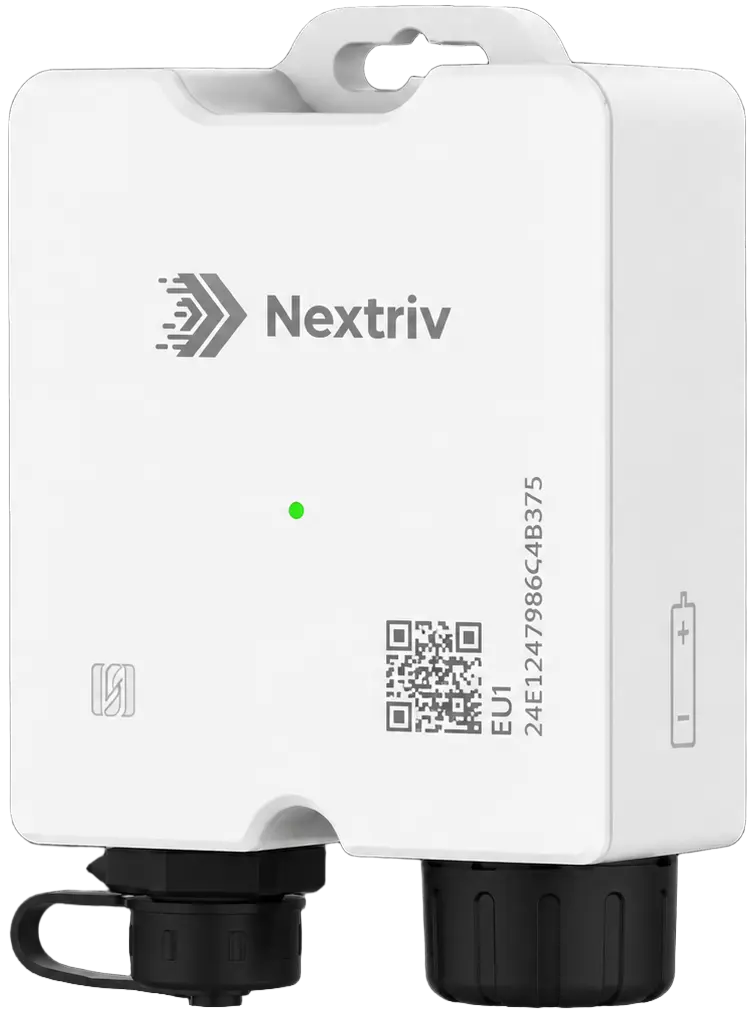
The credibility of the record starts with the hardware. For temperature recorders in the cold chain there is a dedicated standard, EN 12830 — and it is worth requiring compliance with it, because it is what separates a measuring instrument from a gadget. Nextriv Probe Duo is EN 12830 certified and measures to ±0.2 °C and ±2% RH with a single dual-parameter food-grade stainless steel probe — where humidity matters alongside temperature (ripening rooms, dry stores), one measurement point closes out both parameters.
Two details make the difference at an inspection. First, the local buffer of 4000 measurements with retransmission and backfill: an internet outage leaves no hole in the log, because the backlog sends itself. Second, the detachable probe (M12 connector) with its own identifier reported in the data — it is calibrated independently of the transmitter, with no break in supervision and no loss of traceability. The platform meanwhile keeps a calibration register with dates, certificates and reminders of upcoming calibrations, so the answer to "what did you measure with and when was it checked" lives in the system, not in a binder.
Deviations: from obligation to evidence
Paradoxically, it is the deviations — not the perfect charts — that best prove a working system. In the Nextriv platform each metric gets up to four thresholds (warning and critical, lower and upper), and a breach opens an event with a unique ALM code that runs through the active → acknowledged → resolved cycle. The team's comments under the event serve as the corrective action record: you can see who responded, when and what they did with the goods, and the back-to-normal notification closes the story. The alert arrives by email, SMS, web push, MS Teams, Discord or an in-app audible alarm — and an unacknowledged one escalates to the next person before the deviation becomes a loss.

Reports, a signature and five years of history
In the end the documentation has to be presentable. PDF reports with a summary and charts generate on demand or on a schedule, with an extended variant adding statistics, percentiles and a threshold compliance section. A report can carry a SHA-256 signature with a QR code and a verification address — anyone can confirm the document hasn't been altered since it was generated. If the inspector prefers their own arithmetic, there are XLSX and CSV exports. The raw measurement history is available for a full year even on the free plan, and for up to 5 years (1825 days) at most — enough to reach back to the conditions from any past inspection.
Where to start before the next inspection
A practical minimum plan: a sensor in every refrigeration unit, thresholds copied from the HACCP plan, notifications to two people and a month of data collection. The free plan covers 10 sensors, a gateway and 5 alert rules — for a small venue that is often the complete set. The whole scenario for the kitchen and back of house, from goods-in to service, is laid out in the food service solution.
Compare the plans in the pricing or book a short demo — we'll show the log, the events and the signed report exactly as the inspector will see them.


