
Soil moisture monitoring — less water, better yields
Soil moisture monitoring in practice: root-zone measurement, irrigation thresholds and alerts — a 3-in-1 probe saves water and evens out your yields.
Zespół Nextriv4 min read

Soil moisture monitoring is the shortest route to two things at once: lower water costs and more even yields. Most farms irrigate by the calendar or "by eye" — and the calendar does not know that the last rain missed half the plots, or that the sandy part of the field dries out twice as fast as the rest. Data from the root zone turns irrigation from guesswork into a decision: you water when the plant needs it, and only where it is genuinely necessary.
Why watering "by eye" costs you twice
An irrigation error hurts in both directions:
- Too much water — you wash fertiliser below the root zone (paying twice for the same fertilisation), cut the roots off from oxygen and create conditions for soil-borne diseases. On top of that, the water itself and the pump energy cost money with every unnecessary cycle.
- Too little water — the plant enters drought stress long before you see wilted leaves. You discover the effect only at harvest: smaller fruit, uneven ripening, a lower commercial grade.
Worst of all, both scenarios can be happening at the same time on the same field — because soil is not homogeneous. Without point measurement you do not know which plot is being overwatered right now and which one is drying out.
Soil moisture monitoring in practice: measuring in the root zone
Good measurement starts with the location. Moisture matters where the roots work — not at the surface, which wind and sun dry out. The probe therefore goes into the crop's root zone, at points representative of the plot: away from bed edges, drip lines and places where water naturally collects. If a field has clearly different soil types, each deserves its own measurement point — those very differences are the reason one irrigation schedule never fits everywhere.
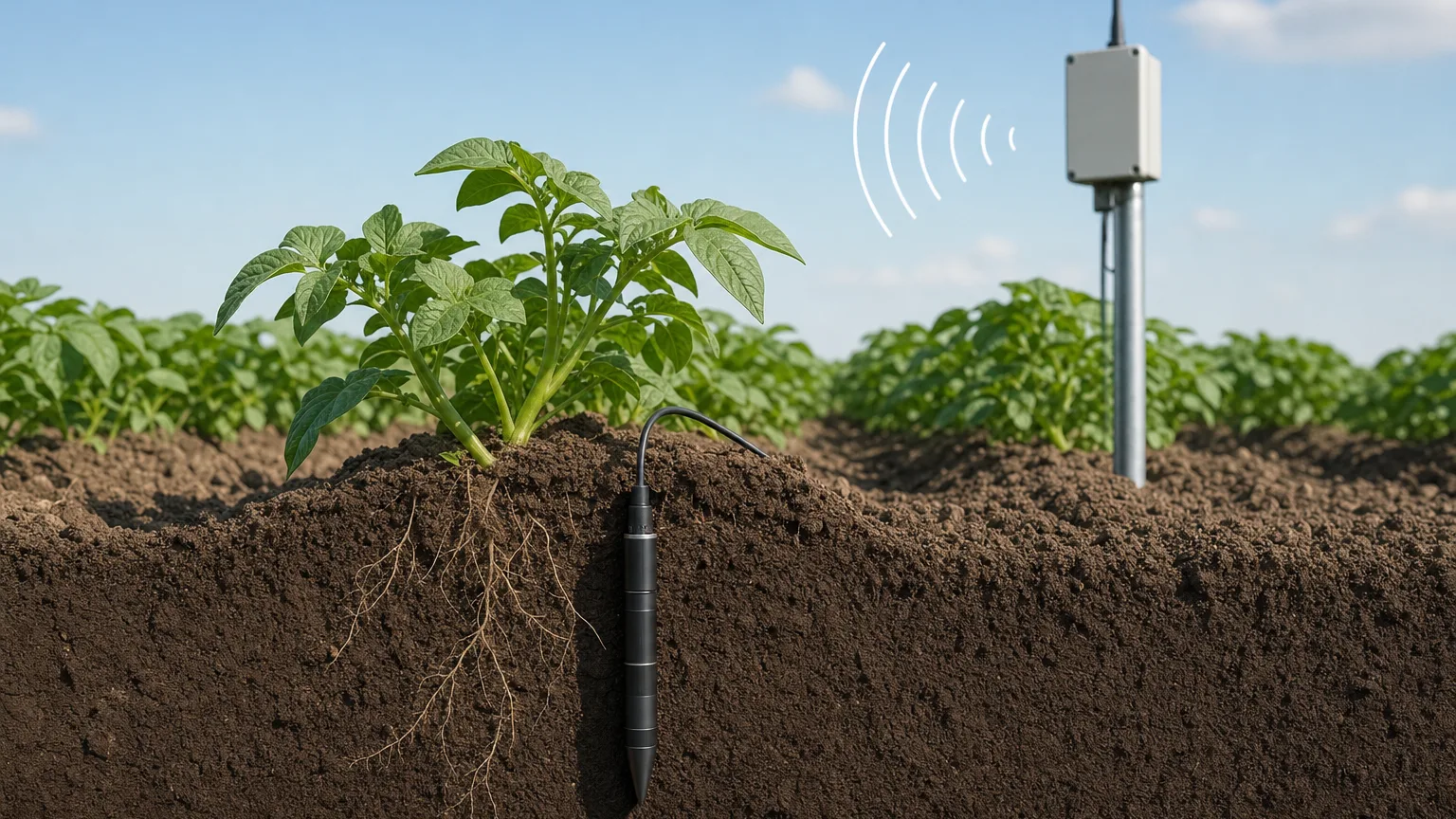
Work like this calls for a probe that can stand being buried for years — including in intensively fertilised, saline soil.
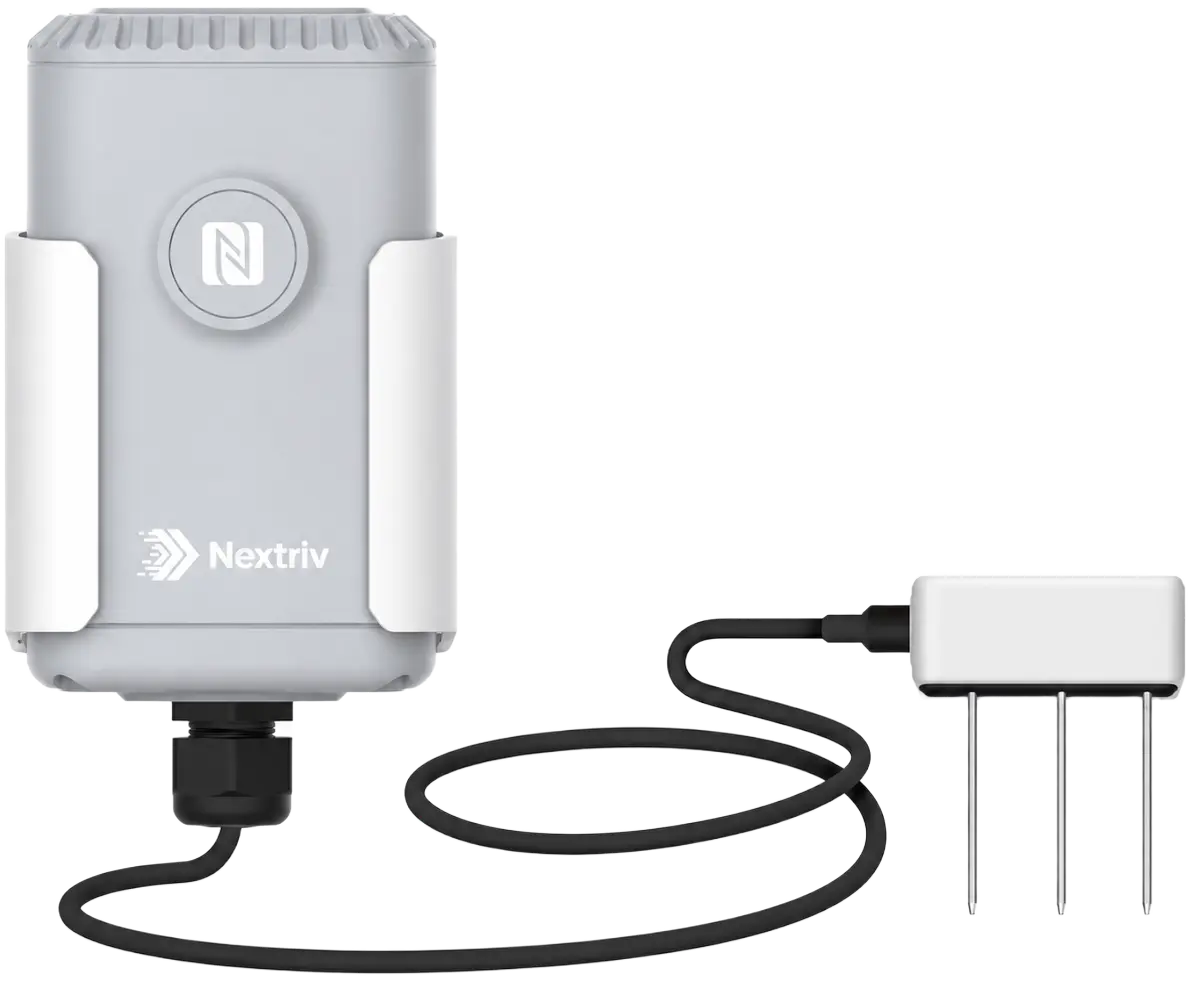
Nextriv Probe Soil measures three parameters with a single probe: soil moisture across the full 0–100% range (±2% accuracy within 0–50%), soil temperature (±0.5 °C) and electrical conductivity EC up to 20,000 µS/cm. The probe is composite — epoxy resin with stainless-steel electrodes — sealed to IP68 and corrosion-resistant, while the transmitter on a 2 m cable stands above ground and reports over radio. One replaceable battery lasts for up to 10 years at a 10-minute reporting interval.
Three parameters, three decisions
Moisture is only the beginning. The full set of three readings from one probe answers three different agronomic questions:
- Moisture — when and how much to irrigate. Instead of a schedule, you maintain a target moisture band in the root zone. You also see whether a dose of water actually reached root depth or simply ran off across the surface.
- Soil temperature — when to sow and when to push. Growth and germination pace is set by the temperature of the substrate, not the air. A continuous record lets you plan sowing, planting and treatments more accurately.
- EC (salinity) — how to fertilise. Electrical conductivity reflects the concentration of salts in the soil, i.e. indirectly the fertilisation level. Rising EC with falling moisture is the classic sign of the soil solution concentrating — and a sudden drop after rain shows the scale of leaching. With fertigation this measurement is worth its weight in gold.
From reading to decision: thresholds and alerts
A moisture chart on its own waters nothing. The difference comes from an automatic response — and that is where the platform works. In Nextriv every metric has up to four thresholds: two warning and two critical. For soil moisture the full setup earns its keep:
| Threshold | What it means | What to do |
|---|---|---|
| Lower warning | the soil is approaching the crop's comfort limit | plan an irrigation cycle |
| Lower critical | real risk of drought stress | irrigate immediately |
| Upper warning | water is no longer needed | shorten or skip the cycle |
| Upper critical | overwatering — possible valve failure or burst line | check the installation |
A threshold breach opens an event with a readable ALM code and sends a notification where you work: email, SMS, web push, Microsoft Teams, Discord or an audible in-app alarm. When the moisture returns to the band, a back-to-normal notification arrives — no need to keep checking the dashboard. And if you have your own irrigation controller, the webhooks integration will pass platform events to it, so your automation can act on thresholds you set against data from the roots.
Deployment on the farm: range, power, no cables
There is no Wi-Fi or power socket in the field — and there does not have to be. The sensors communicate over long-range radio: up to about 2 km in built-up areas and about 15 km in open terrain, so one gateway covers the fields, tunnels and buildings of a typical farm. The probe's transmitter runs on a replaceable battery for up to 10 years and is configured via NFC from a phone, without opening the enclosure.
Connectivity outages leave no holes in the history: the probe buffers around 1000 entries locally and sends them on once the network is back. Commissioning does not need an integrator either — the platform discovers new devices automatically within 30–180 seconds of powering on. How measurement points from fields and tunnels combine into a full picture of the farm — together with a weather station and tank level sensors — is shown on our solution page for agriculture and greenhouses.
Start with one plot
You do not have to instrument the whole farm right away. The best start is two or three probes: one in the plot that always dries out first, another in the "reliable" one, a third under cover. After a few weeks of charts you will see in black and white how many irrigation cycles were unnecessary — and where the water never reached at all. The FREE plan includes 10 sensors and a full year of measurement history, so the pilot costs nothing beyond the hardware.
Details are in the pricing, and if you would rather see moisture thresholds, alerts and charts on live data — book a short demo.


