
An automatic temperature log — the end of manual records
Automatic temperature log replaces the notebook by the fridge: round-the-clock measurement, threshold alarms and PDF reports for audits — no manual entries.
Zespół Nextriv4 min read

An automatic temperature log is one of those changes whose scale only shows after the fact. On paper it is "just" about nobody having to walk to the fridge with a pen three times a day. In practice something deeper changes: documentation stops being a separate duty you have to remember, police and catch up on — and becomes a by-product of measurement that happens by itself, around the clock, including Sunday at three in the morning. This article is not about how to move from a notebook to a system. It is about what everyday work looks like when the log keeps itself.
Why manual records fail — even with diligent people
The problem with a manual register is rarely bad faith. It is the design:
- A record is a snapshot. Three readings a day leave twenty-one hours unsupervised. A compressor failure at 22:00 on Saturday comes to light on Monday morning — together with the question of what happened to the stock in the meantime.
- Entries "from memory". End of shift, a busy floor, a reading taken an hour ago or not at all — and the column filled in wholesale before clocking out. Anyone who has kept a notebook knows it happens.
- Paper does not raise alarms. The notebook will note 9 °C in the fridge, but it will not tell anyone. The response depends on someone looking at the entry and drawing conclusions — usually too late.
- Documentation gets made "for the inspection", not for safety. When the register is a burden, the team treats it as a ritual. And rituals get cut short.
In a HACCP system, recording temperature at critical control points is a requirement, not a choice — we covered it in more depth in our article on designating and monitoring CCPs in food service. So the question is not "whether to record" but "whether a human has to do it".
An automatic temperature log: what a working day looks like
In a kitchen or a shop back room with an automatic log, the morning starts not with a clipboard round but with a glance at the dashboard: every refrigerator, freezer and display case on one screen, each with its current reading and the night's chart. All green — subject closed in ten seconds.
And when it is not green, the order of events reverses. It is not the person who finds the problem — the problem finds the person:
- First a warning, then an alarm. Each metric takes up to four thresholds: two warning and two critical. A fridge slowly drifting from 4 °C towards 6.5 °C triggers a warning long before it crosses the safety limit — there is time to act before it turns into an incident.
- The notification reaches you where you are. SMS, e-mail, push on the phone, the team channel in MS Teams or Discord, or an audible signal in the app — the channel is matched to the site and the time of day.
- An event has a code, a status and a history. The alarm gets a number, someone acknowledges it, adds a comment ("stock moved, service called"), and once the temperature returns to normal the case is closed. Instead of initials in a notebook — a full timeline: who knew, when they reacted, what they did.

What the system does by itself — a list instead of duties
Worth spelling out, because every item used to be someone's job:
- measures around the clock, at a fixed interval, holidays and stocktakes included;
- draws the charts — the trend of a slowly drifting cooler is visible weeks before a failure;
- alarms on thresholds, distinguishing a warning from a critical state;
- watches itself: a sensor that has not reported for twice its reporting interval gets offline status and a notification — silence never passes for calm;
- generates PDF reports with summaries and charts for inspections;
- exports data to XLSX and CSV, straight into quality system documentation;
- keeps the history: a full year of measurements back, available at once — no binders.
A health inspector who asks for the last quarter's register gets a printout with a continuous trace instead of a table with three entries a day. That is a conversation from an entirely different position.
A sensor that keeps the log for you
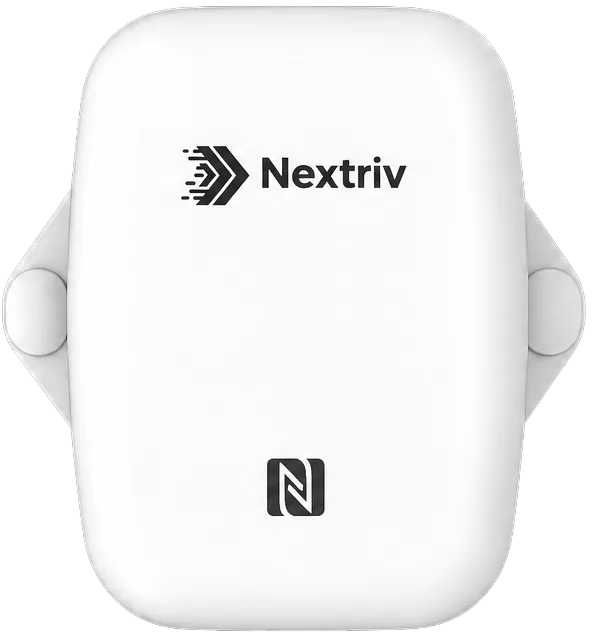
The heart of an automatic log is a logger-class device, not a gadget from an electronics store. Nextriv Sense Essential is certified to EN12830 — the standard for temperature recorders in the cold chain — with ±0.3 °C accuracy and a sealed IP67 housing that withstands back-room washdowns and freezer duty from −30 °C. It is configured contactlessly with a phone over NFC, and the battery runs for years.
What matters most for the log, though, is continuity of record: the sensor keeps a local, non-erasable register of nearly 2,800 readings and, after every connectivity outage, re-sends the backlog by itself. The night the internet went down is not a hole in the documentation — the chart stays complete, and the history cannot be "touched up" by hand.

What is left for the human
Honestly: an automatic log does not excuse you from thinking. Receiving a delivery still takes a measurement and a decision, corrective actions are taken by people, and the alarm thresholds need to be set sensibly once — in line with the requirements for the stored goods. The difference is that the team stops being a data recorder and starts being what it should be: the first line of response. The system reports, the human decides. The full working scenario for the kitchen, the back room and a chain of locations is described on the food service solution page.
From notebook to log in one day
A small food business fits in the free plan with room to spare: up to 10 sensors, a gateway, two users, 5 alert rules and a full year of measurement history — for a bar with two fridges and a freezer that is the complete package, at no charge. The sensors mount with tape or screws, configuration is a tap of the phone, and the log starts writing itself from the first hour.
Check the pricing and count your measurement points — or book a demo and we will show you what a working day looks like with a log that keeps itself.


