
Organic certification and environmental logs — what to document
Organic certification means documentation kept all year round: which environmental logs to collect from crops and storage so they hold up at inspection.
Zespół Nextriv4 min read

Organic certification rests on one principle: the farm's documentation must make it possible to reconstruct what happened to a crop from field to warehouse — and to prove that it happened in line with the requirements of organic production. The certification body's inspector cannot see the whole season; they see records. And records are precisely the most common source of findings: incomplete registers, dates filled in from memory, inconsistencies between the treatment journal and the state of the crops. This article shows which environmental logs are worth collecting automatically, how they are kept without a notebook — and what makes such documentation hold up at inspection.
The inspection takes a day, the documentation takes all year
A farm in the organic farming scheme is inspected at least once a year, and the certification body may also show up unannounced. What gets checked above all are the registers: agrotechnical operations, fertilisation and plant protection products, harvests, storage and sales. The common denominator of all these records is credibility — the inspector judges not only whether a register exists, but whether it is kept up to date and whether the individual documents agree with one another.
And here lies the practical problem: mid-season, documentation loses out to field work. A notebook filled in on evenings "for the past week" has gaps and approximations, and exactly such records are the hardest to defend — especially when the inspector sets them against invoices, warehouse stock or records from previous years. The simplest way to raise the credibility of the entire documentation is to base part of it on data nobody enters by hand — continuous, automatic measurements of the conditions in which the crop grew and was stored. People document decisions and treatments; environmental conditions can document themselves.
Organic certification and environmental documentation: what to record automatically
Environmental logs will not replace the register of operations — but they back it with hard data and fill the gaps that cannot be closed manually. In the practice of an organic farm, automatic recording makes sense in three areas.
The root zone: moisture, temperature and EC. A soil moisture log documents water management — when irrigation ran and how the soil responded (a topic we expand on in the article on soil moisture monitoring). The special role, though, belongs to electrical conductivity (EC): it rises with the concentration of salts and nutrients in the soil, so its continuous log is an objective record of what really happened with root-zone fertilisation — valuable material when you need to show consistency between practice and the fertilisation register.
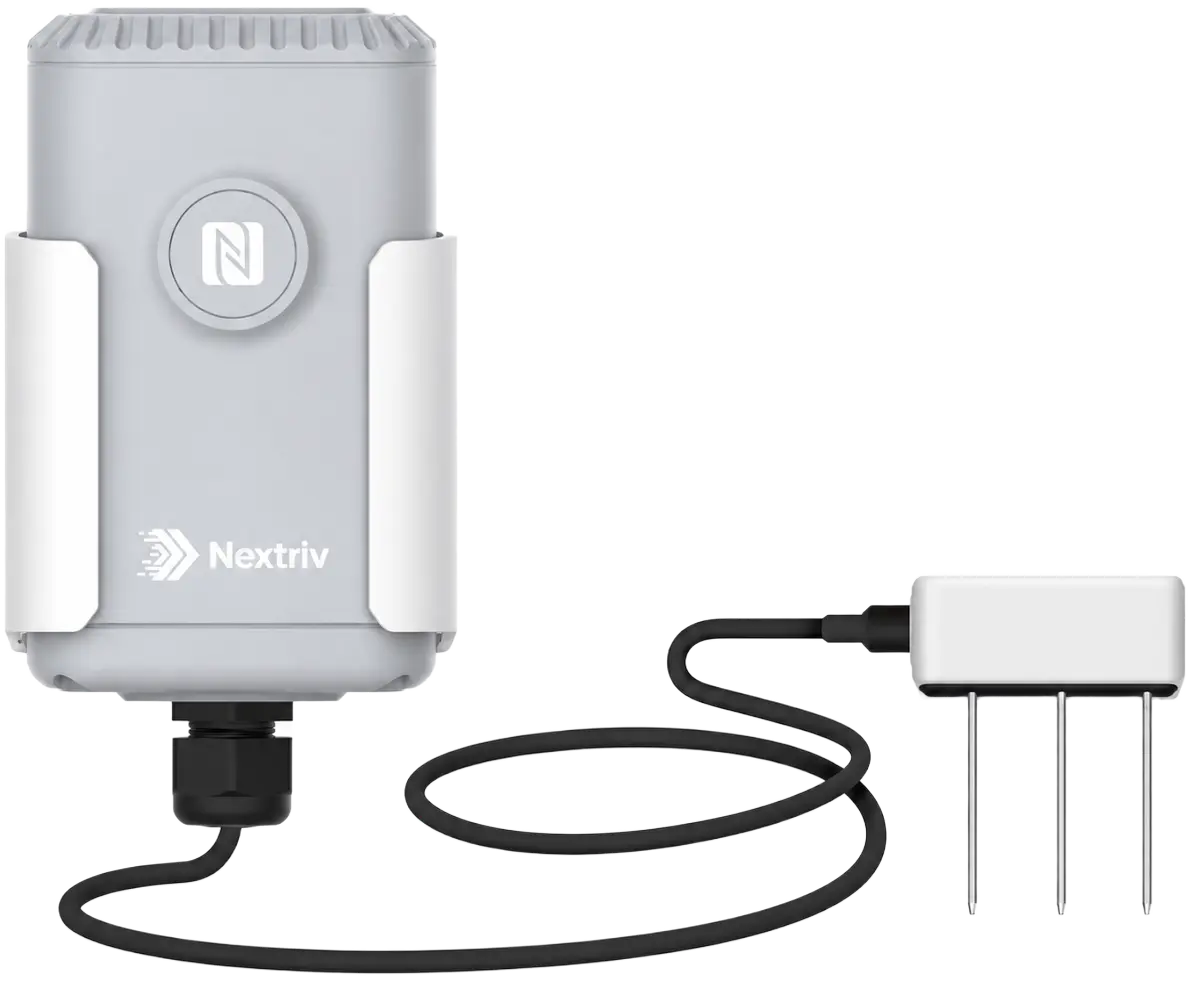
Nextriv Probe Soil measures all three parameters with a single buried probe: moisture with ±2% accuracy in the typical range, soil temperature and EC up to 20,000 µS/cm. The IP68-housed probe works below the surface for years, and the transmitter reports over long-range radio — up to roughly 15 km in open terrain — for up to 10 years on one replaceable battery. A measurement point dug in once documents season after season.
Crops under cover. Temperature and humidity in a polytunnel or greenhouse are a record of growing conditions — useful both when explaining losses and as context for the treatment register.
Post-harvest storage. The warehouse and cold store are where recording conditions is sometimes required outright: a temperature and humidity log documents that produce with organic status was stored correctly, with no gaps between harvest and sale. The same measurements also work operationally — alarm thresholds (up to four per metric: warning and critical) send an SMS, e-mail or web push when the cold store starts drifting out of range, so documentation and crop protection come from a single measurement. The same measurement history proves useful beyond certification too — in buyer complaints and in conversations with the insurer after a loss.

From measurements to documents that hold up at inspection
The measurement itself is only the beginning — what happens to the data next decides its documentary value.
Continuity of the series. A gap in the record raises questions. Nextriv sensors buffer readings locally and re-send them after every connectivity outage, and the platform watches the measurement points itself: a device that has stopped reporting gets marked offline and generates a notification. You learn about a hole in the documentation on the day it could appear — not at the inspection.
Reports instead of screenshots. Data from any period closes into a PDF report — also automatically, on a schedule — and where incontestability matters, the report can be digitally signed: a SHA-256 checksum, a QR code and a verification address let anyone confirm the document has not been changed since it was generated. For your own analyses there are XLSX and CSV exports.
Retention and metadata. Organic documentation has to reach back — raw measurement history kept for years lets you return to any week of the season the inspector asks about; why raw data specifically matters is explained in our piece on measurement data retention for audits. Metadata completes the credibility: the platform keeps a sensor calibration log (date, next due date, certificate) with reminders, plus a register of system changes — you can see who modified thresholds or configuration and when.
Three principles are worth remembering regardless of the tools: records should be created automatically (not retroactively), the series should be continuous (no gaps), and the data should carry its pedigree (calibration, change history). Documentation that meets these conditions needs no explaining at inspection.
Start documenting before the next inspection
The deployment is smaller than it sounds: a gateway by the farm buildings, probes in the key zones, sensors in the warehouse — the platform detects the devices automatically, and thresholds and reports are configured within an hour. More scenarios for farms, from irrigation to storage, are on the agriculture and greenhouses solutions page.
The FREE plan covers 10 sensors and a year of measurement history; longer retention (up to 5 years of raw data), signed reports and schedules belong to the PRO plan — details in the pricing. Or simply book a demo: we will show you, on live data, what an environmental log that passes inspection without a single question looks like.


