
Probe or integrated sensor — what to choose for cold rooms and processes
Probe sensor or integrated? We compare both designs for cold rooms, freezers and processes: temperature ranges, accuracy, calibration and mounting.
Zespół Nextriv4 min read

Probe sensor or integrated — the question comes up at every refrigeration monitoring deployment, and it almost always gets answered too quickly. The salesperson recommends what's in stock; the technician, what they installed last. Yet the two designs solve different problems, and in a well-designed facility they usually work side by side. Below we break the difference down into five concrete criteria — from temperature range to calibration — and finish with practical recommendations for cold rooms, freezers and processes.
Two designs, two ideas about measurement
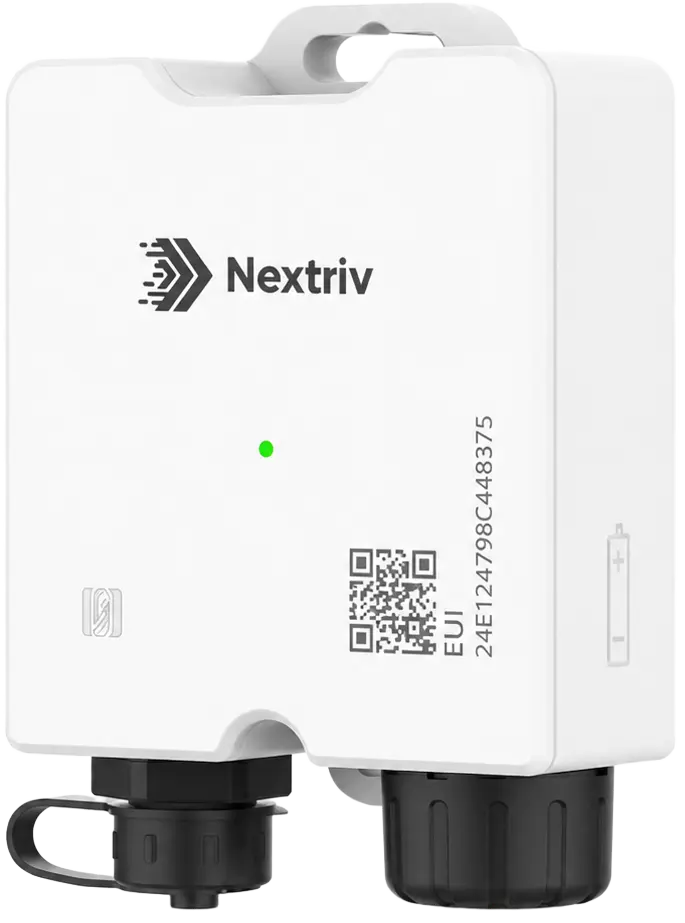
An integrated sensor carries its sensing element inside its own enclosure: it hangs on a chamber wall or clings magnetically to a metal surface and measures the conditions around itself — most often temperature together with humidity. All the electronics, radio and battery work right where the measurement happens.
A probe sensor splits those roles: the sensing element sits in a steel probe on a lead, and the transmitter with the battery and radio hangs separately — usually outside the chamber. It measures whatever point you put the probe into: the air by a shelf, a thermal buffer next to vaccines, the liquid in a tank.

Probe or integrated sensor: five selection criteria
1. Temperature range
Here the difference is most tangible. A probe data logger such as Nextriv Probe Solo measures from −40 to +125 °C — from a deep freezer to warm processes. An integrated sensor, for instance Nextriv Sense Industrial, works across −30…60 °C, because the electronics and battery have to survive the same conditions as the sensing element. For a cold room and a typical freezer that is entirely sufficient; for extreme temperatures — it isn't.
2. What you actually measure: air, product or a process point
An integrated sensor measures the chamber's climate: air temperature and humidity. That is the right picture wherever the storage environment is what counts — in a warehouse, a ripening room, a dry zone.
A probe measures a point. In a vaccine fridge a probe immersed in a thermal buffer tracks the temperature of the product, not the air — a door opened for half a minute doesn't trigger a false alarm, while a real deviation still will. There is also a difference the other way round: a typical probe measures temperature only. If humidity matters in the chamber too, you need an integrated design or an additional sensor.
3. Where the electronics — and the battery — work
At low temperatures every cell delivers less energy, and a chamber's metal cladding muffles the radio signal. The probe design sidesteps both problems at once: only the steel probe stays in the freezer while the transmitter hangs outside — the battery at a comfortable temperature, the radio outside the metal box. A Probe Solo transmitter works this way for about 8 years on a replaceable battery at a 10-minute reporting interval.
Industrial-class integrated sensors are prepared for this too — lithium thionyl chloride batteries tolerate sub-zero duty, and long-range radio (up to approx. 2 km in built-up areas and approx. 15 km in open terrain) punches through chamber walls to a gateway in the office. Physics can't be cheated, though: the colder the electronics run, the more cautiously you should read battery-life claims.
4. Calibration and documentation continuity
In audited regimes this criterion can be decisive. A detachable probe with an M12 connector has its own identifier reported in the data: you pull it out for calibration or swap it for a freshly calibrated one in a minute, without taking the logger down and without a gap in supervision — and calibration traceability stays in the history. An integrated sensor is calibrated as a whole, so for the duration of calibration the measurement point disappears, or you replace the entire device. How to organise dates, certificates and reminders is covered in our guide to temperature sensor calibration.
5. Mounting and environment
Integrated wins on simplicity: the magnetic version of Sense Industrial holds onto a fridge wall with no drilling, the 18 mm-thick enclosure slips between a shelf and a display case wall, the food-contact-approved plastic raises no sanitary doubts, and IP67 with a conformal coating tolerates washdowns around it. The probe design requires thinking through a gland for the lead (typically 1.5 m long), but in return the transmitter stays somewhere easy to reach — replacing the battery or checking the status LED doesn't mean entering the chamber.

Cold room, freezer, display case: practical recommendations
- Cold room at 0–8 °C, where climate counts: integrated sensor — it measures temperature and humidity, and ±0.2 °C accuracy catches compressor drift long before the alarm threshold.
- Freezer at −18 °C and below: probe through a gland, transmitter outside — reliable connectivity despite the metal cladding, and electronics out of the frost.
- Pharmacy or vaccine fridge: probe in a thermal buffer — the measurement tracks the product, not the air movement by the door.
- Display case and refrigerated counter: integrated in the magnetic version — mounted in seconds, with a slim profile that doesn't get in the way.
- Warm processes — incubators, baths, production lines: probe, because only it reaches +125 °C; a rapid-change alarm catches a process spike before it turns into a loss.
Both approaches, device by device, are laid out in detail in our guide to sensors for commercial fridges and freezers.
In the platform the differences disappear
Whatever the design, both sensor types report to the same platform and use the same mechanisms: four thresholds per metric (two warning, two critical), escalation when nobody acknowledges an alarm, and local buffers with retransmission — 4000 measurements in the probe logger, 3000 in the integrated sensor — so history has no gaps even after a connectivity outage. Both designs are EN12830 certified, so the hardware decision doesn't weaken your documentation: PDF reports and the calibration register look the same across the whole fleet.
The decision in three questions
The choice between a probe and an integrated sensor boils down to three questions: how extreme are the temperatures (above 60 °C or deep frost — probe), are you measuring a climate or a point (climate and humidity — integrated; product and process — probe), and what does your calibration regime look like (a swappable probe with its own identifier simplifies audits). You can compare both designs field by field in the product catalogue, plan prices are in the pricing — and if you'd rather talk through your own facility in specifics, book a short demo.


