
Temperature Excursion — How to Prove Your Medicines Are Safe
Temperature excursions in pharma: what counts as a deviation from 2–8 °C, how to detect and document it, and how to prove the medicines stayed safe.
Zespół Nextriv5 min read

In this article
A temperature excursion is the moment a medicine leaves the temperature range validated by its manufacturer — most often outside 2–8 °C in a cold store or outside 15–25 °C in a warehouse. It sounds like a verdict, but it isn't one: not every deviation means a destroyed batch. The problem is that without data you can't tell a harmless, brief spike from a real loss of quality — and then you're left either discarding good stock for nothing, or releasing a medicine whose safety nobody can defend. In this article we show exactly what a temperature excursion is, why the full time–temperature profile matters rather than the peak value alone, and how to gather the evidence that lets you make — and justify — the decision to release or withdraw a batch.
Temperature excursion — what it actually is
In the language of good distribution practice, an excursion (temperature deviation) is any recorded departure of storage or transport conditions from the range defined in the product's storage conditions. It cuts both ways, and both directions are dangerous:
- Above the range — accelerated degradation of the active substance; the higher and the longer, the greater the loss of potency.
- Below the range and freezing — for many preparations, especially those containing adjuvants, the damage can be irreversible, even if the temperature quickly returns to normal.
The key word is "recorded". An excursion nobody wrote down doesn't disappear — it simply becomes a risk that can't be assessed. That's why the starting point for any assessment is a continuous, trustworthy record: without gaps, with timestamps, from a device you can rely on.

Not every deviation is a loss — the time–temperature profile decides
The most common mistake is judging an excursion by its peak value alone: "it hit 11 degrees, so it's over". In reality, the outcome is determined by exposure — the combination of temperature and how long it lasted. A brief spike to 11 °C while stock is being moved is something entirely different from a dozen-plus hours at 11 °C after a silent compressor failure.
Assessing whether a batch is fit for further distribution rests on two things: the full time–temperature profile from monitoring, and the stability data provided by the manufacturer (the declared allowable excursions). Quality teams often work here with mean kinetic temperature (MKT), which condenses a variable profile into a single value reflecting the heat load on the product. Whatever you calculate, though, you need the same input material: complete raw data, not hourly averaged bars. That's why an "once an hour" record isn't enough to assess an excursion — you need a dense, unbroken trace.
The decision to release or withdraw a batch is made by the responsible person, based on that data and the manufacturer's conditions — monitoring doesn't replace that decision. What it does provide is the thing without which the decision is just guesswork: hard, complete evidence of what actually happened to the medicine.
Three pillars of proof that the medicines are safe
To defend a batch — or knowingly withdraw it — you need three things at once.
- A continuous record without gaps. The measurement history covers the entire storage period, not spot readings. On the FREE plan it reaches a year back; where documentation requires it, up to five years. Raw data, not just averages — because raw data is what lets you calculate exposure.
- Real-time detection and response. Four thresholds per metric (two warning, two critical) let you watch the product window and the safety limit separately. Every crossing creates an event with an ALM-XXXXXX code, and the notification goes out on one of six channels — from SMS to a Microsoft Teams post.
- A trail of how it was handled. The event moves through the statuses active → acknowledged → resolved, you can attach a comment with the assessment and corrective action, and the system records who handled it and when. That turns "I think we responded" into a documented deviation history.
The threshold-and-response logic here is shared with refrigeration as a whole — we broke it down in our article on cold storage zone monitoring, and we described a preparation's full journey from manufacturer to dispensing point in our guide to the vaccine cold chain.
How to document an excursion, step by step
Documenting a deviation doesn't have to be handcrafted. In practice it looks like this:
- The event creates itself the moment the threshold is crossed — with the exact start and end times and the peak value.
- The time–temperature profile comes from the trend chart or an XLSX/CSV export, and it becomes the material for the exposure assessment.
- The assessment and decision go into a comment on the event, and you change the status to resolved — the deviation has an unambiguous conclusion.
- A PDF report gathers the trace, the thresholds and the event list into a single document for an audit or a complaint; the extended variant adds statistics, percentiles and a cryptographic signature on the document.
The result: instead of hours spent digging through logbooks, you have ready evidentiary material in a few minutes. What that record should look like under inspection is something we covered in more detail in our article on temperature monitoring under HACCP — the evidentiary logic is similar, though in pharma the bar sits higher.

What to measure with, so the evidence holds up
The quality of the evidence starts with the device. In a pharmaceutical warehouse and goods-in area it's not just temperature that matters but humidity too, and the record has to survive a connectivity outage.
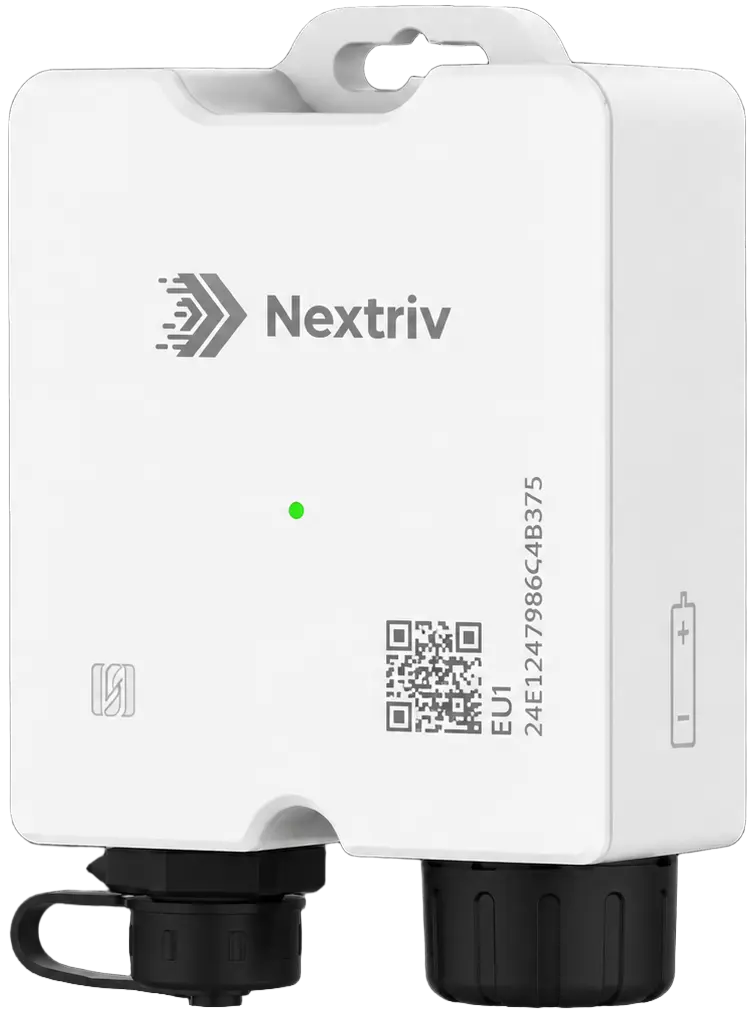
A data logger with a dual-parameter probe, like the Nextriv Probe Duo, fits these applications: it measures temperature and humidity from a single point, with ±0.2 °C accuracy and drift below 0.03 °C per year, so calibration intervals stop being guesswork. A 4,000-measurement buffer with retransmission keeps the record complete after every network outage, and EN 12830 certification places the device in the class of refrigeration data loggers, not ordinary sensors. The detachable probe has its own identifier reported with the data — you can calibrate or swap it without interrupting oversight and without losing traceability.
From evidence to procedure
A single excursion is defended with data. A recurring excursion is a signal that the process needs to change: different refrigeration equipment, a relocated sensor, less time on the dock for incoming goods. Monitoring supplies the material for that conversation too — year-over-year season comparisons, a map of the spots where deviations keep returning, a list of the most frequent ALM codes. The full medicine oversight scenario, from the pharmacy fridge to a wholesaler operating under good distribution practice, is described on our pharma solutions page.
Start with one zone
A temperature excursion stops being a nightmare once you have a procedure and data for it. The simplest start is one fridge or one zone: set the thresholds, define the response, watch the trace for a month. The FREE plan covers 10 sensors, all notification channels and a year of history — enough for a first complete picture; longer retention and signed reports can be compared in the pricing section.
Book a short demo — we'll show you, on live data, what a recorded excursion looks like, how it's assessed, and the finished deviation report.


