
ISO 11799 — Climate Conditions for Archives and Libraries
ISO 11799 for archives and libraries: temperature and humidity bands for collection storage, why climate stability matters and how to document it.
Zespół Nextriv4 min read

In this article
ISO 11799 is the standard every archive and library with its own collection storage runs into sooner or later: it describes the requirements for storing archival and library materials, and its essence is a stable storage climate and monitored conditions. In practice it comes down to two obligations: maintain conditions suited to the material, and be able to document it. Below, we explain which temperature and humidity bands are accepted for paper-based collections, why stability matters more than the "ideal" average, and how to build monitoring whose record will hold up before an auditor and an insurer.
What ISO 11799 requires of a collection store
The standard doesn't impose a single universal temperature for all collections — and that's its most overlooked feature. What it does require is that the storage climate be deliberately managed: matched to the materials held, maintained stably and continuously monitored, with deviations recorded. The European standard EN 16893, covering storage spaces for cultural heritage collections, follows the same track — there, measurement data underpins the required analyses.
This shifts the weight from "what temperature should we set" to "how will I know it's being maintained". A drum thermohygrograph and a readings notebook are formally monitoring — but they reveal a deviation only when someone walks over and looks. On weekends, at night and during holidays, the store is left unattended.
ISO 11799 in practice: which conditions for archives and libraries
Target values are always agreed with a conservator for the specific holdings, but established conservation practice provides a starting point:
| Holdings | Temperature | Relative humidity |
|---|---|---|
| Paper-based collections (records, books, prints) | 14–18 °C | 30–50% RH |
| Mixed collections and exhibitions | 18–21 °C | 40–55% RH |
More important than any specific value, though, is stability: daily fluctuations should stay within ±2 °C and ±5% RH. A store that averages 16 °C but swings between 12 and 20 °C is worse for the collections than one holding a steady 19 °C.
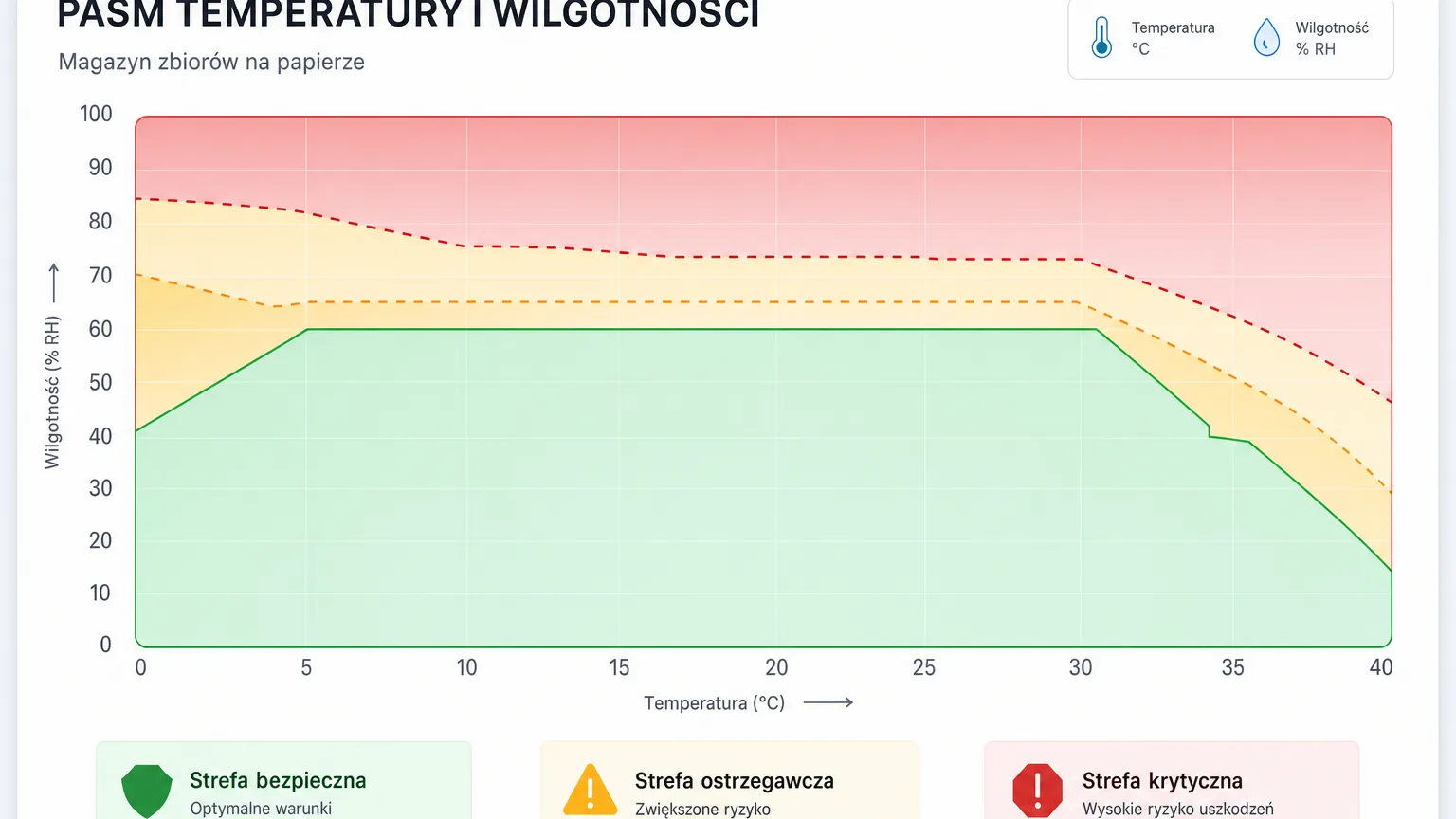
Why stability beats the average
Organic materials — paper, leather, wood, adhesives — respond to humidity mechanically: they absorb water and swell, release it and shrink. A single swing is harmless; the problem is cycles. Repeated humidity swings cockle paper, delaminate wood and crack paint layers — and those changes are irreversible. That's why a manual reading twice a day proves nothing: the daily fluctuations play out precisely between the readings, when the heating switches off or the humidifier in the HVAC system stops keeping up.
Continuous logging every few to a dozen minutes is the only way to see the real daily profile — and the only record that demonstrates compliance with a band, rather than with "the average of two readings".
Conservation bands as four alarm thresholds
In the Nextriv platform, every band maps directly: each metric gets four thresholds — two warning and two critical, separately for the temperature and humidity of every room or store. An example from a paper collection store: crossing 55% RH opens a warning event, and 65% RH — a critical one. Every event receives an ALM code and moves through the statuses active → acknowledged → resolved, so after the fact you can see not just the deviation, but the team's response too.
Then there's escalation: the conservator on duty gets a web push and an email with the trend chart, and if they don't acknowledge the event within the set time, an SMS goes to the department head. Six notification channels are available — from email and SMS to Microsoft Teams and Discord.
Sensors that suit the store and the gallery
Collection stores end up in basements, in attics and in historic buildings where chasing walls is out of the question. Wireless sensors mount with tape or screws, without intruding on the historic fabric, and long-range radio covers the entire building with a single gateway.
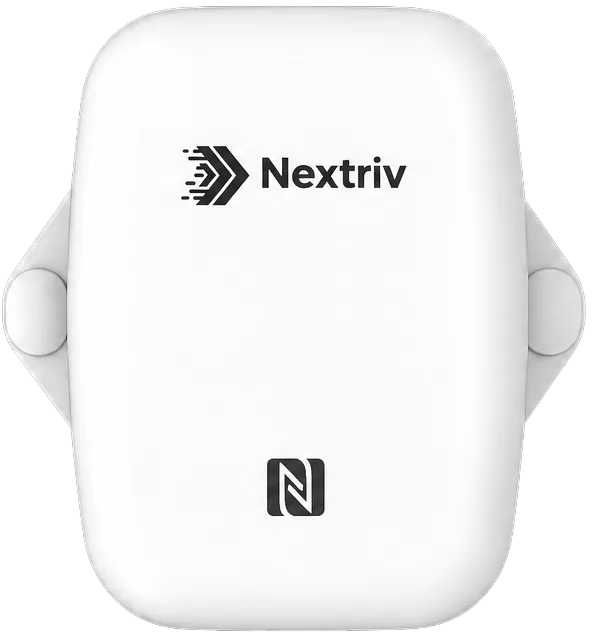
The Nextriv Sense Essential measures temperature to ±0.2 °C accuracy and humidity across the full range, and its sealed IP67 housing lets it work in damp basements and unair-conditioned rooms as well. A local buffer of around 3,000 records with retransmission keeps the record gap-free even after a connectivity outage — and the batteries last at least 10 years.
In exhibition rooms and reading rooms, it's worth going a step further:
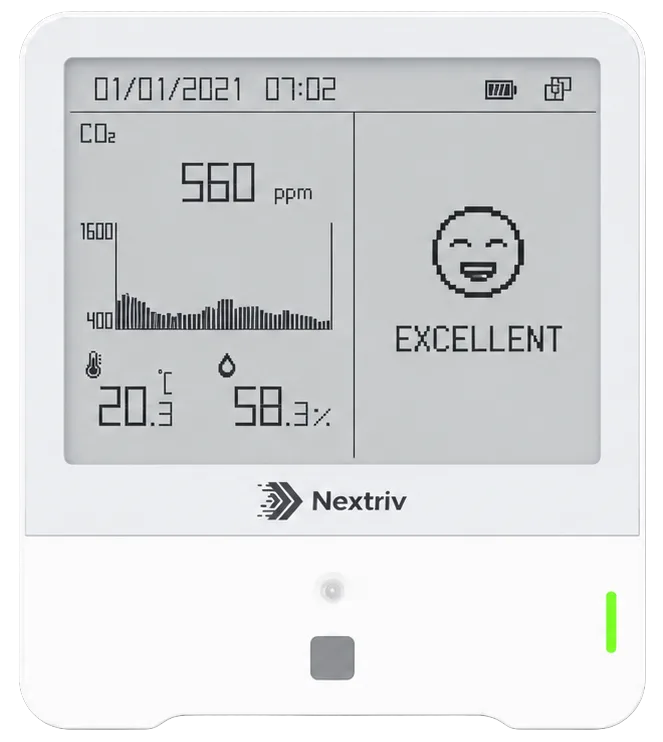
Alongside temperature and humidity, the 7-in-1 station also measures CO₂, volatile organic compounds, pressure, light and occupancy — one mounting point gives a complete picture of the room's climate and visitor traffic.
Documentation an auditor and insurer will accept
Monitoring in the spirit of ISO 11799 ends with documentation — and that's where its value is decided:
- Raw measurement history — a full year even on the free plan, and up to 1,825 days (5 years), with measurements never replaced by averages.
- PDF reports with charts — generated for any period, with optional cryptographic signing (SHA-256 checksum + QR code for verification), so a report from a year ago is as trustworthy as yesterday's.
- Calibration register — calibration date, next due date, certificate and notes for every sensor, with automatic reminders.
- Alarm event history — who acknowledged, when it was resolved, with the full trace of readings.
This is exactly the set that collection insurers and loan agreement parties ask about — fine art policies increasingly require documented environmental monitoring, not declarations.
Where to start
- Map the zones — stores, exhibition rooms and reading rooms separately; each can have its own band.
- Agree the bands with a conservator — target values and warning limits for every zone.
- Place the sensors — first where the climate is least stable: basements, attics, external walls.
- Set thresholds and escalation — four thresholds per metric plus a notification path for nights and weekends.
- Turn on a recurring report — charts and band compliance in the inbox every week, before anyone asks for them.
Our full approach to cultural institutions — from exhibition rooms to leak detection — is described on the climate monitoring for museums and archives page. And if you'd like to see the bands, alerts and reports on live data, book a short demo — or start with the free plan with 10 sensors and a year of recorded history; details in the pricing section.


