
How to read a sensor datasheet — range, accuracy, IP rating, battery
How to read a sensor datasheet: measuring range vs operating conditions, accuracy with an asterisk, IP rating and battery claims — what the numbers really say.
Zespół Nextriv5 min read

In this article
- Measuring range is not the same as operating conditions
- How to read a sensor datasheet: accuracy with an asterisk
- IP67: two digits, two promises — and a few things it doesn't promise
- Battery: the words "up to" do all the work
- Fields that are easy to overlook — and often matter most
- Let's read one datasheet together
- The datasheet is the beginning, not the end
How do you read a sensor datasheet so you don't end up buying a device that can do everything on paper, yet keels over on site during the first freezing night? Specifications are written to look good: the numbers are true, but each one holds only under specific conditions — listed in fine print next to it, or not at all. Below we walk through the four fields that genuinely decide whether a sensor is fit for the job — range, accuracy, ingress protection and battery — and for each we show what to ask before you place an order.
Measuring range is not the same as operating conditions
The datasheet contains two similar-looking temperature ranges, and they are very easy to confuse. The measuring range tells you what the sensor can measure. The operating conditions tell you where its electronics will survive. In integrated designs the two usually coincide, because the sensing element sits in the same enclosure as the radio and the battery. In designs with a probe on a cable they diverge on purpose — and that's an advantage: the probe of a cold-storage recorder measures up to +125 °C, while the transmitter operates within −30…+55 °C, because it hangs outside the chamber.
The practical takeaway: before you fall for the range, check which part of the device has to work in the extreme conditions. A −25 °C freezer fits within the measuring range of most sensors, but the electronics and the cell are far from happy in there.
The second piece of fine print concerns humidity. A spec of "0–100% RH (non-condensing)" means the sensor will measure any humidity as long as water vapour doesn't condense on the device. In a cold room with frequently opened doors, condensation is a daily reality — without a sealed enclosure that specification is met mostly in the lab.
How to read a sensor datasheet: accuracy with an asterisk
"±0.3 °C" is the beginning of a sentence, not its end. Three questions to ask of every accuracy claim:
Over what range does it hold? Accuracy almost always depends on the measured value. An honest datasheet quotes bands: for example ±0.3 °C between 0…70 °C and ±0.6 °C below zero. If the sensor is going into a freezer, the number that applies to you is the one from the negative band — not the one in the headline. Same with humidity: a typical spec is ±3% within 10–90% RH at 25 °C and ±5% outside it.
Typical or maximum? The abbreviation "typ." before a value means most units will fit the claim — but your particular unit may be worse. A maximum value is a hard limit; a typical value is a statistic.
Resolution is not accuracy. Displaying readings in 0.1 °C steps doesn't mean the measurement is accurate to 0.1 °C. Resolution tells you how small a change the sensor will show — and it's great for tracking trends. Accuracy tells you how close to the truth the number itself is.
Why all this pedantry? Run the numbers on your own process: a pharmaceutical fridge has a 2–8 °C window, i.e. six degrees. A sensor accurate to ±0.3 °C leaves nearly all of that band intact; a consumer-grade device with a ±1 °C error eats a third of the window before anything even happens.

IP67: two digits, two promises — and a few things it doesn't promise
You read an IP rating digit by digit. The first describes protection against solids: "6" means fully dust-tight. The second — against water: "7" means the enclosure withstands temporary immersion. In practice, IP67 is a sensor that won't mind driving rain on a loading dock, a steamed-up back room or the area around it being washed down.
What an IP rating does not promise: resistance to UV radiation (outdoors, a plastic without that declaration grows brittle and fades — look for a separate statement on UV resistance), resistance to chemicals, or to regular pressure washing. In food environments it's worth looking for additional declarations, such as a conformal coating on the electronics or an enclosure made of food-contact-approved plastic.
There's also an operational catch: the IP rating holds with the enclosure closed. Every opening — for configuration, a battery swap, pressing a button — is a test of the gasket. That's why touch-free configuration over NFC, without opening the enclosure, is not a gimmick but a way to keep the seal intact for the device's entire life.
Battery: the words "up to" do all the work
"Up to 5 years", "up to 8 years", "as much as 10 years" — all of these claims are true, and none of them tells you how long the sensor will run at your site. Battery life depends on the reporting interval (claims almost always assume a report every 10 minutes or less often), on radio conditions (a sensor at the edge of coverage transmits longer and at a higher energy cost) and on the temperature the cell operates in. An honest datasheet spells those conditions out — for example "at least 5 years, depending on interval and radio configuration" — while a suspiciously round "10 years" with no footnote should be treated as a marketing figure.
Two control questions: is the battery replaceable (a replaceable cell means a service job costing a few dozen PLN; a built-in one means disposing of the whole device) and does the sensor report its battery level to the platform — because without that, replacements get planned by guesswork. We take a sensor's entire energy budget apart — what really drains the battery and how to conserve it — in the article on sensor battery life.
Fields that are easy to overlook — and often matter most
- Radio sensitivity and range. A value like −137 dBm tells you how weak a signal the receiver can still make sense of — the lower the number, the better. For long-range radio, a realistic reference point is about 2 km in built-up urban areas and up to about 15 km in open terrain.
- Local buffer and retransmission. Memory for around 2,800 measurements with automatic backfill after a connectivity gap means history without holes — the difference between "the chart looks nice" and "the chart will pass an audit".
- Certificates. For the cold chain the key one is EN12830 — the standard for temperature recorders that health inspectors and auditors look at. How a certified recorder differs from an ordinary sensor is something we cover in the piece on HACCP temperature monitoring.
- Mounting and configuration. Screws, tape or cable ties in the box, plus configuration over NFC, decide whether commissioning thirty units takes an hour or a weekend.

Let's read one datasheet together
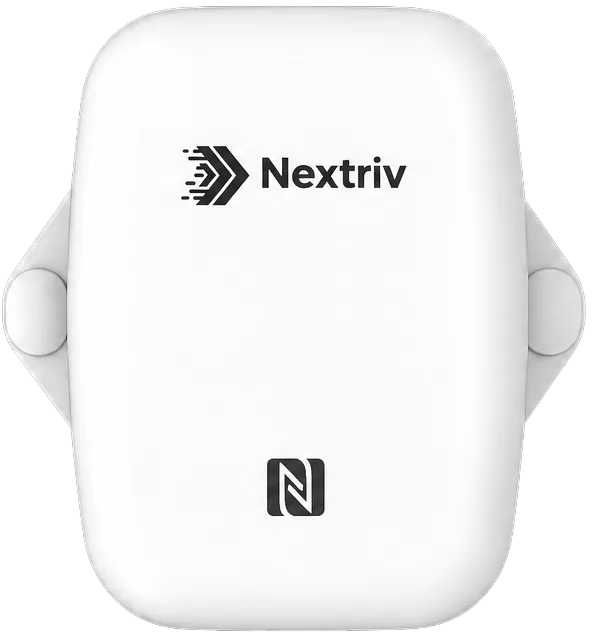
A good exercise is to read a complete, honestly written specification. The datasheet of the Nextriv Sense Essential sensor quotes accuracy in bands (±0.3 °C at 0…70 °C, ±0.6 °C below zero), separates the measuring range from the operating conditions, declares IP67 together with UV resistance, and for battery life — at least 5 years — explicitly notes the dependence on interval and radio configuration. On top of that: a replaceable 4000 mAh battery, a buffer of around 2,800 measurements with retransmission, and an EN12830 certificate. You'll find the remaining datasheets in the product catalogue — the fields are described uniformly, so you can compare them one to one.
The datasheet is the beginning, not the end
A specification read with understanding weeds out the devices that only look good in a table. The rest you learn from a pilot: the Nextriv free plan includes 10 sensors and a gateway, so you can verify the datasheet's claims at your own site with no platform fees — details in the pricing. And if you'd rather see how accuracy bands and battery levels look on live data, book a short demo.


