
BREEAM and LEED — how sensor data supports building certification
BREEAM and LEED in practice: which sensor data counts in building certification — air quality, energy, water — and how to collect it credibly.
Zespół Nextriv4 min read

BREEAM and LEED changed the conversation about building quality: instead of declarations of being "modern and green" there are points, categories and an assessor's review. For a building manager, though, this means a concrete operational problem — a large share of the assessed areas concerns how the building actually performs, not how it was designed. This is where sensors come in: continuous measurement of air quality, comfort, energy and water turns "we believe it is fine" into charts and reports you can sit down with for an assessment. One thing should be said honestly right at the start: no monitoring system awards a certificate. The certificate is awarded by a certification body based on the work of a licensed assessor — sensors provide the data that makes that work possible and documents it. No more, no less.
BREEAM, LEED and sensors: what is actually assessed
Both schemes work similarly: the building earns points across categories, and the total decides the certification level. BREEAM (the scheme of the UK's BRE, the most popular in Poland for commercial real estate) scores, among other things, management, occupant health and well-being, energy, water and pollution. LEED (the American scheme) groups credits in areas including indoor environmental quality, energy and atmosphere, and water management.
From the measurement data perspective, something else matters most: both schemes have pathways for existing buildings — BREEAM In-Use and LEED for buildings in operation — where the assessment relies on real operational data and the certificate is subject to periodic renewal. Here a good design from years ago is not enough; you have to demonstrate on an ongoing basis how the facility performs. In other words: certifying an existing building is largely an exercise in continuously collecting credible data — exactly what environmental monitoring is for.

Health and well-being: air you can actually show
The categories on occupant health and comfort reward facilities that measure indoor environmental quality rather than assume it. In practice it is the familiar set of parameters: carbon dioxide as an indicator of ventilation effectiveness, volatile organic compounds (TVOC), particulate matter PM2.5 and PM10, temperature and humidity as the basis of thermal comfort.
The multi-parameter station Nextriv Sense IAQ Comfort measures eight parameters from a single mounting point — including particulates with a laser method and CO₂ with an NDIR sensor — while its large e-ink display communicates the air status to everyone passing by. That is the second, often overlooked dimension of certification: the schemes reward not only measuring but also communicating the results to building occupants. A sensor that shows air quality on the spot does both at once.
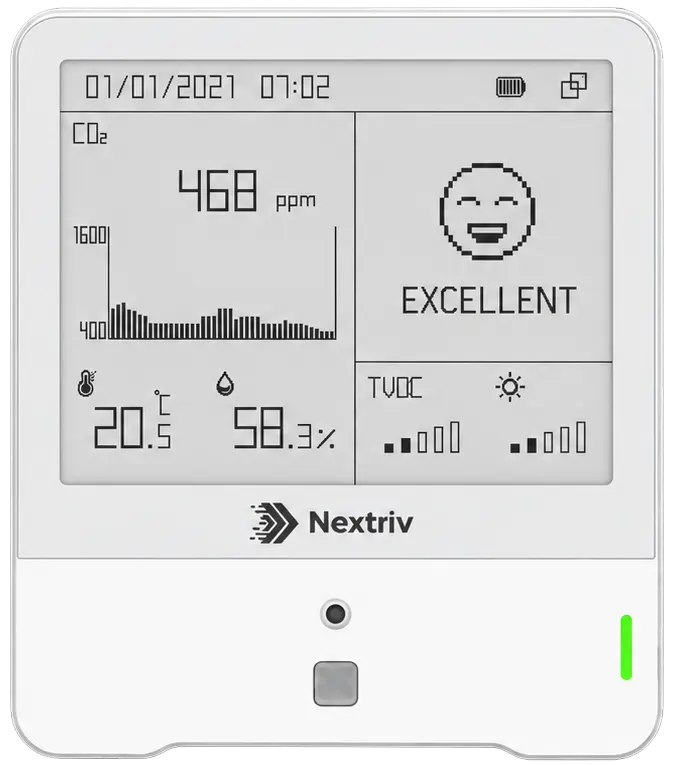
The same data works double duty anyway: before it reaches the certification documentation, it helps find and fix real problems — from under-ventilated rooms to zones where occupants complain of headaches and fatigue. How air metrics map to symptoms is covered in our article on sick building syndrome.
Energy and water: submeters instead of declarations
In the energy and water areas there is one currency: measured consumption, ideally broken down by zones and installations. Both schemes value detailed submetering — because only that shows where energy and water actually disappear and lets you document the effect of corrective measures.
The good news: in most buildings the submeters are already on the wall — working and legally verified, just read manually. A pulse counting module clips onto their pulse output and turns every pulse into a remote, logged reading; a non-erasable local register means tenant billing, ESG reporting and building certification processes can be built on this data. The continuous-flow alarm catches leaks along the way — a burst pipe or a valve left open — which in the water categories can cost both points and money.

The economics work regardless of the certificate anyway: submetering usually pays for itself in savings alone, and the certification points are the bonus. We ran the numbers in more detail in our article on the ROI of environmental monitoring.
Data credibility: that is what convinces the assessor
Between "we have sensors" and "we have documentation for the assessment" there is one more step: the data must be complete, continuous and tamper-resistant. Several mechanisms of the Nextriv platform work on precisely that:
- Raw measurement history up to 5 years — certificate renewal cycles run over years, so the data has to reach further back than last season. Readings older than 7 days are compressed but remain full, raw data.
- Measurement continuity — sensors buffer data locally and re-send it after a connectivity outage, and the platform marks a device offline after just twice its reporting interval. A data gap does not appear silently.
- Reports that can be verified — PDF reports with a SHA-256 signature, QR code and verification address; plus XLSX/CSV exports when the documentation has to be delivered in the auditor's format.
- Accountability — the audit trail records who changed what in the system, and a calibration log with reminders answers the question that comes first in every assessment: "what was this measured with, and when was it calibrated?".

Honestly: what sensors do and do not give you
For clarity, because marketing materials tend to blur this line:
Sensors give you: continuous measurement of environmental, energy and water parameters; historical documentation for assessments and renewals; alerts when parameters leave the assumed thresholds; data for communicating with tenants and occupants.
Sensors do not give you: a certificate or points "automatically"; they replace neither the licensed assessor, an energy audit nor accredited laboratory testing where the scheme requires them; nor will they fix the building — they will show the problem, but the ventilation has to be balanced by you.
If you are planning certification or a renewal, it pays to start monitoring as early as possible — every month of measurements is a longer history to lean on and more time for corrections before the facility goes up for assessment.
Where to start
The natural starting point is measuring air quality in the highest-occupancy zones and clipping pulse modules onto the existing submeters — both without cabling and without touching the installations. How such monitoring comes together at facility level is described in our buildings and offices solution.
Book a short demo — we will show you the periodic reports and multi-year trends that go into certification documentation. Plan details and limits are in the pricing.


