
Sense environmental sensors
Nextriv Sense IAQ Comfortair quality sensor with PM2.5/PM10
SKU: NX-SN-AQ8C
8-in-1 climate monitoring with laser PM2.5/PM10 particulate measurement — the full picture of air health in facilities with elevated dust levels.
€520net
VAT is added to the price.
Description
- Laser measurement of PM2.5 and PM10
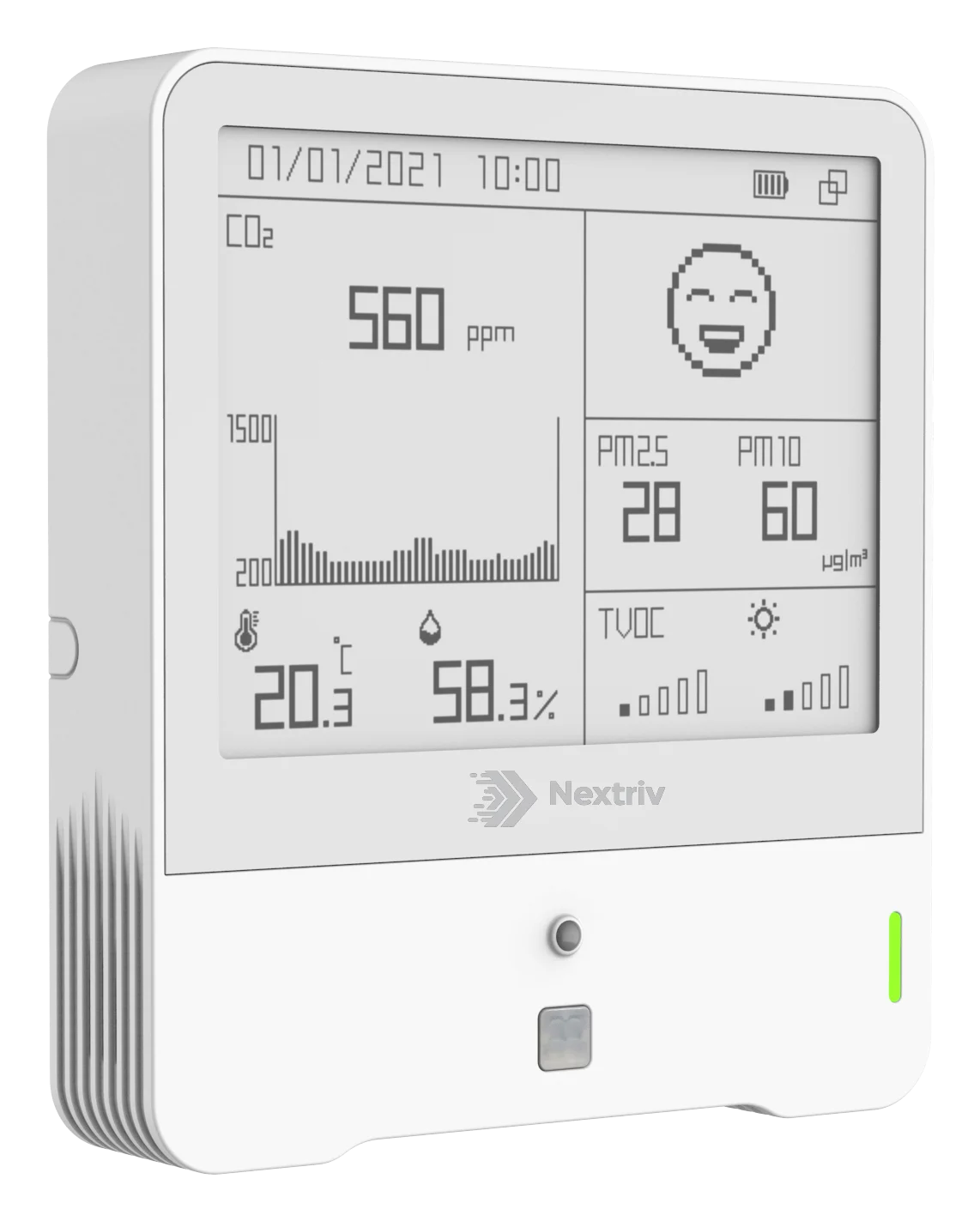
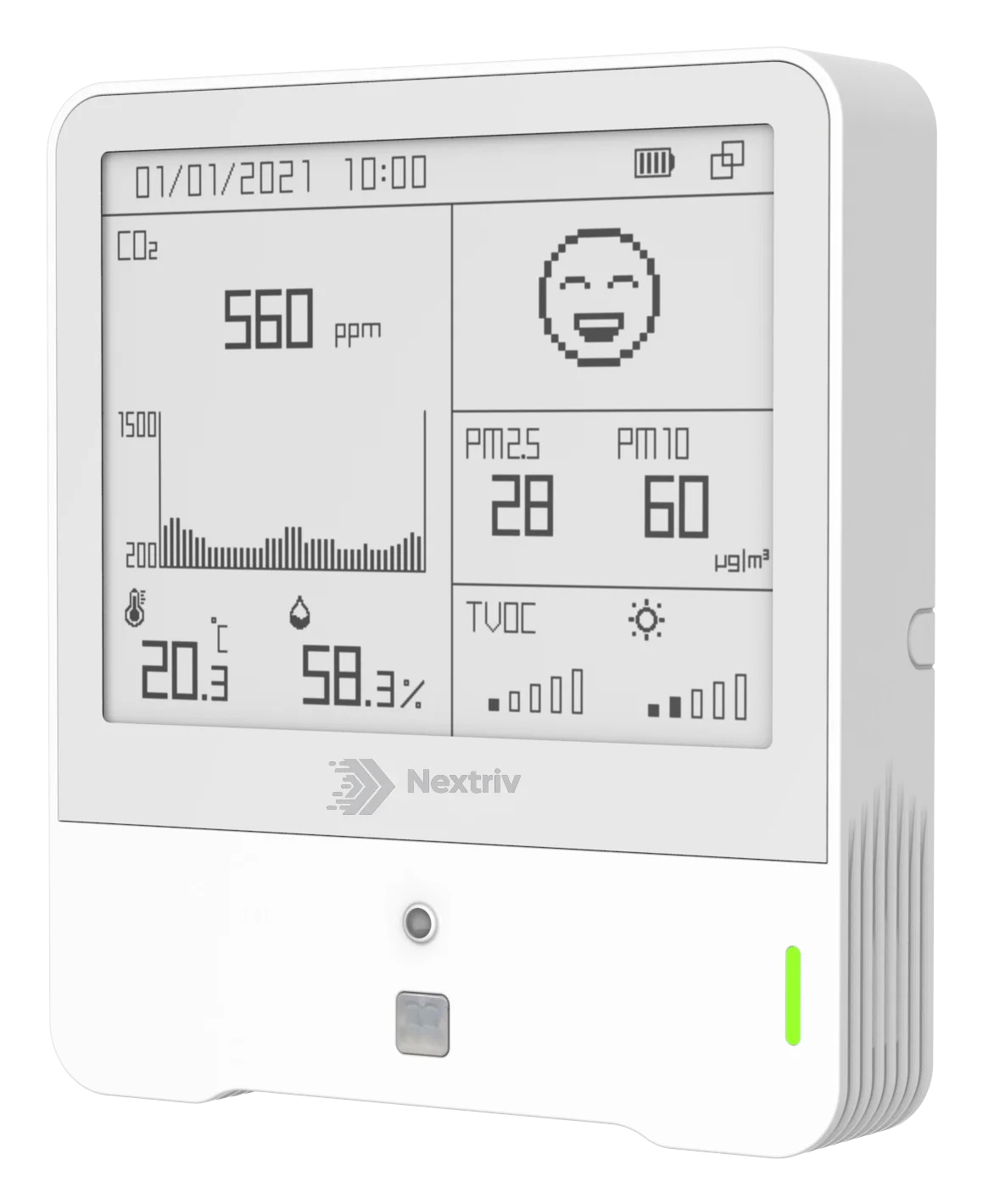
- 8 parameters from a single mounting point
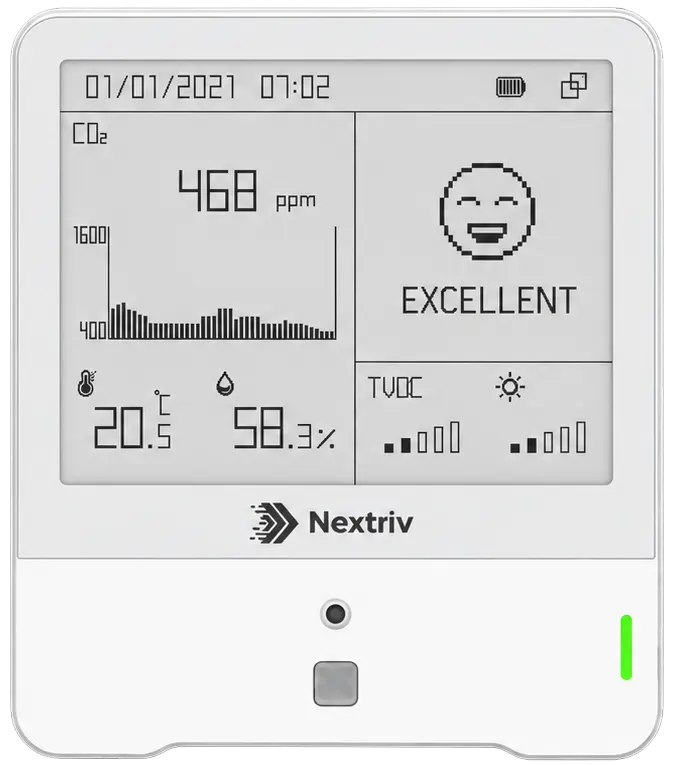
- E-ink display communicates air status
- Objective check of HVAC filtration performance
- 18,000 records of tamper-proof history
What it is for
Some spaces need more than CO₂: lobbies with doors onto a busy street, airport terminals, shopping centres, zones near print shops and workshops. There, air health is decided by PM2.5 and PM10 particulates — particles fine enough to reach deep into the lungs, and invisible enough that without measurement nobody knows about them. Nextriv Sense IAQ Comfort takes everything the 7-in-1 variant can do and adds a professional-grade laser particulate sensor.
This is a device for high-traffic facilities where comfort is the product: a passenger, a mall customer or a hotel guest will never see the ventilation system, but they will feel its effect. Laser-scattering particulate measurement also makes it possible to objectively assess HVAC filtration performance — a filter "due for replacement" stops being a matter of schedule and becomes a matter of data.
Devices of this class prove themselves in the most demanding public spaces — from airport terminals to large-format shopping centres — where the data ties into building automation and steers ventilation in real time.
Beyond particulates, the device measures temperature, humidity, CO₂ (NDIR), volatile organic compounds, pressure, light and occupancy — eight parameters from a single mounting point, with a large e-ink display that communicates the air status to everyone passing by.
Particulates are measured across the full 0–1000 µg/m³ range — from "alpine air" to emergency conditions — with ±10 µg/m³ accuracy in the range that matters most for health. The laser sensor is the most power-hungry element of the device, so for dense particulate sampling we recommend USB-C power; for less frequent measurements replaceable batteries suffice. In zones with variable traffic it pays to pair the measurement with the occupancy sensor: dust levels rise with foot traffic, and the data shows that relationship in black and white.
Usage scenarios
- Airport terminals: sensors of this class deployed across departure and arrival halls continuously measure CO₂, temperature, humidity and volatile compounds. Staff react faster, and ventilation runs against the real occupancy of the halls.
- Shopping centre: sensors integrated with the building automation platform optimise the air for customers and tenants while cutting HVAC energy use.
- Office by a busy artery: PM2.5 measurement shows how much smog comes inside with every door opening — and whether the supply-air filters really stop it. The decision to upgrade the air-handling units with better filtration is made on a chart, not a hunch.
- Technical workshop and print shop: zones generating dust and fine aerosols get their own watch. The acoustic alarm is a reminder to crank up the extraction ventilation.
- Hotel with a wellness zone: one sensor watches stuffiness (CO₂), air dryness (RH) and dust (PM) at once — reception sees guest comfort in numbers before a review appears.
- Clinic waiting room: in smog season, PM measurement at the entrance helps decide the operating mode of the air-handling units and protect patients with respiratory conditions.
Key features
- Laser-scattering measurement of PM2.5 and PM10 — technology from professional air quality stations in a wall-sensor enclosure.
- 8 parameters from one mounting point — a complete set of data on the air and on space utilisation.
- Large 4.2″ e-ink display with emoticons and "traffic lights" — communicating with the occupants of the space without an app.
- Acoustic alarm on threshold breaches — a reaction on site, not only in the platform.
- Smart display sleep when the room is empty (motion sensor) — energy savings with no loss of data.
- 18,000 records of tamper-proof local history + retransmission after connectivity outages.
- Configuration with a tap of a smartphone (NFC); USB-C as a power and service port.
- Flexible power: replaceable batteries or USB-C — recommended for frequent particulate sampling.
- The same flat white enclosure as the rest of the series — a consistent look for the whole fleet on the walls.
In the Nextriv system
Eight metrics means eight independent threshold sets in the Nextriv platform — two warning and two critical each, with event deduplication and clear alarm codes. Notifications go out over six channels (e-mail, SMS, web push, Discord, MS Teams, in-app sound), and rules and escalation policies match the alarm flow to the facility's procedures — from reception to the technical department.
Dashboards with nearly 20 widget types put particulates side by side with CO₂ and zone occupancy; PDF reports document environmental quality for tenants and the board, while XLSX/CSV exports feed the customer's reporting systems. The platform flags a sensor as offline after just twice its reporting interval — no measurement point disappears quietly. Notification rules split events between teams — engineering gets particulates and HVAC, reception gets guest-zone comfort — while quiet hours protect against an alert avalanche at peak times. Measurement history reaches back up to 5 years: smog seasonality is plain to see, year over year.
Typical deployments
- Commercial buildings: lobbies, common areas and high-traffic terminals — comfort measured where thousands of people pass every day.
- Malls and retail: PM and CO₂ data integrated with HVAC automation — air for customers without burning energy.
- Hotels: guest comfort in numbers: stuffiness, dryness and dust under one watch.
- Schools and healthcare: a fuller picture of the air where vulnerable groups spend time — with alerts on particulate breaches.
Specification
| Temperature | -20…60 °C, ±0.2 °C (0…60 °C) |
|---|---|
| Humidity | 0…100 % RH, ±2 % RH |
| CO₂ (NDIR) | 400…5000 ppm, ±(30 ppm + 3 % of reading) |
| PM2.5 / PM10 (laser) | 0…1000 µg/m³, ±10 µg/m³ (0–100) / ±10 % (100–1000), 1 µg/m³ resolution |
| TVOC | air quality index 1.00…5.00 (MOX sensor) |
| Barometric pressure | 260…1260 hPa, ±0.5 hPa |
| Light / motion (PIR) | 0…60,000 lx; PIR 80° × 55°, range up to 5 m |
| Display | 4.2″ e-ink with emoticons and a traffic-light air quality indicator |
| Connectivity | Long-range radio (~2 km urban / ~15 km open terrain), internal antenna |
| Power | 4× replaceable lithium battery (Li-SOCl₂) 2700 mAh or USB-C 5 V/1 A (recommended for frequent PM sampling) |
| Enclosure and dimensions | IP30 (indoor use), 100.8 × 114 × 22 mm, mounting via 3M tape or screws |
| Configuration | NFC from a smartphone, USB-C, remotely via downlink |
Files
- Download
Nextriv Sense IAQ Comfort — datasheet
pdfEN0.6 MBversion 1.0
Related products
Other devices from the same family.
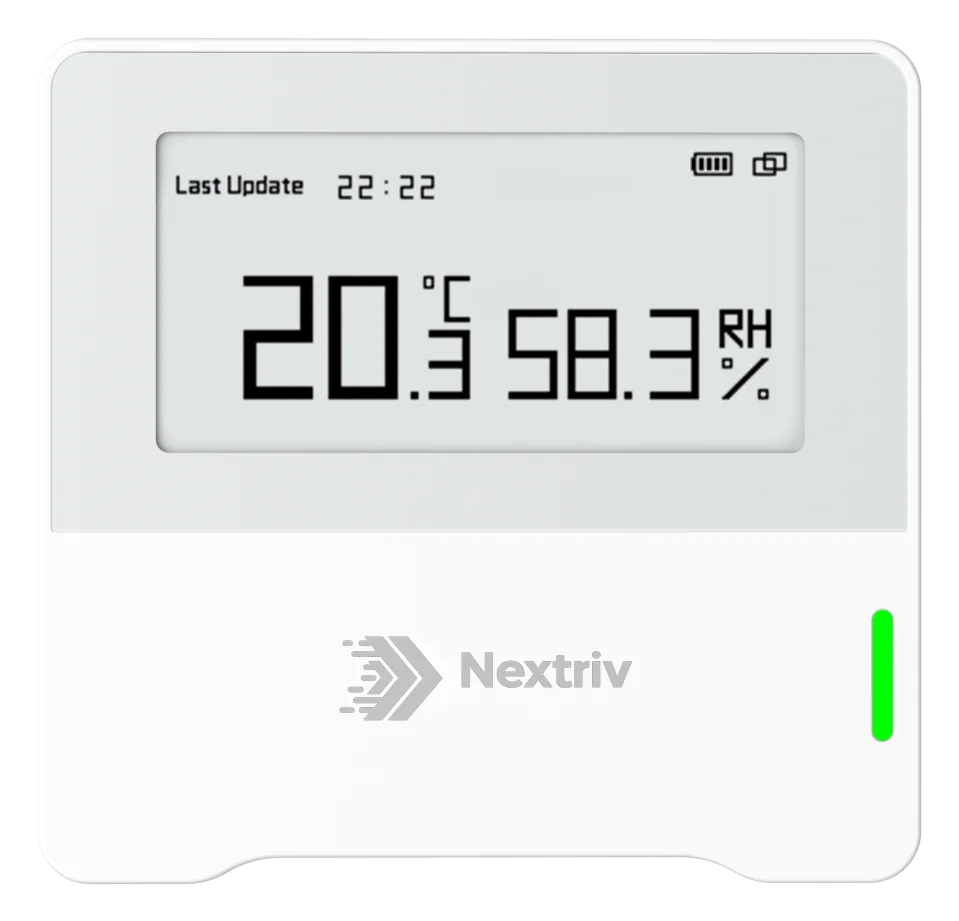
Nextriv Sense Display
SKU: NX-SN-DISP
Temperature and humidity sensor with a 2.13″ e-ink display — readings on-site and in the Nextriv platform. Over 7 years on replaceable batteries.
- Temperature
- Humidity
Nextriv Sense CO₂
SKU: NX-SN-CO2
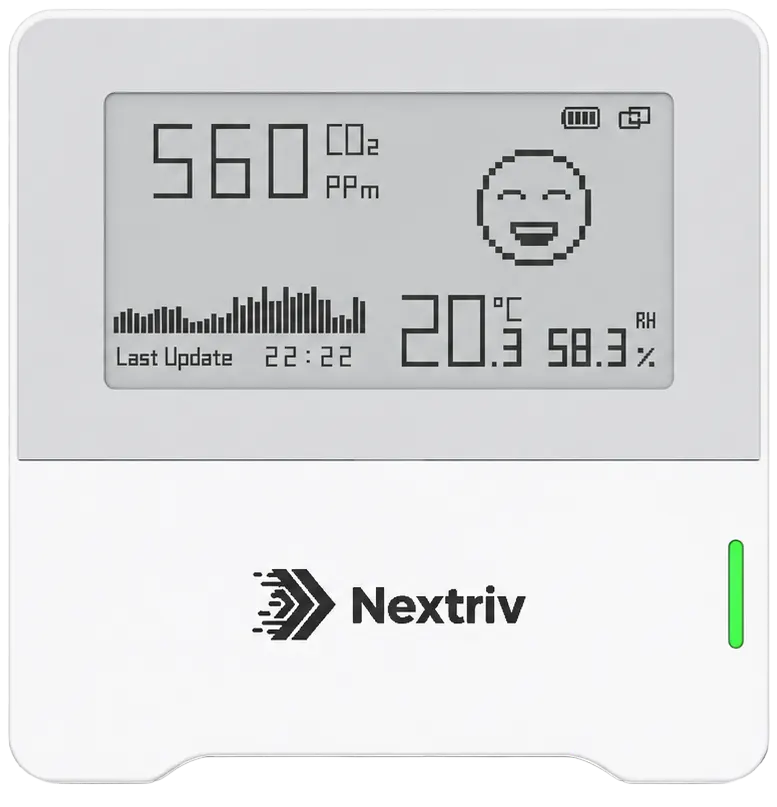
CO₂, temperature and humidity sensor with NDIR measurement and an e-ink display. Shows on the spot when to air the room — and sends the data to the Nextriv platform.
- Temperature
- Humidity
- CO₂
Nextriv Sense IAQ
SKU: NX-SN-AQ7
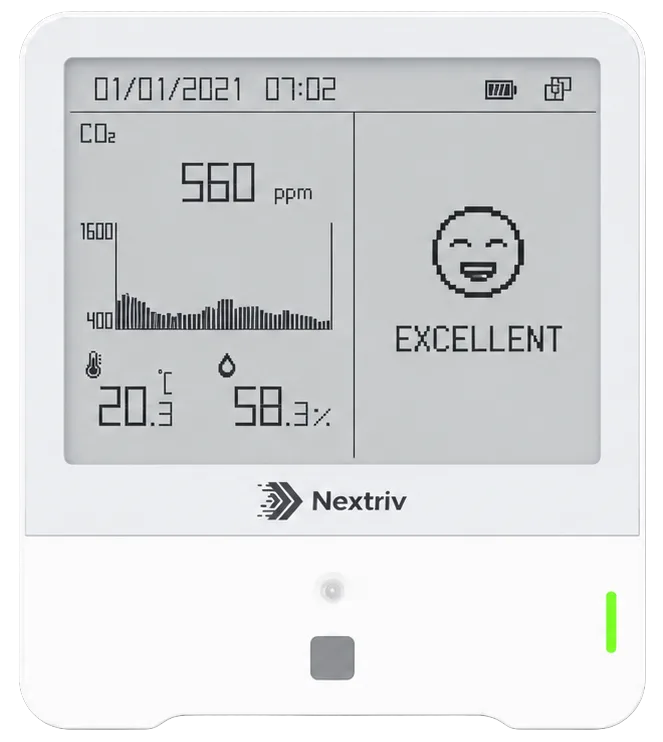
7-in-1 air quality station: temperature, humidity, CO₂, TVOC, pressure, light and occupancy — with a 4.2″ e-ink display and an 18,000-record buffer.
- Temperature
- Humidity
- CO₂
- TVOC
- +3
Nextriv Sense IAQ Pro
SKU: NX-SN-AQ9P
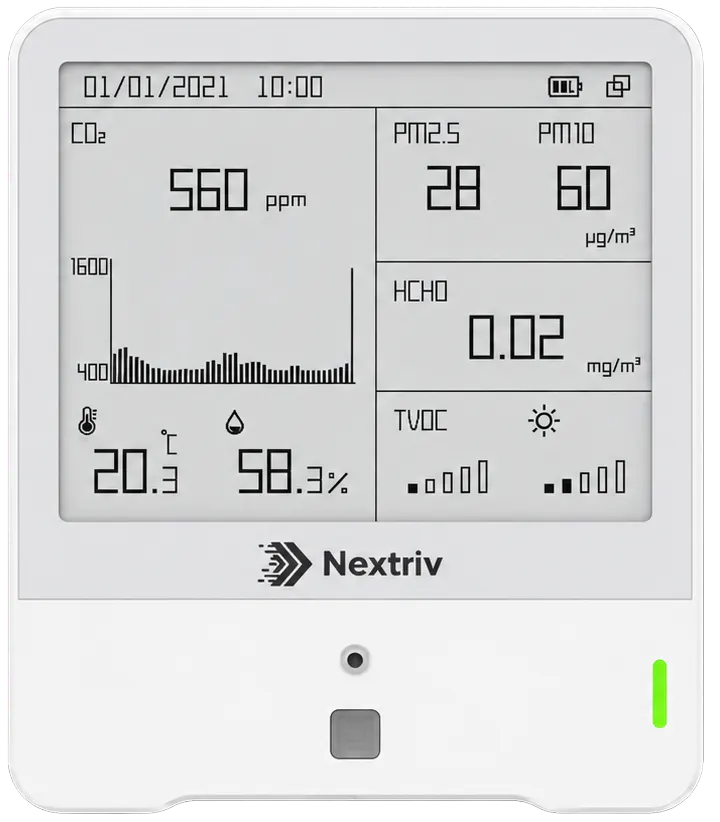
The richest 9-in-1 air quality station — choose formaldehyde (HCHO) or ozone (O₃) measurement. Always-listening radio with instant response to commands, WELL programme compliance.
- Temperature
- Humidity
- CO₂
- TVOC
- +5
Not sure which set to choose?
Tell us about your facility and we'll match sensors and a gateway to the exact rooms you need to monitor — no unnecessary hardware.