
Sense environmental sensors
Nextriv Sense Pulsepulse counter module for utility meters
SKU: NX-SN-PLS
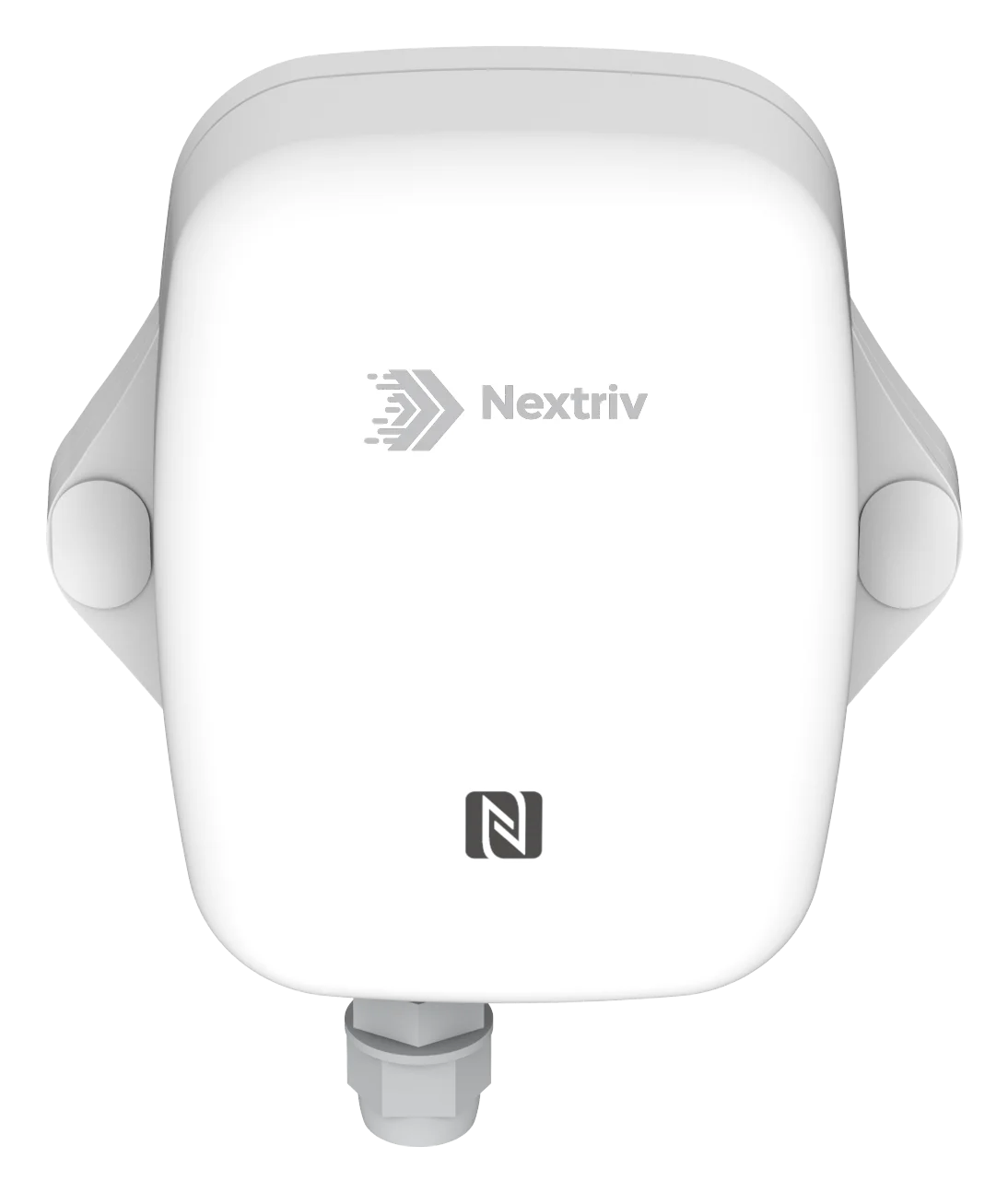
Pulse counting module — turns conventional water, gas and energy meters into remotely read meters. A retrofit with no meter replacement, rated IP67.
€105net
VAT is added to the price.

Description
- Remote reading without replacing the meter
- Noise filtering — trustworthy counting
- Continuous-flow alarm detects leaks
- Data ready for ESG and certification
- IP67 — works even down a meter pit
What it is for
Thousands of buildings and plants are fitted with perfectly good, legally verified water, gas and energy meters whose only flaw is that someone has to walk up and write down the reading. Nextriv Sense Pulse solves this without replacing the meter: it wires into the pulse output — dry contact, reed switch or open collector, which covers the vast majority of pulse-equipped meters on the market — and turns every pulse into a remote, trustworthy reading. It is retrofit in its purest form: the infrastructure stays, only the walking around with a notebook disappears.
"Trustworthy" is the key word here. The device automatically filters out interference — signals shorter than 250 µs (a configurable threshold) are rejected, so contact bounce and electrical noise in switchrooms do not inflate the counts. The counter can be managed remotely and contactlessly: counting modes (accumulate, stop, reset, refresh), initial-value correction to match the actual meter reading, instant readout of the current value — all from the app, without unscrewing anything. The local data register is tamper-proof — a reading you can build tenant billing, ESG reports and building certification processes (LEED/BREEAM) on.
Sense Pulse also thinks ahead for its user: built-in alarms detect continuous flow — the classic signature of a burst pipe or a valve left open — as well as temperature threshold exceedances. The device also measures temperature and humidity along the way, protecting a water-meter pit from freezing, for example. The IP67 housing lets you install it where meters actually live: in pits, basements, outdoors.
Long-range radio connectivity pulls data even out of underground pits to a gateway kilometres away — an advantage over short-range solutions that would require concentrators on every street. The minimum pulse width can be tuned for sensitive transmitters and electrically "noisy" installations, while an internal LED indicator and a button hidden under the housing make servicing easy without inviting anyone uninvited. For a fleet operator one more thing counts: an identical commissioning procedure in every pit — tap the phone, correct the initial reading, done.
Usage scenarios
- Municipal waterworks: modules attached to existing water meters in pits turn drive-around meter reading into automatic remote readout — without replacing a single legally verified meter.
- Office building with tenants: every unit billed on actual water consumption; the tamper-proof reading register cuts off invoicing disputes and feeds the building's ESG report.
- Manufacturing plant: a "flow continues uninterrupted after 10 p.m." alarm catches a failure or a loose valve the same night, not on next month's bill.
- Farm and irrigation: consumption counting per irrigation zone balances water field by field and flags a damaged drip line through unusual draw.
- Housing community: readings from garden and garage meters without entering private property; temperature measurement in the meter room warns of frost before a pipe bursts.
- Building certification: utility consumption data from a tamper-resistant register as evidence in a LEED/BREEAM process — the auditor gets a history, not a declaration.
Key features
- Retrofit without meter replacement: works with dry contacts, reed switches and open collectors — most pulse meters on the market.
- Noise filter: automatic rejection of signals shorter than 250 µs (configurable threshold) — counts immune to electrical noise.
- Four counter modes (accumulate / stop / reset / refresh) + remote value correction to match the actual meter reading.
- Instant on-demand readout of the current value — stocktaking of meter readings without a site visit.
- Counting up to 2000 pulses per second — enormous headroom compared with water and gas meters.
- Smart alarms: continuous flow (a leak signature) and temperature thresholds.
- Additional temperature and humidity measurement — frost protection for meter rooms as standard.
- Tamper-proof local reading register + backfill after a connectivity outage — data ready for ESG and LEED/BREEAM.
- IP67 housing in flame-retardant ABS+PC; 1 m signal cable (length configurable to order).
- Contactless NFC configuration; up to ~10 years of operation with the double-capacity battery.
In the Nextriv system
Pulses only become useful as consumption — the Nextriv platform turns counts into charts, balances and comparisons of zones or tenants on dashboards with nearly 20 widget types. Virtual sensors aggregate multiple meters into a single metric (a floor total, the whole facility), while XLSX/CSV exports and PDF reports — including schedule-generated ones — go straight into billing and ESG statements.
Alarms have four thresholds per metric, and notifications about continuous flow or frost in a pit arrive through six channels, with escalation when nobody reacts. No transmission for twice the reporting interval means an offline status — a dead metering point will not slip past anyone until the end of the billing period. Scheduled reports deliver statements in step with billing periods, external contacts let you send notifications to service companies outside your organisation, and a reading history reaching back up to 5 years covers a full certification cycle without manual archiving. An invoice dispute ends with a printed history, not an exchange of e-mails.
Typical deployments
- Commercial buildings: billing tenants on actual consumption plus data for ESG reporting and LEED/BREEAM certification.
- Manufacturing plants: utility balancing per line and hall; continuous-flow alarm outside working hours.
- Agriculture: counting irrigation-zone water meters and correlating them with weather data in one platform.
- Municipal infrastructure: meter reading in pits and hard-to-reach places — IP67 and years of battery life.
Specification
| Pulse input | dry contact, reed switch, open collector |
|---|---|
| Counting | minimum pulse width 250 µs (configurable), frequency up to 2000 Hz |
| Input cable | 1 m (configurable length) |
| Temperature | -30…70 °C, ±0.3 °C (0…70 °C) |
| Humidity | 0…100 % RH, ±3 % (10–90 % RH) |
| Connectivity | Long-range radio, -137 dBm sensitivity, range up to ~2 km in urban areas / 15 km in open terrain |
| Power | 1× replaceable Li-SOCl₂ battery, 4000 mAh (optionally 8000 mAh) |
| Battery life | approx. 5 years at a 10-minute interval (up to ~10 years with the 8000 mAh battery) |
| Ingress protection | IP67 — also suitable for meter pits and outdoor mounting |
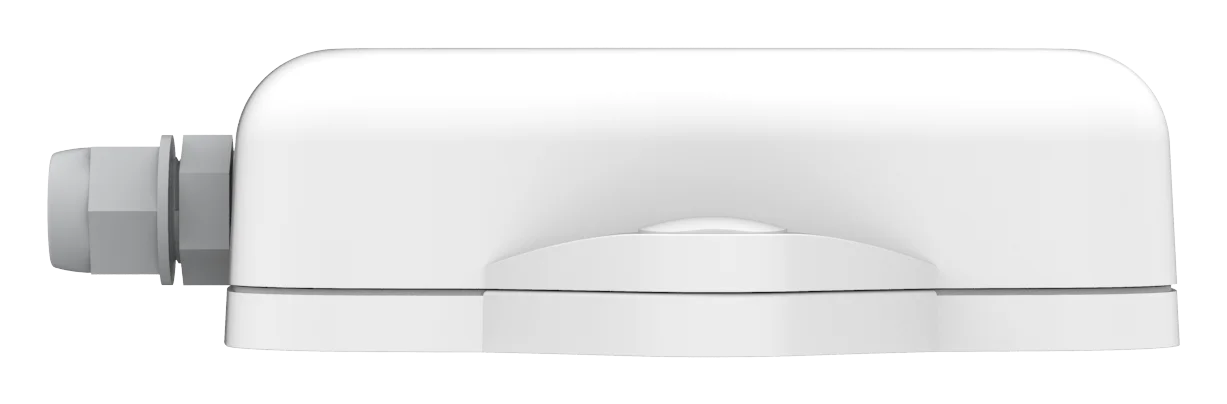
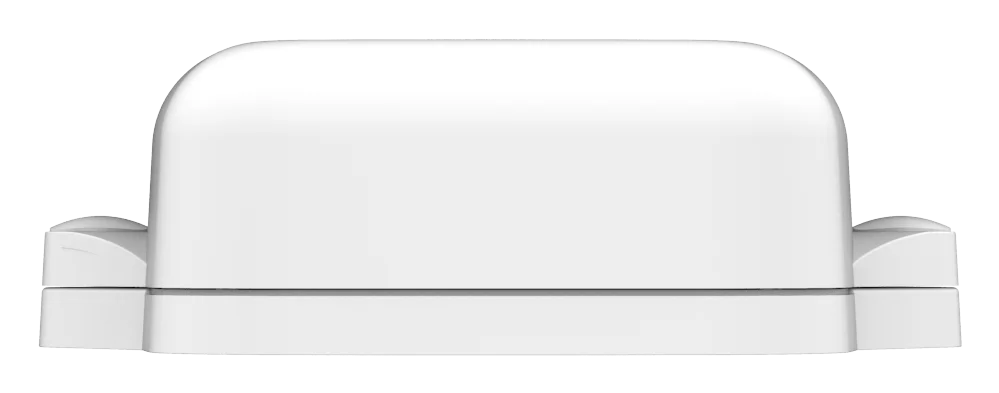
| Dimensions and weight | 105.6 × 85.2 × 27 mm, approx. 114 g (with battery and cable) |
| Operating conditions | -30…70 °C, humidity up to 95 % RH (non-condensing) |
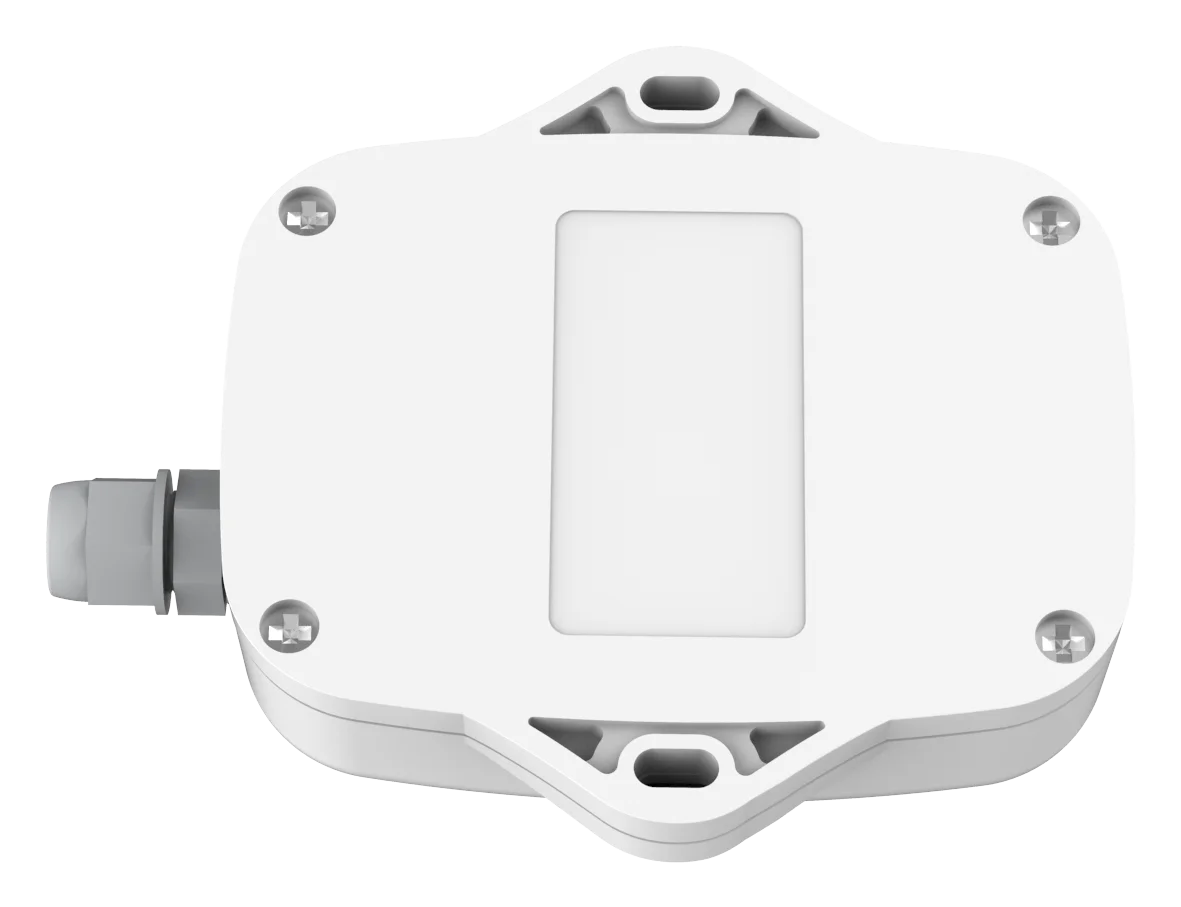
| Mounting | screws, 3M tape or cable ties |
Related products
Other devices from the same family.
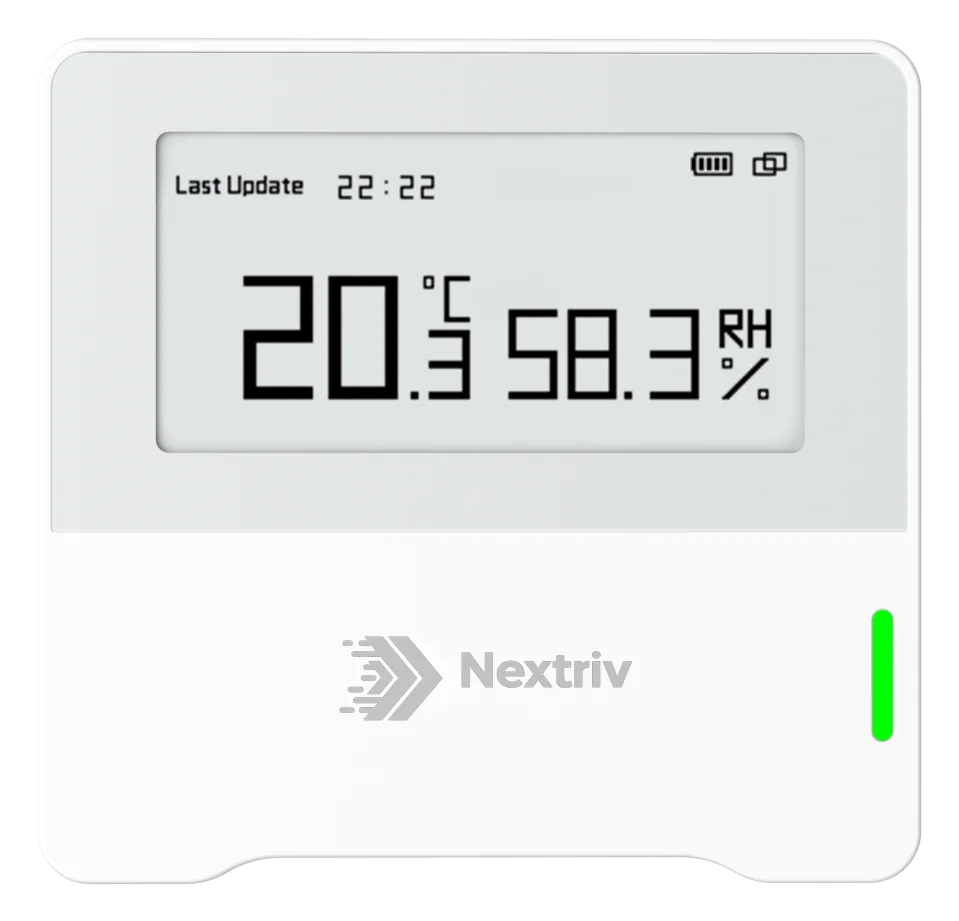
Nextriv Sense Display
SKU: NX-SN-DISP
Temperature and humidity sensor with a 2.13″ e-ink display — readings on-site and in the Nextriv platform. Over 7 years on replaceable batteries.
- Temperature
- Humidity
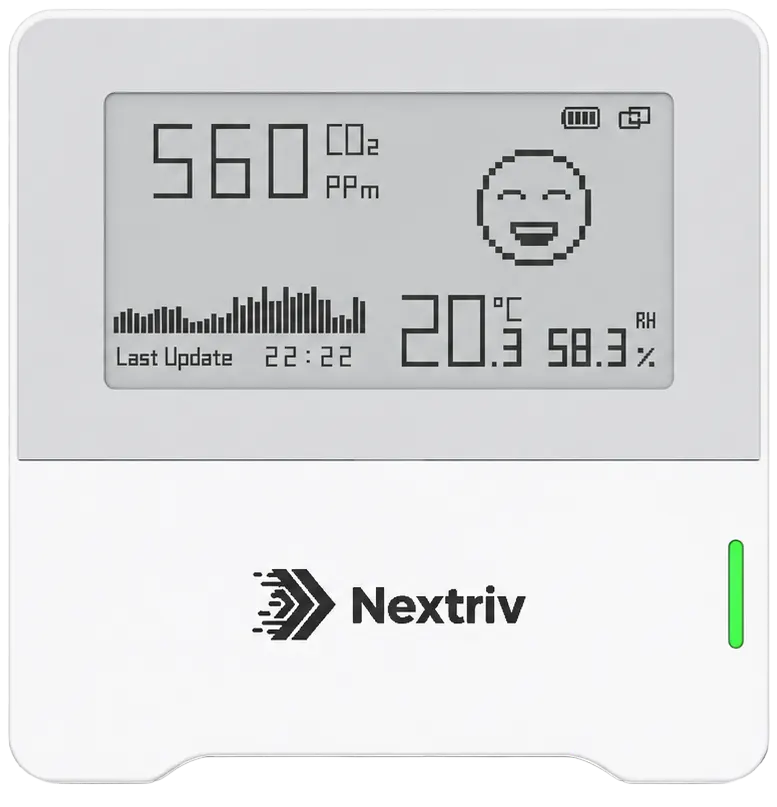
Nextriv Sense CO₂
SKU: NX-SN-CO2
CO₂, temperature and humidity sensor with NDIR measurement and an e-ink display. Shows on the spot when to air the room — and sends the data to the Nextriv platform.
- Temperature
- Humidity
- CO₂
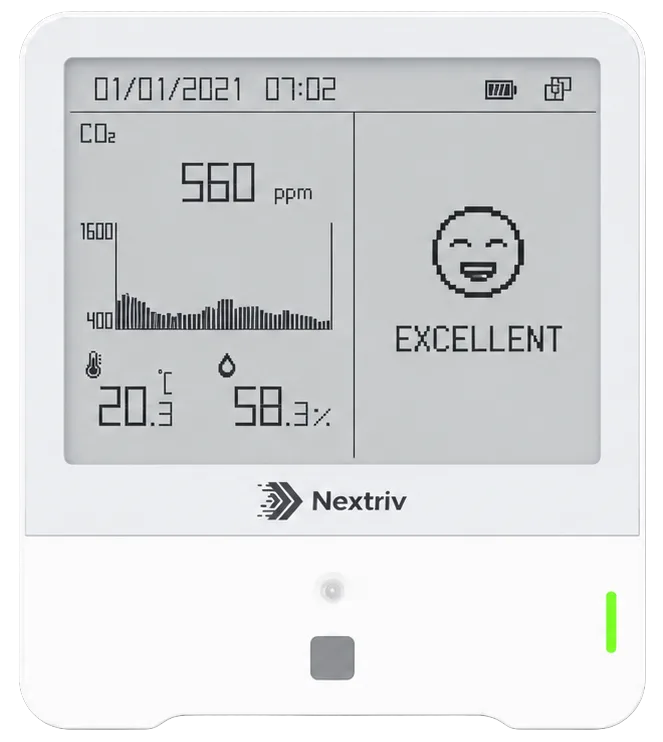
Nextriv Sense IAQ
SKU: NX-SN-AQ7
7-in-1 air quality station: temperature, humidity, CO₂, TVOC, pressure, light and occupancy — with a 4.2″ e-ink display and an 18,000-record buffer.
- Temperature
- Humidity
- CO₂
- TVOC
- +3
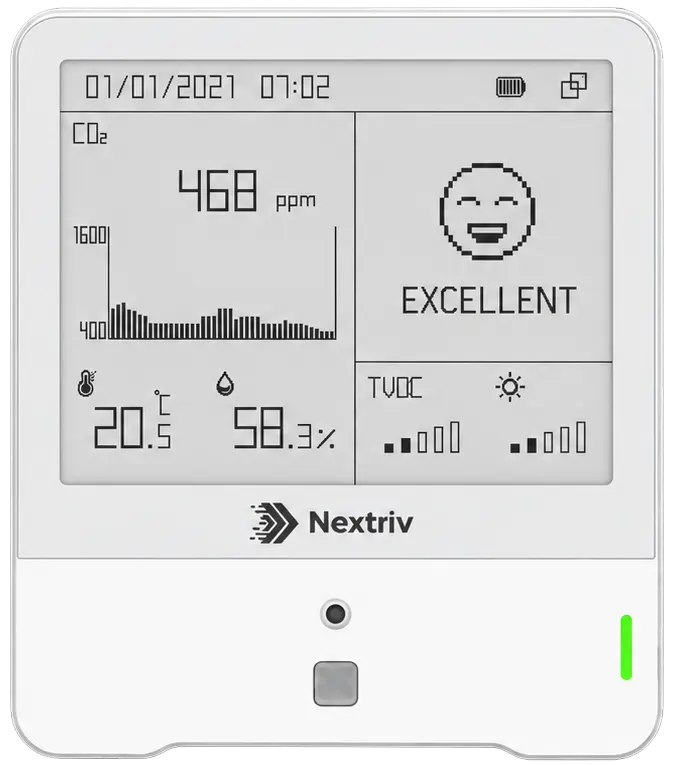
Nextriv Sense IAQ Comfort
SKU: NX-SN-AQ8C
8-in-1 climate monitoring with laser PM2.5/PM10 particulate measurement — the full picture of air health in facilities with elevated dust levels.
- Temperature
- Humidity
- CO₂
- TVOC
- +4
Not sure which set to choose?
Tell us about your facility and we'll match sensors and a gateway to the exact rooms you need to monitor — no unnecessary hardware.