
Industry solutions
Air quality monitoring for offices and buildings
CO₂, temperature, particulates and occupancy on floor plans. Hard data for ventilation decisions, lower energy bills and points towards BREEAM, LEED or WELL.

Sound familiar?
Complaints instead of data
“It's stuffy in here”, “the AC is blowing on us” — the facility manager settles disputes by gut feeling, because the building collects no comfort data at all.
Ventilation on a fixed schedule
Air handling units run at full power in empty zones and too weakly in crowded rooms. Without CO₂ and occupancy measurement you pay for air nobody breathes.
Certification without measurements
BREEAM, LEED and WELL reward indoor environmental quality monitoring — and most buildings have no IAQ data to show the assessor.
A property portfolio with no single view
Every building has a different BMS, or none. Comparing conditions across buildings and reporting to the board means stitching data together by hand.
How Nextriv solves it
IAQ in every zone
Sense IAQ Comfort measures 8 parameters: CO₂, PM2.5/PM10, TVOC, temperature, humidity, pressure, light and motion. The e-ink screen with an emoticon shows air status on the spot.
CO₂ as the ventilation thermostat
Thresholds aligned with EN 16798-1 — e.g. a warning at 1000 ppm, critical at 1400 ppm — with alerts to the technical team. Airing and DCV based on facts.
Occupancy and space utilisation
Sense Motion detects movement and light level: data on the real occupancy of rooms and zones to optimise cleaning, booking and lighting.
Sensors on the floor plan
Upload a floor layout, place markers and see values exactly where the sensors hang. Alerts can be scoped to a specific floor.
Appliance energy under control
Control Plug measures the consumption of individual devices and switches them off on a schedule after hours — “energy vampires” disappear from the bill.
Reports for managers and tenants
Recurring PDF reports (SHA-256-signed), public tiles with live readings in the lobby and XLSX/CSV exports for ESG analyses.
Recommended products
Nextriv hardware picked for this industry — up and running with the platform in minutes.
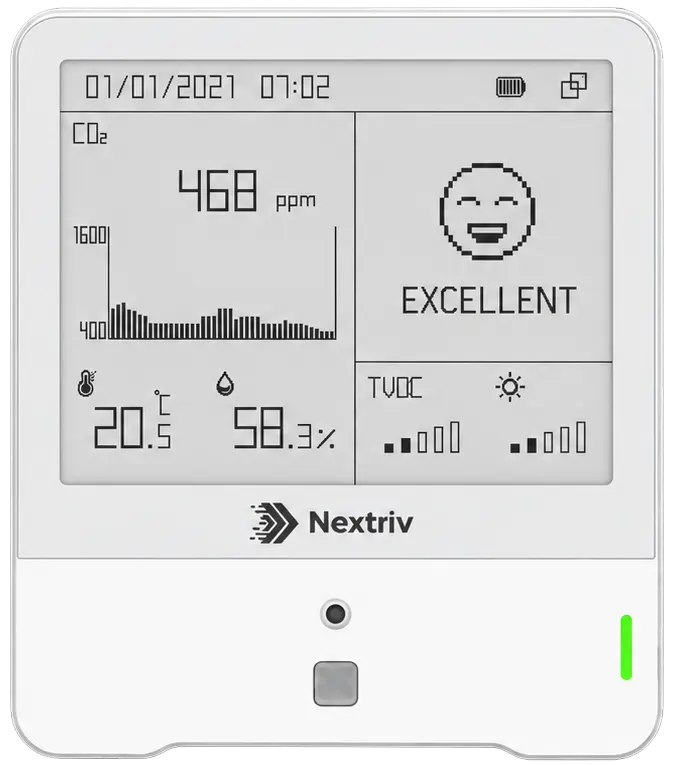
Nextriv Sense IAQ Comfort
8-in-1 with laser PM2.5/PM10 measurement — a complete picture of comfort on office floors and in common areas.
View product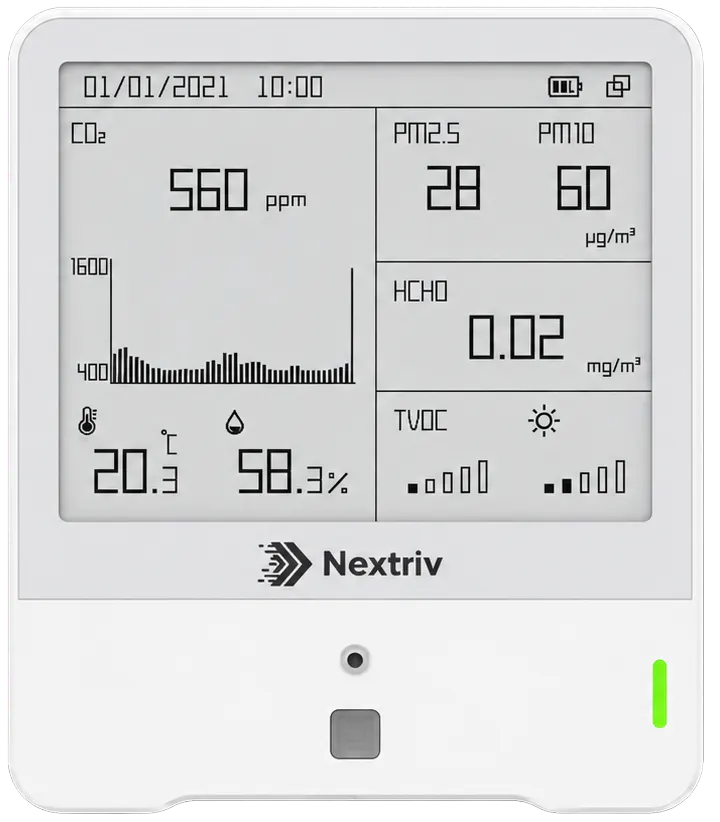
Nextriv Sense IAQ Pro
9-in-1 with formaldehyde or ozone measurement and WELL program compliance marking — for premium buildings and freshly renovated spaces.
View product
Nextriv Sense Motion
Occupancy (PIR) and light sensor — real usage of rooms and zones, the basis for lighting automation and on-demand cleaning.
View product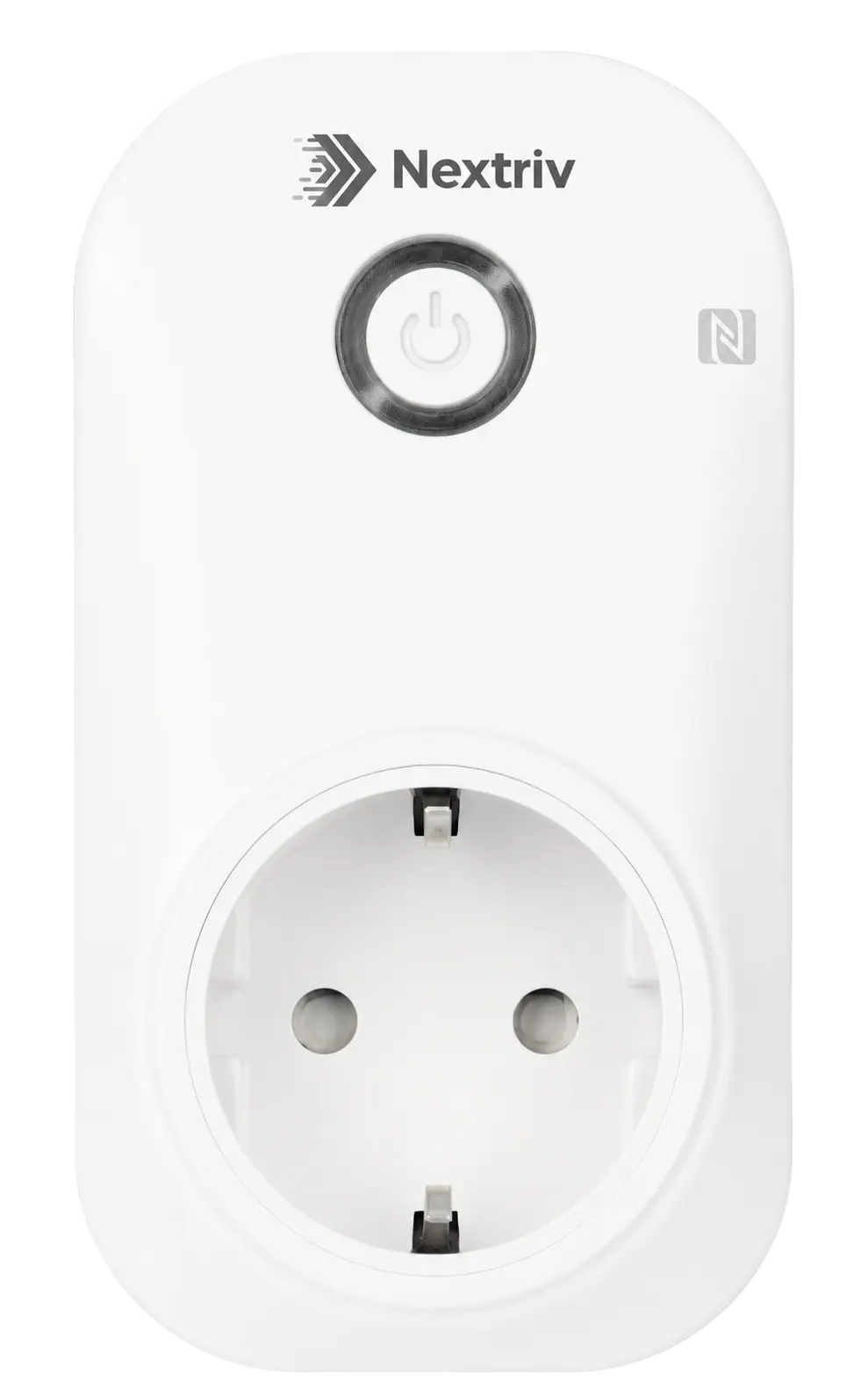
Nextriv Control Plug
Energy measurement and remote control of socket-powered devices — after-hours schedules and data for efficiency reports.
View product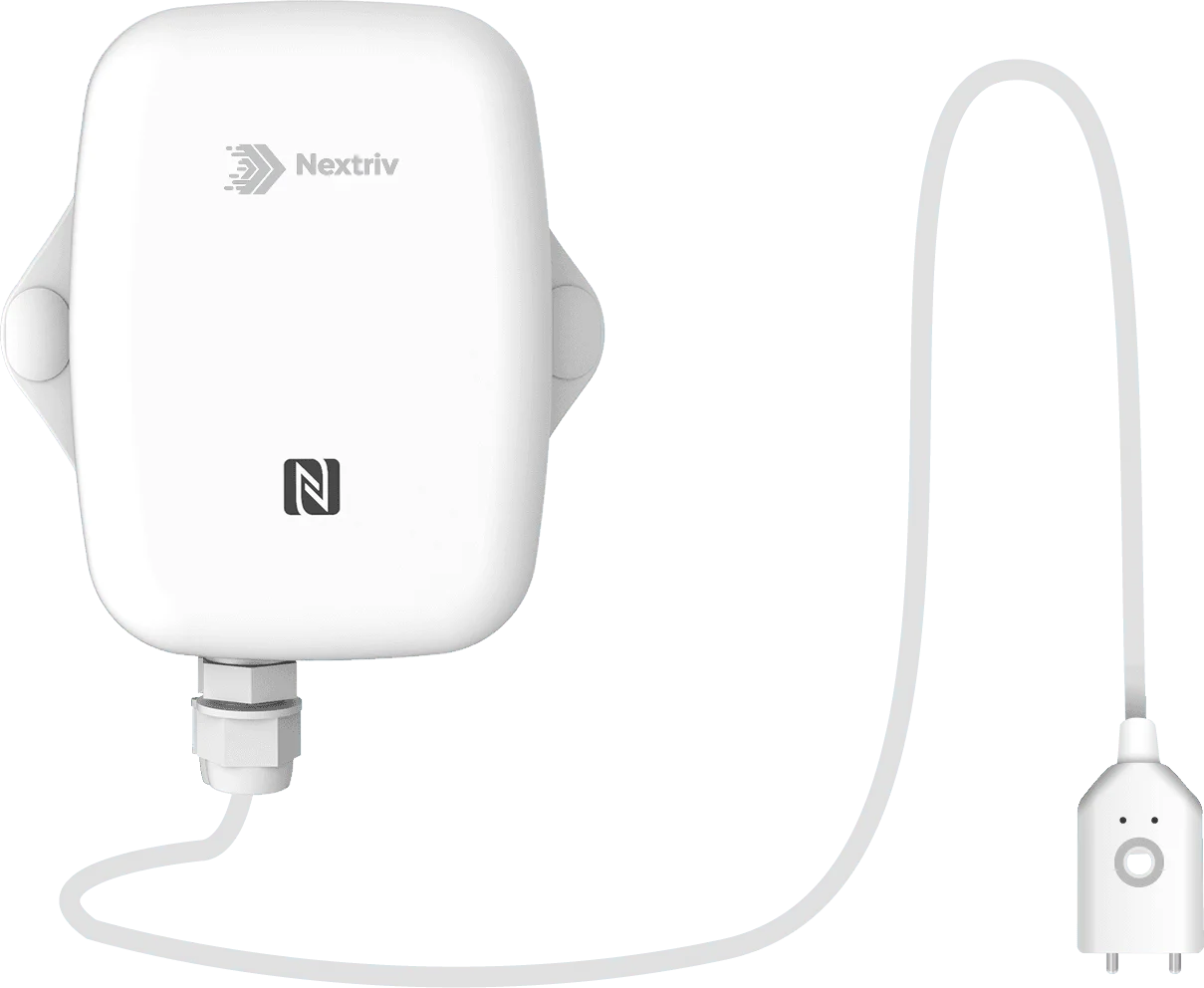
Nextriv Sense Leak Spot
Spot leak detection in plant rooms, hydraulic nodes and server rooms — reacts at ~5 mm of water while also measuring ambient temperature and humidity.
View product
Nextriv Sense Noise
Noise level measurement (dB, Leq, Lmax) in open spaces and coworking zones — data for acoustic comfort analysis and work environment assessment.
View productA stuffy conference room in the middle of the day
Alerts in Nextriv have four thresholds per metric and escalation policies. Quiet hours can be enabled for comfort alerts (e.g. CO₂) outside the building's working hours — critical alarms such as a leak or failure always get through. Once values return to normal, the system sends a recovery notification.
- If
CO₂ in the 3rd-floor conference room exceeds 1000 ppm (warning threshold) during a meeting.
- Then
The platform opens event ALM-2B9X4T and sends a web push to the facility manager; the sensor's LED changes colour, so attendees see the signal too.
- Escalation 1
Concentration rises to 1400 ppm (critical threshold) — an email and a Teams notification reach the technical team with the sensor's location on the floor plan.
- Escalation 2
No acknowledgement for 15 minutes — an SMS goes to the building manager, per the escalation policy.
Compliance and standards
EN 16798-1
The European indoor environmental quality standard defines categories based among others on CO₂ concentration. Set alert thresholds directly to your building's chosen category.
BREEAM
Indoor environmental monitoring supports credits in the Health & Wellbeing and Energy categories — with data ready to present to the assessor.
LEED
Continuous IAQ and energy measurements provide data towards Indoor Environmental Quality credits and energy use optimisation.
WELL
Sense IAQ Pro carries WELL program (IWBI) compliance marking; CO₂, PM and TVOC measurements support the Air concept requirements.
Frequently asked questions
What CO₂ level is acceptable in an office?
The reference point is around 1000 ppm (the Pettenkofer number); EN 16798-1 defines building categories relative to outdoor air. In practice: below 800 ppm is comfortable, while 1000–1400 ppm is a signal for more intensive ventilation — exactly the thresholds you can set in Nextriv in minutes.
Do I need BMS integration?
No. Nextriv works independently: long-range radio sensors, a gateway and a cloud platform. If you want to feed your BMS or other systems with data, use webhooks. No cabling needed — sensors run on batteries for years.
How many sensors per office floor?
A practical rule: one IAQ sensor per open zone of 100–200 m², plus one in each conference room — that is where CO₂ rises fastest. Occupancy sensors go in the rooms and zones you want to actively manage.
Will the data help with BREEAM, LEED or WELL certification?
Yes — continuous indoor environmental quality monitoring is scored in these schemes, and Nextriv provides measurement history, reports and exports. Keep in mind that certification is conducted by an assessor — we provide the data, not the certificate itself.
How do I show building conditions to tenants?
Through public tiles: a public view of selected sensors (e.g. on a lobby screen) available without login, with an optional 24 h chart and an expiring link. A tenant's team can also get accounts with a restricted role.
Start monitoring today
FREE plan to start: 10 sensors, 1 gateway, alerts and PDF reports — no credit card required.