
How to document conditions for your collection's insurer
Documenting conditions for a collection insurer: gap-free continuous records, signed PDF reports, a calibration register and event history, not declarations.
Zespół Nextriv4 min read

Documenting conditions for a collection's insurer has stopped being a formality settled with a declaration. Fine art policies and inter-museum loan agreements increasingly require documented environmental monitoring — and after a loss, the adjuster's first questions are precisely about conditions: what was the humidity in the store over the past quarter, when did the system flag the deviation, who responded and how quickly. A drum thermohygrograph and a notebook of readings won't carry those answers. Below we break down documentation that defends itself: what it has to contain, why a tamper-proof record matters, and how to build it without dedicating a full-time post to reporting.
What the insurer really expects
From the insurer's perspective, environmental monitoring plays two roles. Before a loss it is an argument about diligence: an institution that measures, alerts and responds is simply a smaller risk — which matters when a policy is taken out and its terms are negotiated. After a loss it becomes evidence: it allows a sudden event to be separated from neglect, demonstrates that conditions before the incident stayed within the agreed bands, and reconstructs the response minute by minute.
The same logic applies to inter-museum loans: the lending institution wants to know in what conditions its object will be displayed and stored — and expects a record covering the whole loan period, not a measurement from the day the agreement was signed.
Both roles lead to the same conclusion: the documentation has to be produced continuously and automatically. A record created by hand after the fact — or a system where the data could be quietly corrected — is worth close to nothing in a dispute.
Condition documentation the insurer will accept without argument
Five elements make up the complete set:
- A continuous history of raw measurements — with no gaps. The foundation is temperature and humidity recorded every few to a dozen-odd minutes, stored as raw measurements, not averages. Completeness matters just as much: Nextriv sensors keep a local measurement buffer and resend the backlog after a connectivity gap, and a device silent for longer than twice its reporting interval gets offline status and a notification. A gap in the record is a gap in the argument — best if it never appears at all.
- Reports whose authenticity can be verified. The platform generates PDF reports with charts and statistics for any period, also automatically on a schedule. A report can be cryptographically signed: a SHA-256 hash, a QR code and a verification address mean the document sent to the insurer a year ago can be unambiguously confirmed today — to the byte.
- A history of alarm events with the response trail. Every threshold breach gets an ALM code, a severity and the active → acknowledged → resolved statuses, with the team's comments. That is the answer to "who knew and what did they do" — with exact times, including the escalation when the first person on duty didn't acknowledge the alarm.
- A calibration register. Data is worth as much as the trust in the instrument. For each sensor the platform holds the calibration date, the next due date, the certificate and notes — and reminds you of approaching deadlines itself. "What was this measured with" is answered by the system, not a binder.
- Exports and an audit trail. XLSX/CSV exports let you hand over the data in whatever form the adjuster or surveyor asks for, and the system event log documents who operated on the data and configuration, and when.

A record that can't be "corrected"
The credibility of the documentation is decided in the technical details. In Nextriv two layers work towards it. The first is in the devices themselves: the sensors keep non-erasable local registers — the multi-parameter station stores 18,000 records that cannot be manually wiped, the compact temperature and humidity sensor nearly 2800. The second is in the platform: historical data remains raw measurements for the whole retention period (compression reduces their volume, not their content), and the history reaches back up to 5 years — the typical horizon within which disputes return and multi-year inspection cycles run. Why raw data and long retention specifically are decisive at an inspection is covered in more depth in our article on measurement data retention for audits.
After an incident: from alarm to a complete file
A real-life scenario: Saturday, a humidifier failure in the HVAC system, humidity in the print store rising. At 55% RH a warning event is created — the duty officer gets a web push and an email with the trend chart. No acknowledgement within half an hour triggers an SMS escalation to the department head. Once the situation is under control, the system records the return to the band and closes the event.
On Monday, preparing the documentation for the insurer takes minutes, not days: a PDF report for the event period with charts and a cryptographic signature, the ALM event trail with acknowledgement times, an export of the raw data from the fateful day. The package shows what the adjuster wants to see — that the deviation was detected immediately, the response came within a defined time, and conditions before the incident had stayed for months within the bands agreed with the conservator. Which temperature and humidity bands conservation practice applies to different collections is gathered in our guide to protecting works of art.
A sensor that gathers evidence
In exhibition rooms the role of evidential recorder is well served by a multi-parameter station:
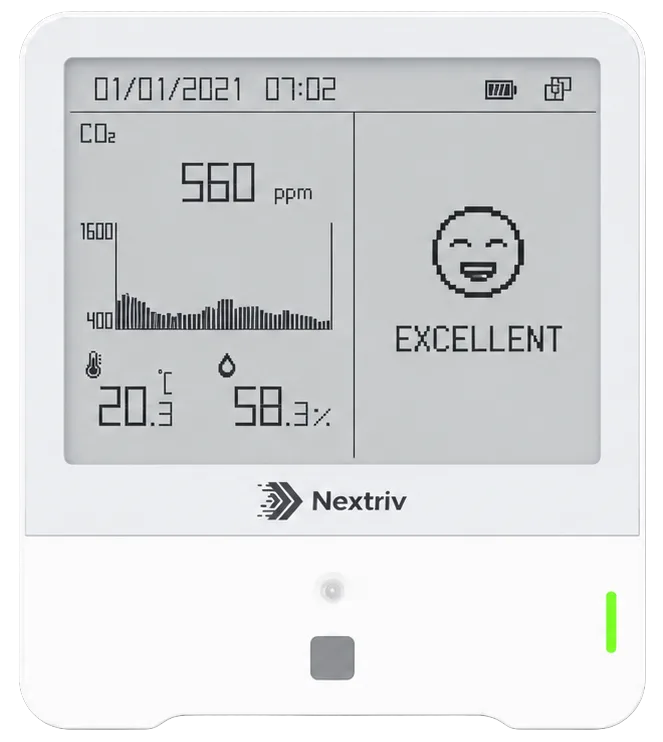
Nextriv Sense IAQ measures temperature (±0.2 °C) and humidity (±2% RH) together with CO₂, volatile organic compounds, pressure, light and occupancy — and each of the seven parameters has its own alarm thresholds and its own history in the platform. The non-erasable memory of 18,000 records with retransmission after connectivity gaps means the evidential record is created even when the network fails. A single tape-mounted point, with no cabling and no intervention in the historic fabric, documents the room's complete conditions.
From monitoring to an evidence file
If monitoring is already running, the road to insurance documentation is mostly configuration: bands and thresholds written down together with the conservator, escalations for nights and weekends, a recurring report landing in the inbox every week — before anyone asks for it. Full credibility comes with the paid plan: 5 years of raw measurement history, signed reports and an audit trail for 99 PLN net / 30 days or 990 PLN net / year; to begin with, the free plan with a year of records is enough. Compare the details in the pricing.
How condition documentation connects with the rest of collection protection — light, leaks, display case microclimate — is shown in the museums and archives solution. And if you want to see a signed report and an ALM event trail on live data, book a short demo.


