
Microclimate in museum display cases — small volumes, big swings
Display-case microclimate shifts faster than the gallery around it. How to measure inside a closed case, set thresholds and keep humidity buffers honest.
Zespół Nextriv4 min read

The microclimate of museum display cases obeys a different physics than the climate of the gallery they stand in. A few dozen or a few hundred litres of air sealed behind glass has practically no inertia: sun on the façade, exhibition lighting or the afternoon visitor peak is enough for the temperature and humidity inside to drift away from the gallery conditions faster than anyone can notice. The paradox is that the display case — bought to protect the most precious objects — is often the spot with the most poorly understood climate in the whole building. This article shows why a small volume means big swings, how to measure the inside of a case without opening it, and how to turn those measurements into thresholds that genuinely protect the exhibit.
Why a small volume means big swings
In an exhibition gallery, hundreds of cubic metres of air dampen change: it takes a long time before the whole volume heats up or dries out. Inside a case that buffer does not exist. Three mechanisms act most strongly:
- Heat from lighting and the sun. An enclosed space behind glass heats up like a miniature greenhouse. And because the water-vapour content of a sealed case is constant in the short term, every rise in temperature lowers the relative humidity at the object — and vice versa: night-time cooling raises it. The exhibit goes through a cycle the gallery never sees at all.
- Location. A case by a window, above a radiator or against an external wall lives in the microclimate of that spot, not in the "gallery climate" delivered by the HVAC plant. Two identical objects in two cases in the same gallery can have completely different conditions.
- Leakage and opening. No case is perfectly airtight, and every exhibition change or cleaning is a full air exchange — after which the interior takes hours to reach equilibrium again.

Display-case microclimate under measurement: inside, not next to
The most common mistake is drawing conclusions about the case from a sensor hanging on the gallery wall. Second in line — manual measurement: opening the case to insert a hygrometer destroys the very conditions it was meant to measure, and a reading "once per round" will not reveal the cycles playing out between rounds anyway.
The solution is a permanent measurement point inside the closed case. A data logger with a probe on a cable is well suited to this, such as Nextriv Probe Duo: a dual-parameter probe (temperature and humidity, ±0.2 °C and ±2% RH) goes discreetly into the interior or plinth of the case, while the 58 × 65 mm transmitter stays outside the display, somewhere with good radio coverage. The 1.5 m cable gives freedom of arrangement, drift below 0.03 °C per year keeps the measurement credible between calibrations, and a local buffer of 4,000 entries with retransmission closes the record even after a connectivity outage.
The full picture only emerges paired with a reference measurement in the gallery:
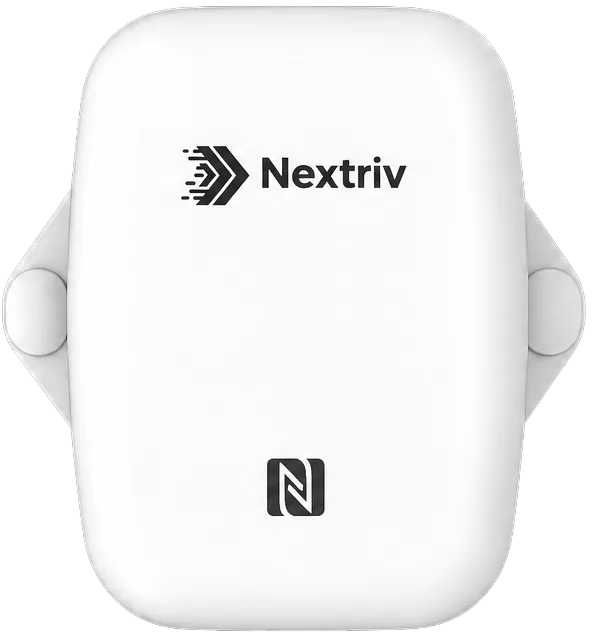
Nextriv Sense Essential as the gallery reference sensor shows whether the swings in the case are an echo of the room's climate or a problem with the case itself — and those are two entirely different fixes: in the first you talk to the technical department about HVAC, in the second you reposition the case, change the lighting or seal the construction. On a multi-series chart in the platform both curves sit side by side and the difference is visible at once.
Humidity buffers must be held to account with measurement
Cases holding sensitive objects use humidity-buffering materials, conditioned silica gel above all. It is good practice with one catch: the buffer works until its capacity is exhausted, and the moment it stops keeping up is invisible from the outside. Continuous measurement inside the case turns guesswork into a schedule — the chart shows how long the buffer actually holds the band and when it needs regenerating, instead of replacing it "just in case" or too late.
The same applies to cases with active climate stabilisation: the device may report correct operation, but only measurement independent of it proves that the object really has the declared conditions — and only that measurement will raise the alarm when the stabilisation fails quietly, over a long weekend for instance.
Thresholds for display cases: tighter bands, faster response
Since a case reacts faster than the gallery, its thresholds should be tighter. In the Nextriv platform every metric has four thresholds — two warning and two critical — set individually per sensor, so a case with miniatures on parchment can run a ±3% RH band around the target value while the gallery around it works on looser margins. Events get ALM codes and statuses active → acknowledged → resolved, notifications go out over six channels (from email and SMS to team messengers), and the escalation policy makes sure an unacknowledged alarm reaches the head of conservation. When conditions return to the band, the system sends the all-clear itself, and a notification rate limit protects the team from an avalanche of alerts from an unsettled case. The logger can also alarm on a sudden change in the reading — the typical signature of the case being opened or of a lighting failure right next to it.

A topic of its own is light: lighting inside the case not only heats its interior but also adds to the lux-hour dose falling on the object — how to measure and account for it is covered in our article on light monitoring in museums.
From one case to a map of microclimates
A pilot fits into an hour and a single decision: pick the case with the most sensitive object or the worst location (window, radiator, external wall), place the probe inside and the reference sensor in the gallery, and record for two weeks. The first overlay of the two curves almost always brings a surprise — and a concrete list of corrections, from repositioning the case to changing the lighting regime. Then further cases are added where the risk is greatest; the temperature and humidity bands for different materials are collected in our guide to protecting works of art in museum practice.
The whole picture — cases, galleries, stores, light and leaks in one system — is shown in our solution for museums and archives. The free plan with 10 sensors and a year of recorded history is enough to pilot several cases; details on the pricing page. And if you want to see the "case vs gallery" chart on live data — book a short demo.


