
Protecting works of art — temperature and humidity in museum practice
Protecting works of art starts with humidity: conservation bands, stability over averages and alerts before climate swings leave a permanent mark.
Zespół Nextriv4 min read

In this article
Protecting works of art from humidity and temperature is rarely spectacular — which is precisely why it loses so easily to more urgent topics. Fire and burglary have sirens, procedures and drills; climate fluctuations work silently, for weeks, and their effects — a cracked paint layer, a delaminated panel, rippled paper — are as irreversible as fire damage. Below we sort out what temperature and humidity really do to objects, which bands established conservation practice assumes, and how to build supervision that warns before the climate leaves a permanent mark on the collection.
Humidity destroys mechanically, temperature accelerates
Most collections are made of organic materials: wood, canvas, paper, leather, adhesives. All of them are hygroscopic — they absorb water from the air and release it again, swelling and shrinking with every change in relative humidity. An object usually forgives a single swing. The problem is cycles: repeated humidity swings work on an object's structure like a wire bent back and forth. The panel delaminates, the ground and paint layer crack, paper ripples, bindings stiffen — and none of these changes can be undone.
Temperature contributes in two ways. First, the warmer it is, the faster the ageing processes of materials run. Second — and this is what gets forgotten most often — in a room with a constant water vapour content, every change in temperature shifts the relative humidity: heating the room dries the air, cooling it raises RH, and at a cold external wall it can end in condensation. Temperature and humidity are communicating vessels — which is why museum practice always measures them together.
Protecting works of art in numbers: temperature and humidity bands
The starting point is the values assumed in established conservation practice:
| Collections | Temperature | Relative humidity |
|---|---|---|
| Paper-based (prints, watercolours, archival materials) | 14–18 °C | 30–50% RH |
| Exhibitions and mixed collections | 18–21 °C | 40–55% RH |
The target values for a specific collection are always set by a conservator — polychrome wood, textiles or photographs have requirements of their own. More important than the number itself, however, is stability: daily fluctuations within ±2 °C and ±5% RH are considered safe. A room that averages 50% RH but swings between 35 and 65% is more dangerous for a panel painting than a room holding a stable 55%. An average of two manual readings a day will not show that difference at all.

The climate escapes when nobody is watching
The most dangerous deviations share a common denominator: they happen outside walk-round hours. A humidifier failure in the HVAC system on Friday evening works on the collection all weekend. The heating season dries the galleries gradually, by a fraction of a percent a day. A crowd of visitors at an opening can raise a room's humidity by a dozen points within an hour. And collection stores — in basements, in attics, against external walls — live by their own rhythm, which two readings a day do not describe even approximately.
Continuous logging every few to a dozen minutes changes the perspective: instead of points you get the full daily curve, showing both the slow drift and every swing. The platform also watches the sensors themselves — a device that fails to report for twice its interval gets offline status and a notification, so silence is never mistaken for stability.
Conservation bands as alarm thresholds
In the Nextriv platform, the band agreed with the conservator maps directly: every metric has four thresholds — two warning and two critical, separately for the temperature and humidity of each gallery and each store. An example for a print store: 55% RH opens a warning event, 65% RH — a critical one; and likewise from below, because desiccation destroys just as effectively.
Every event gets an ALM code, moves through the statuses active → acknowledged → resolved and accepts team comments — afterwards you can see not only the deviation but also the response. Notifications go out on six channels (email, SMS, web push, Microsoft Teams, Discord, in-app sound), and escalation policies pass an unacknowledged alarm upwards: the duty officer does not respond — an SMS goes to the department head. When the conditions return to the band, the system itself sends an all-clear. This mechanism of thresholds and escalations proves itself wherever a deviation costs money — it guards chambers and loading docks in cold storage zone monitoring just the same; in a museum, instead of a batch of goods, it protects objects that cannot be bought back.

A sensor for the gallery, a sensor for the store
An exhibition gallery and a collection store are two different measurement tasks. In galleries, a multi-parameter station gives the most:
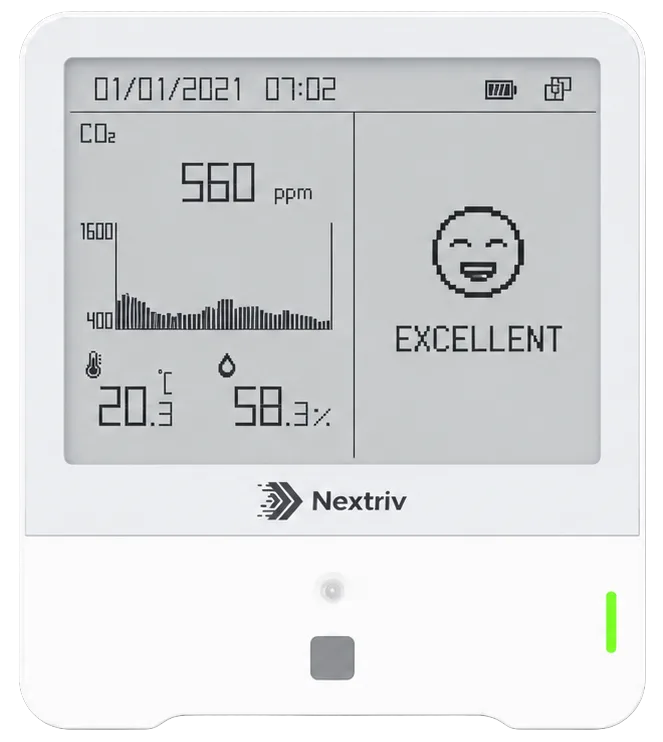
Nextriv Sense IAQ measures temperature to ±0.2 °C and humidity to ±2% RH, and alongside them CO₂, volatile organic compounds, pressure, light level and presence — one discreet mounting point gives a full picture of the gallery's climate and of the visitor traffic that disturbs it. Local memory of 18,000 records, which cannot be erased manually, also makes it an evidential logger.
In stores, basements and rooms without air conditioning, a simpler and better-sealed unit is the better fit:
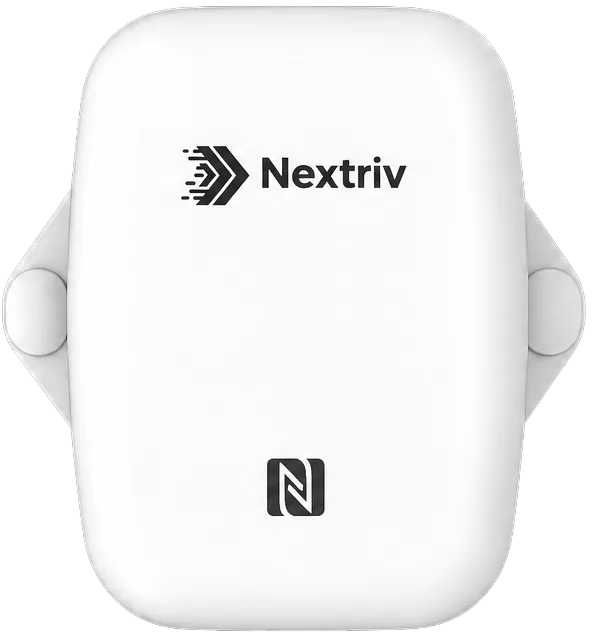
The IP67 enclosure copes with damp basements, a tamper-proof log of nearly 2800 readings with automatic retransmission closes the record even after a connectivity outage, and the battery runs for at least 5 years. Both sensors are wireless and mount with tape — no chiselling walls or interfering with historic fabric — and the long-range radio link covers the whole building with a single gateway.
From the first sensor to full supervision
A sensible start does not require a project covering the whole building: a sensor in the most exposed gallery (daylight, an external wall), a second in the store with the least stable climate, bands agreed with the conservator and two weeks of logging. The first full daily chart is usually enough to move the climate conversation from impressions to numbers. The free plan includes 10 sensors, a gateway and a full year of measurement history — and configuration via NFC from a phone takes a moment, as we showed at the platform's launch.
How temperature and humidity control combines with light measurement and leak detection into one system for cultural institutions is described in our solution for museums and archives. Plan details are in the pricing, and if you would rather see the bands and alerts on live data — book a short demo.


