
Proving Temperature SLA Compliance — Reports for Colocation Clients
Prove temperature SLA compliance to colocation clients: continuous rack-inlet measurement, gap-free history and cryptographically signed PDF reports.
Zespół Nextriv5 min read

Proof of temperature SLA compliance is needed exactly once — the day a colocation client files a claim for a damaged storage array and asks what temperature their rack saw on the third weekend of July. The contract promises a temperature and humidity range, the client pays for that promise every month, and the bill comes due a year or two later — settled down to the hour. The assurance that "everything was within spec" and a green light in the BMS won't survive the first call with the client's legal team. What does survive is continuous measurement at the racks, a history without gaps and a report that could not have been quietly touched up. Below, we take that proof apart piece by piece.
What a colocation contract actually promises
An environmental SLA usually boils down to a few numbers: rack inlet temperature within a defined band (most often around the ASHRAE recommendations, 18–27 °C), a humidity window, sometimes a maximum duration for any single excursion. The trouble starts with the question of how that promise is measured. A single sensor next to the cooling unit says nothing about the inlet of a specific rack — and the rack inlet is precisely what the contract is about. The second problem is the format of the evidence: the client won't accept a screenshot of a chart, and an auditor will ask point-blank whether the data could have been edited along the way.
From the operator's perspective, the proof therefore has to answer three questions at once: what exactly was measured and with what, whether the record is complete, and whether the final document stands on its own without anyone's word being taken for it.
Temperature SLA proof has three layers
Layer 1: measurement without gaps. Every hole in the data works against the operator — "we don't know what happened" reads, in a dispute, as "something went wrong". That's why Nextriv sensors keep a local measurement buffer and, after a connectivity outage, automatically backfill the missing readings: a brief network failure leaves no hole in the history. The platform also watches the devices themselves — a sensor that goes silent for twice its reporting interval is flagged offline and triggers a notification; a gateway, after 15 minutes of silence. Missing data becomes an alarm, not a surprise discovered while generating the report.
Layer 2: a trustworthy instrument. In a dispute over a single degree, the first question is: "when was this sensor calibrated?". The platform keeps a calibration register — the date of the last calibration, the next due date, the certificate and notes, with reminders as deadlines approach. The answer lives in the system, right next to the data it concerns — not in a binder nobody can find.
Layer 3: a document that can't be challenged. A chart in the app convinces the team, but what convinces the client and their lawyer is a signed document — more on that below.

A report you never have to defend
PDF reports in Nextriv go beyond a summary and charts. You get statistics and percentiles — the 99th percentile of temperature says more about SLA compliance than any average — plus threshold compliance sections, including thresholds set precisely to the window in a specific client's contract. The most important element is the cryptographic signature: the report receives a SHA-256 checksum, a QR code and a verification URL, so the recipient can confirm for themselves that the file hasn't been altered since it was generated. That flips the dynamic of the conversation — instead of defending the credibility of a PDF, you point to the verification link.
A daily or weekly schedule sends reports automatically, so the documentation for each billing period is produced without human involvement — including the week when everyone was busy fighting other fires. And when a client wants to run their own numbers, XLSX and CSV exports hand them the raw data for their own analysis.

Events: a chronicle of every excursion
The report closes the period, but a dispute usually concerns specific hours — and that's where alarm events do the work. Four thresholds per metric (warning and critical, on both sides of the range) turn every departure from the band into an event with a code, a severity level and a full lifecycle: active, acknowledged, resolved, with operator comments. Two years later you don't have to reconstruct the night of the incident from the on-call team's memory — you have a record of who responded, when, and what they did. When the reading returns to the band, a back-to-normal notification closes the episode on the communication side as well: you know immediately how long the excursion lasted, because it's the duration — not the mere fact of leaving the range — that usually decides the contractual penalty. Escalation policies add a process guarantee: an unacknowledged alarm moves up a level, and the audit trail, retained for 5 years, also shows who changed the thresholds themselves and when. If the contract requires that the client be informed directly, their address goes into a recipient group as an external contact — they hear about the event from the system, within a minute, not from an email written after the fact. The same evidentiary logic — thresholds, events, audit-ready documentation — applies in the cold chain too; we walked through it step by step in our article on cold storage zone monitoring.
Let the client see for themselves
The best cure for "what's the temperature in the DC right now?" emails is to give the client their own window onto their racks. Nextriv's public widget shares selected sensors and metrics under a tokenized link with no login — read-only, with an optional chart of the last 24 hours, a link expiry date and a view counter. The client sees the conditions of their colocation in real time, and the operator doesn't open the door to the rest of the system. Day-to-day transparency noticeably lowers the temperature of the conversation when something genuinely goes wrong.
Evidence-grade measurement
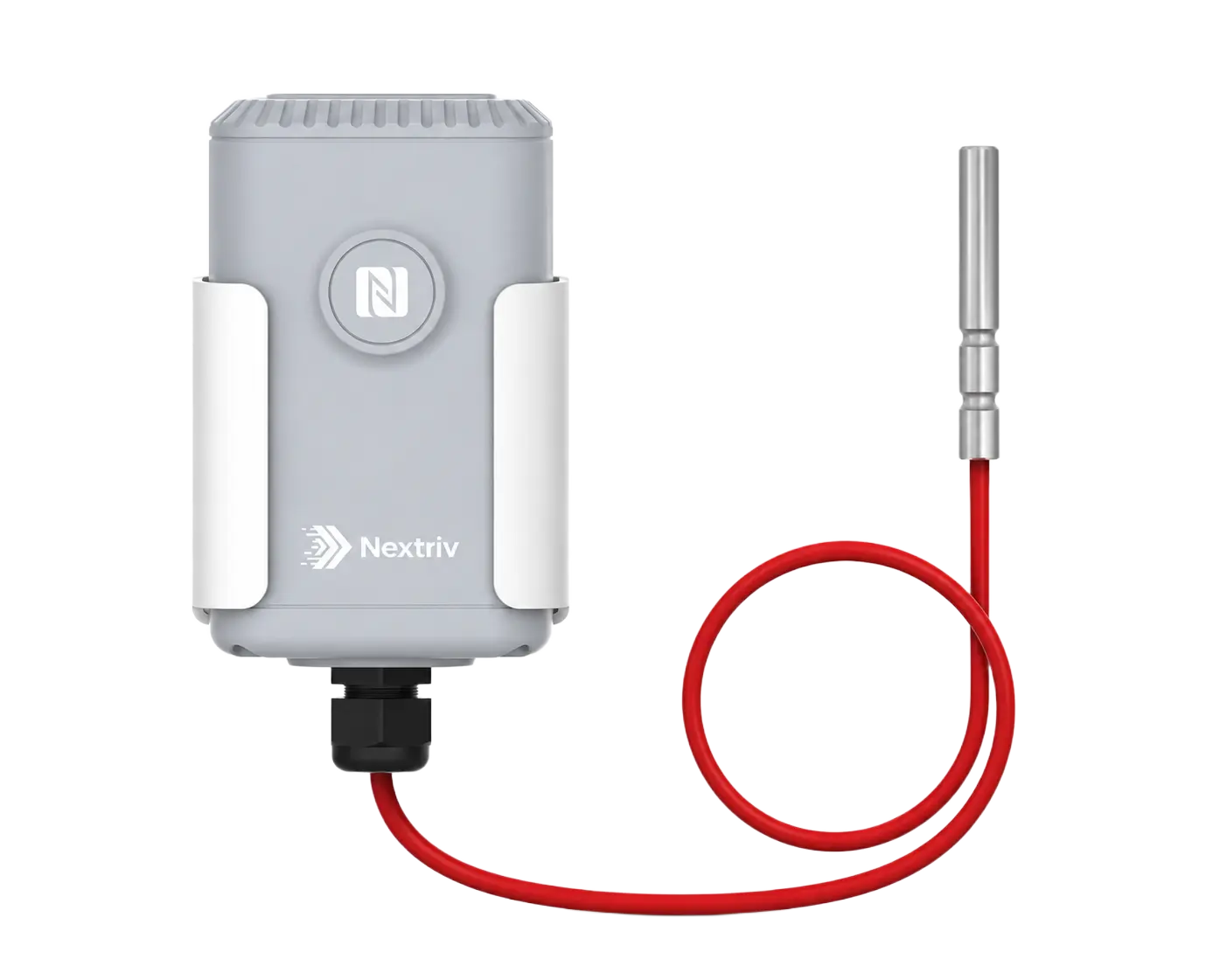
Where an SLA is settled to a tenth of a degree, the instrument itself matters. The industrial Nextriv Probe PT100 measures with ±0.5 °C accuracy at 0.1 °C resolution, and its platinum sensing element in a 3-wire configuration eliminates lead resistance error. A local buffer of around 1,000 measurements with automatic retransmission patches connectivity gaps, the battery lasts up to 10 years, and data travels over long-range radio — up to about 2 km in built-up areas and about 15 km in open terrain — so a single gateway covers the entire facility without pulling cabling across the data hall.
From the first sensor to the first signed report
A practical rollout order: a sensor at the inlet of every rack covered by the contract (or at least at representative points along the rows), thresholds copied straight from the SLA, a report schedule aligned with the billing period. The free plan — 10 sensors, a gateway and 365 days of raw history — is enough to document the first racks and test the entire workflow. Full 1,825 days of history, signed scheduled reports and the audit trail come with the paid plan: 99 PLN net per 30 days or 990 PLN net per year (excl. VAT).
How SLA evidence fits into the rest of server room oversight — hot spots, leaks, power — is covered in our data center solution. Plan details are in the pricing section, and we'll generate a signed report live during a demo.


