
Early water leak detection in collection storerooms
Water leak detection for museums and archives: spot and zone sensors, a risk map of collection storerooms, and alarms that do not wait until morning.
Zespół Nextriv4 min read

Early water leak detection in a museum or archive is a discipline where one thing counts: the time between the first drop and the first notification. A burst water riser or a leaking roof above the collection storeroom is a scenario usually discovered the next morning — when nothing is left to do but the loss report. And water's exceptionally bad reputation in cultural institutions is no accident: paper, textiles and photographs respond to flooding quickly and often irreversibly. This article shows how to build detection that alarms at the first drops: where to place the sensors, when to choose a spot probe and when a sensing cable, and how to set the notifications so they also work at 3:14 in the morning.
Water will find the most valuable shelf
Water risk in museum and archive buildings rarely comes from floods — more often from the building itself. Plumbing risers and stubs run through the walls adjoining the storerooms, the air-conditioning systems have drip trays, roofs and skylights age, and collection storerooms often end up in basements, at the lowest point of the entire building — where water drains first.
The worst trait of these failures is their timing: they play out at night, on weekends and holidays, when nobody is in the building. Without automatic detection the response time is measured in hours — and it is precisely the first hours that decide the scale of the losses, as the water spreads across the floor and wicks up into the lowest shelves of the racking.
Water leak detection in a museum: at a point or along a line?
Leak detection is built from two kinds of sensors — and usually from both at once.
A spot probe watches a specific, known risk point. Nextriv Sense Leak Spot has a stainless steel head on a 1.5 m cable and reacts at about 5 mm of liquid already — the alarm arrives with the first drops, before moisture has time to do any harm. The head goes exactly where water will appear first: into the air-conditioner drip tray, under a valve, by a plumbing stub.
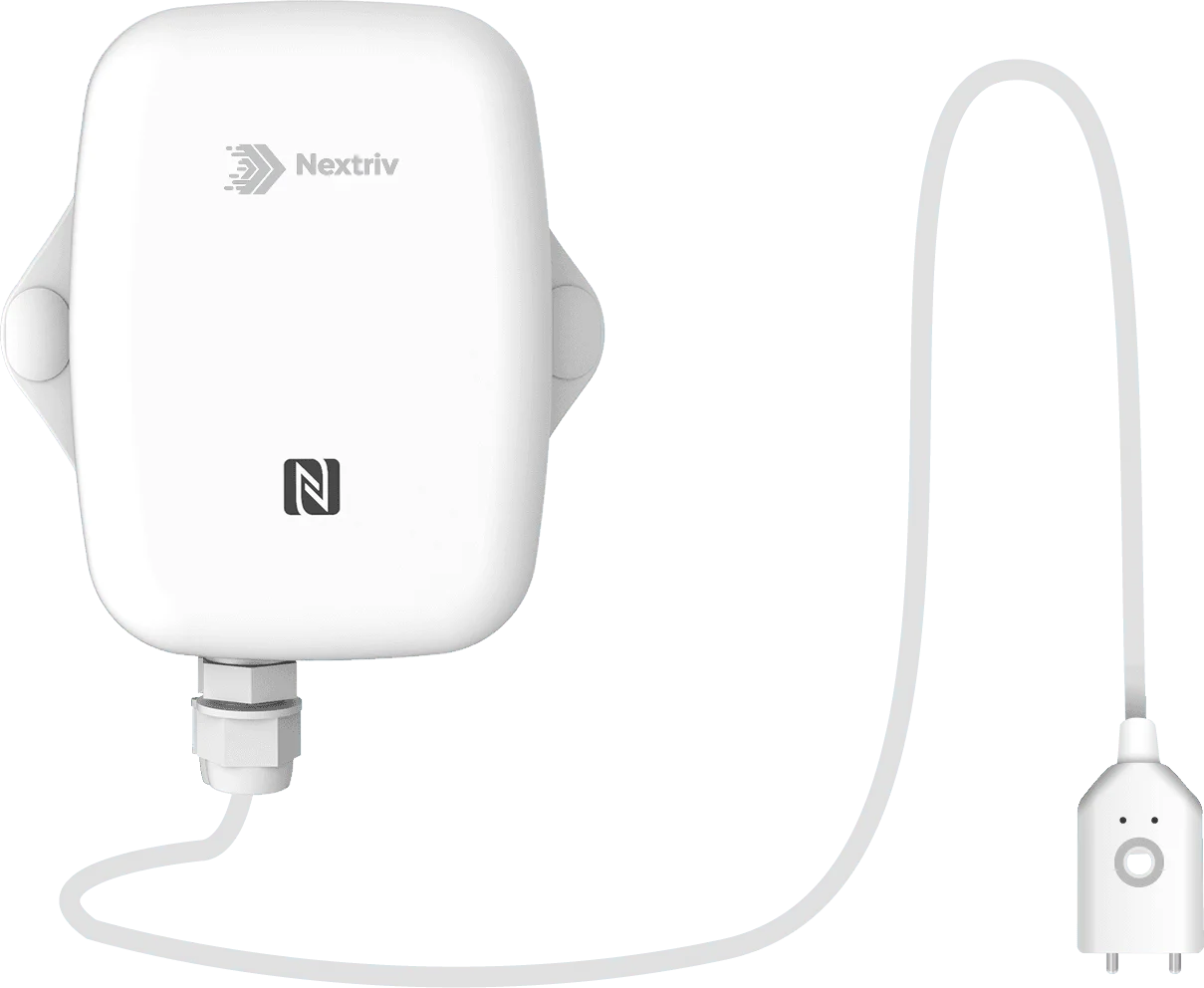
A sensing cable protects a whole zone. In Nextriv Sense Leak Zone, liquid at any point along the cable's entire length triggers the alarm — the standard run is 3 m, with longer ones available to order for specific routes. The cable is laid along the wall carrying the water risers, around the storeroom perimeter or along a pipe route — perimeter protection wherever a single probe is not enough.

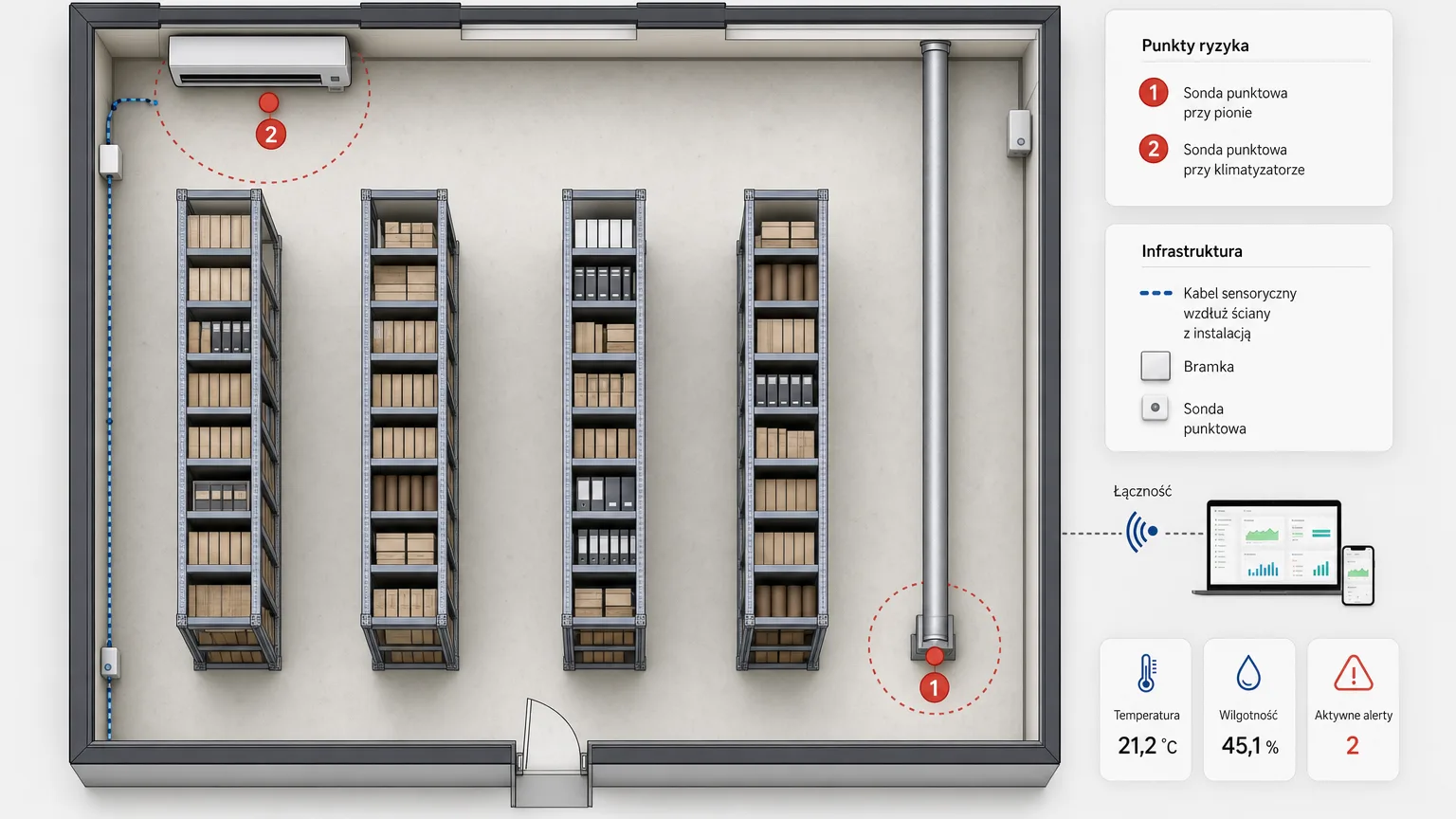
Where to install: the storeroom risk map
A good deployment starts with a walkthrough, a building plan and one question: which way can water reach the collections? A typical list of points:
- Water risers and stubs in the storeroom walls and in adjacent rooms — a spot probe at the base of the riser.
- Air-conditioning drip trays serving the storerooms and galleries — the first drops from an overflowing tray mean an immediate alarm.
- Technical rooms: heat substations, pumps, boiler rooms — failures show up here earliest.
- Basements and the lowest storeys holding storerooms — a sensing cable around the room perimeter will catch water no matter which direction it comes from.
- Zones under the roof and skylights — a leak from above appears at a point but travels across the slabs; it pays to watch the spots that have historically leaked before.
An alarm at 3:14, not over morning coffee
The sensor is only half the system — the other half is a notification path that does not let go:
- The head detects liquid — the platform opens an event with an ALM code and immediately sends a web push and an email to the staff member on duty.
- No acknowledgement within the set time — an SMS goes to the administrative manager under the "if unacknowledged" escalation policy.
- The next escalation step can notify a group of recipients and an external plumbing service — including contacts from outside the system.
- The full course of the event — times, readings, acknowledgements, comments — stays in the history: ready material for the insurer.
Six notification channels are available: email, SMS, web push, Discord, Microsoft Teams and an audible alarm in the app. And because devices in the Nextriv network can communicate directly with one another, a leak sensor can trigger a response on the spot — closing a valve via an actuator in the network, for example — without the server's involvement and without waiting for a human.
Two measurements thrown in: temperature and humidity
Both leak sensors additionally measure the ambient temperature and humidity — in collection storerooms that is the second pillar of protection beside water detection. One installation thus yields three measurements: a leak alarm, humidity supervision (creeping damp can herald a problem long before any puddle) and temperature control of the storeroom.
On the technical side, both designs are built for years of unattended operation: an IP67 enclosure, a battery typically lasting up to around 5 years, a local buffer of around 2,800 records with retransmission after a connectivity gap, and configuration via NFC. Long-range radio coverage spans the whole building — basements included — usually from a single gateway.
Deployment in five steps
- Walk the building with a plan and mark every way water can reach the collections — from the roof to the basement.
- Cover the points and zones: known risk points with spot probes, room perimeters and service routes with sensing cable.
- Set the escalation path: who gets the alarm first, who after no acknowledgement, who from outside (service company, building administrator).
- Add humidity thresholds in the storerooms — an early warning of creeping damp, before any puddle appears.
- After a month, review the event history and adjust the sensor placement wherever alarms keep recurring.
Leak detection works best as part of broader supervision — together with climate stabilisation and light control, which we describe on the museum and archive monitoring page. The free plan includes 10 sensors and 5 alert rules — enough for a pilot covering the riskiest points; details in the pricing. And if you would rather see a leak alarm and the escalation live, book a short demo.


