
Frost warning for orchards — sensors and automatic alerts for fruit growers
Frost warning for orchards: an on-site weather station, sensors at crop level and automatic SMS alerts with escalation — before frost takes the bloom.
Zespół Nextriv4 min read

For a fruit grower, frost warning is the difference between a normal season and a loss there is no way to make up. One night below zero in a blooming orchard or in a tunnel full of seedlings can wipe out a year's work — and radiation frost arrives quietly, in the small hours, while everyone is asleep. The good news: the phenomenon is remarkably predictable, provided you measure temperature where the plants grow rather than 30 km away. This article shows how to build your own warning system: from sensors, through thresholds, to an alarm that actually wakes someone up.
Why a regional forecast won't protect your block
The most dangerous spring frosts are radiation frosts: a cloudless, windless night during which the ground radiates its heat straight into the sky. They have three traits that make a regional forecast fail:
- The minimum arrives just before dawn — the temperature falls all night and bottoms out at the least watchful moment of the day.
- It is colder at ground level than at standard measurement height — on a radiation night, the temperature at bud and seedling level can be markedly lower than what the regional forecast reports.
- Cold air drains into low ground — the lower parts of an orchard, hollows and basins form local frost pockets. Within the same block, the upper rows can come through the night unscathed while the lower ones freeze.
The conclusion is simple: the forecast tells you the night will be dangerous. Whether your orchard is turning critical right now — only measurements from your own orchard can tell you that.
Frost warning in practice: two layers of measurement
A proven setup consists of two layers that complement each other.
Layer 1: your own weather station. It provides context — it shows the conditions lining up into a frost scenario: temperature falling, wind dying down, sky clearing. It also measures what a single sensor cannot see: wind and precipitation, both relevant when planning protection.

Nextriv Weather Pro measures six parameters: temperature (±0.3 °C), humidity, wind speed and direction (ultrasonic, with no moving parts), barometric pressure and rainfall at 0.01 mm resolution. The station runs autonomously on a solar panel with a battery buffer — at least a week without sun — so it goes up on a mast in the middle of the orchard, with no power connection.
Layer 2: temperature sensors at the crop. These measure what is really happening at bud and seedling level — separately in each block, with particular attention to frost pockets: hollows and the lower parts of the orchard.
Nextriv Sense Industrial operates from −30 to 70 °C and measures to ±0.3 °C above zero — precisely where the alarm thresholds sit and the fate of the bloom is decided; below zero it holds ±0.6 °C, enough to faithfully record the course of a freezing night. The sealed IP67 enclosure shrugs off rain, dew and spraying, the magnetic version holds onto metal structures without drilling, and replaceable batteries last for years of measurement. A local buffer of 3000 records resends data after any connectivity gap, so the night's record has no holes.
Both layers connect to the platform over long-range radio — up to approx. 15 km in open terrain — so a single gateway in the farm building serves the station on its mast and the sensors scattered across the blocks.
Thresholds and escalation: an alarm that wakes you up
The heart of the system is the thresholds and the notification path. In Nextriv every metric takes up to four thresholds; for temperature at the crop, a two-stage setup works well:
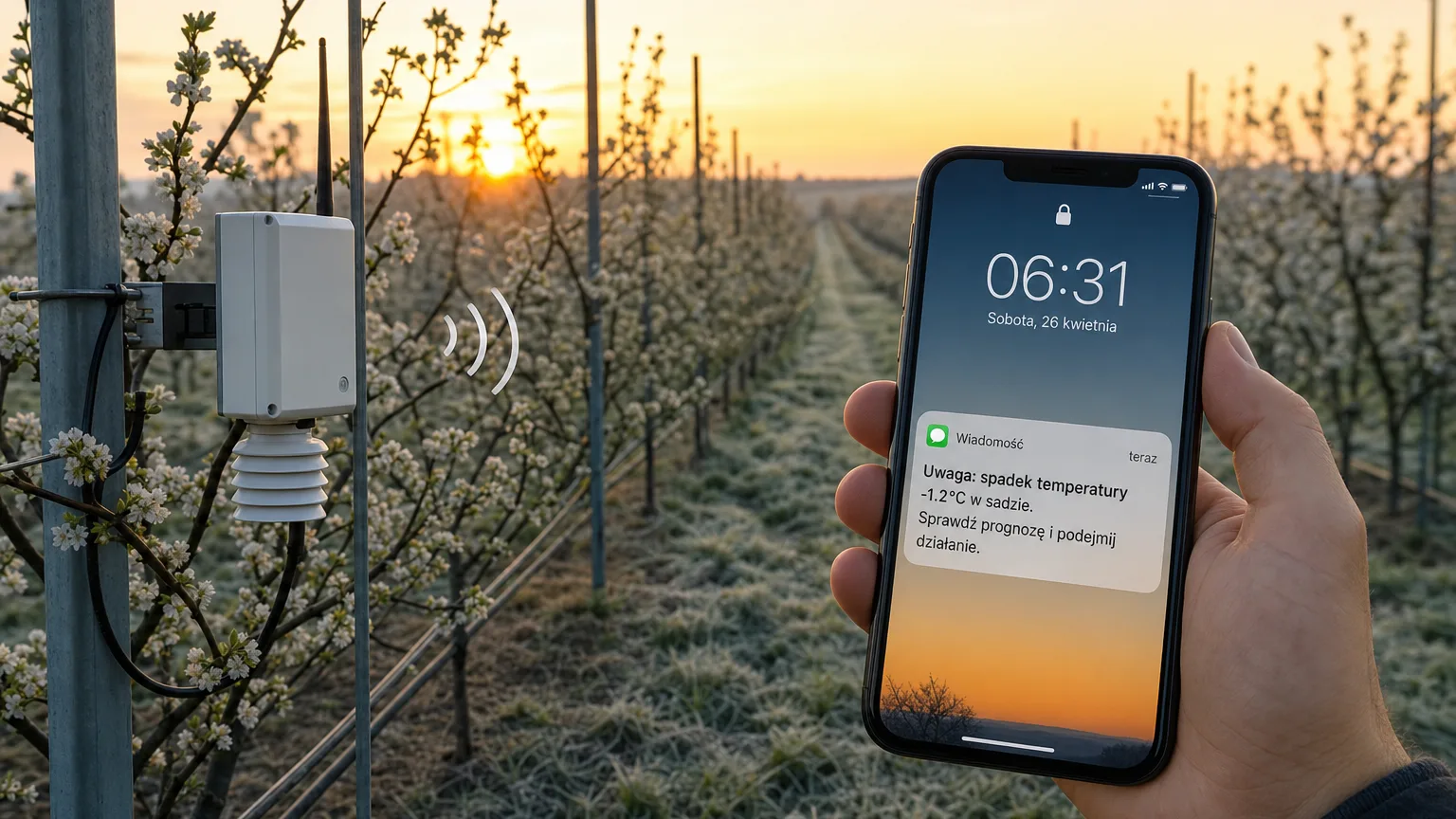
- +2 °C — warning threshold. The temperature at the crop enters the risk zone. The platform opens an event with an ALM code and sends an SMS and web push to the person on duty — with a chart of the rate of decline that shows whether the night is heading for zero.
- No acknowledgement within 10 minutes — the escalation policy passes the alert on (the "if unacknowledged" condition): SMS and email to a second person. An alarm nobody answered is no different from no alarm at all.
- 0 °C — critical threshold. The event escalates to critical level: an in-app siren and an SMS to the farm owner. This is the moment to start protection — sprinklers, candles, fans — according to the site's procedure.
- Once the threat passes, the platform sends a recovery notification on its own, and the whole event — timestamps and acknowledgements included — stays in the history.
Six channels are available: email, SMS, web push, Microsoft Teams, Discord and an audible in-app alarm. One practical note: quiet hours, which silence night-time notifications, are great for most rules — but not for frost rules. This one alert is supposed to wake you.
After the night: data that pays off in seasons to come
A warning system earns its keep on the night of a frost, but the data works far longer. A full measurement history spanning several seasons shows which blocks really are the coldest and by how much — meaning where more sensors belong, where protection has to start earlier, and which spots are better not planted with sensitive varieties. Charts and PDF reports from a specific night document how the event unfolded: when the temperature crossed the threshold, who acknowledged the alarm and how long the threat lasted, while XLSX or CSV export hands over the source data for your own analysis.
The system also keeps an eye on itself: if a sensor goes silent, the platform marks it offline after twice its reporting interval — and a gateway after 15 minutes of silence — and sends a notification about it. So you learn about a dead measurement point straight away, not on the night it was needed most.
The full frost scenario — from warning threshold to escalation — along with the rest of the puzzle for a farm (soil moisture, climate under cover, tank levels) is described on the solution page for agriculture and greenhouses.
Install before the season, not after the damage
Deployment needs no integrator: a gateway, a station on a mast, sensors at the crop — the platform discovers new devices automatically within 30–180 seconds of power-up, and thresholds take a few minutes to set. The FREE plan covers 10 sensors and a year of measurement history, so protecting one or two key blocks comes with no subscription at all.
Check the details in the pricing or book a short demo — we will walk through a frost alert from the temperature drop to the SMS escalation, on live data.


