
ASHRAE guidelines for data centers — temperature ranges in practice
ASHRAE data center guidelines in practice: recommended 18–27 °C at equipment inlets, classes A1–A4, humidity and dew point — and the resulting alert thresholds.
Zespół Nextriv4 min read

In this article
- Where the ranges come from: the ASHRAE TC 9.9 committee
- ASHRAE guidelines for data centers: recommended versus allowable
- Measurement you can actually compare with the standard
- From ranges to four alarm thresholds
- The cooling installation: where an ordinary sensor cannot go
- Compliance has to be demonstrable
ASHRAE guidelines for data centers come up in every other conversation about server room cooling — usually shortened to a single number: "it has to be 18–27 degrees". That shorthand goes far enough to drive bad decisions: someone cools the room to 19 °C "to be safe" and burns through the energy budget, someone else sees 30 °C on a sensor under the ceiling and declares an emergency even though everything at the server inlets is within spec. Below we take the guidelines apart: where the ranges came from, how the recommended envelope differs from the allowable one, what about humidity — and how to turn those numbers into alarm thresholds that genuinely protect the equipment.
Where the ranges come from: the ASHRAE TC 9.9 committee
ASHRAE (the American Society of Heating, Refrigerating and Air-Conditioning Engineers) runs technical committee TC 9.9, which has for years published the "Thermal Guidelines for Data Processing Environments" — the de facto global standard for environmental conditions for IT equipment, updated in successive editions in cooperation with server manufacturers. Two things need understanding from the start:
The guidelines talk about the equipment inlet, not the room. All the ranges refer to the air entering IT devices — measured at the front of the rack, in the cold aisle. The temperature "in the room", under the ceiling or next to the air-conditioning unit can differ by a dozen degrees or more, and from the standard's point of view means almost nothing.
The guidelines divide equipment into classes. Class A1 is the most demanding enterprise hardware (storage arrays, critical servers), A2 — typical servers and storage, A3 and A4 — devices designed to run in wider ranges, with free cooling on outside air in mind. The higher the digit, the wider the allowable envelope.
ASHRAE guidelines for data centers: recommended versus allowable
The most common misunderstanding concerns two different envelopes the guidelines define side by side:
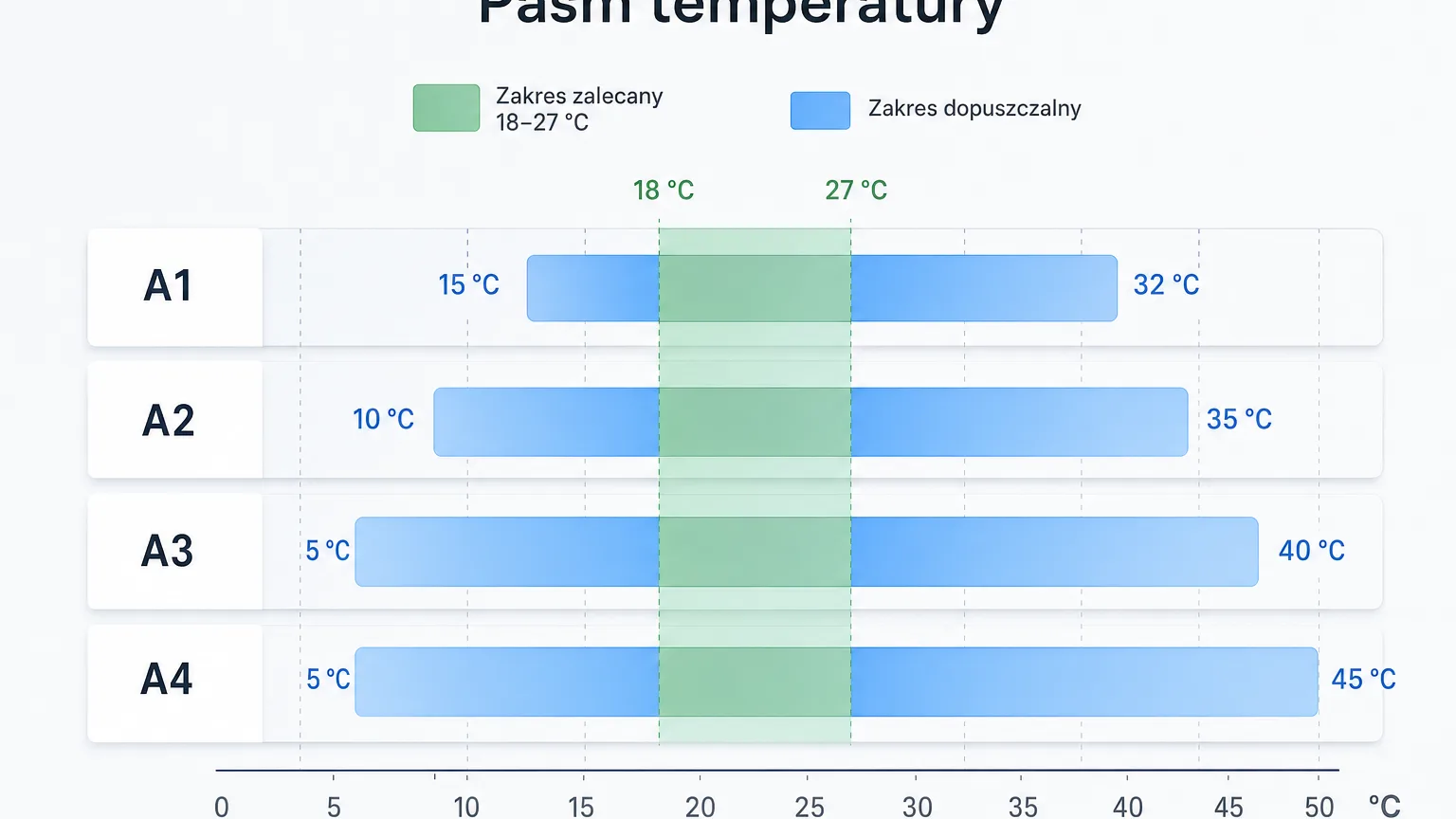
- Recommended range: 18–27 °C at the equipment inlet — common to all classes. This is the envelope the equipment should operate in for the vast majority of the time; a balance between reliability and cooling cost.
- Allowable range — class-dependent: A1: 15–32 °C, A2: 10–35 °C, A3: 5–40 °C, A4: 5–45 °C. These are the limits within which equipment may operate for short periods without voiding the warranty — e.g. during an air-conditioning failure or maintenance — but not the design operating point.
The practical interpretation: a server room does not have to be a fridge. The upper limit of the recommended envelope is 27 °C — holding 19–20 °C "in reserve" usually means overpaying for cooling with no reliability gain. On the other hand, the allowable envelope is an emergency buffer, not an invitation to run at 32 °C every day: what counts is the time spent outside the recommended range, and that time is worth measuring.
The guidelines also address humidity — in newer editions expressed primarily as dew point, with an upper bound on relative humidity (up to around 60% RH within the recommended envelope). Too dry means electrostatic discharge risk; too humid — condensation and corrosion. For monitoring practice it is enough to remember: humidity is measured together with temperature, at the same inlets, and covered with thresholds on both sides.
Measurement you can actually compare with the standard
Compliance with the guidelines can only be assessed when you measure what they talk about. Three rules:
- Sensors on the rack fronts, in the cold aisle — every 3–4 racks, at inlet height. How to lay out measurement points in a hot aisle / cold aisle setup is described in detail in our article on server room temperature monitoring.
- Continuous measurement, not a walk-round with a thermometer. Excursions happen at night and on weekends — when nobody is watching. A battery-powered sensor reporting every few minutes builds a history you can audit compliance against over time: how many hours per month the inlets were outside 18–27 °C.
- Aggregate metrics computed from the readings. Virtual sensors in the Nextriv platform can average the inlets of a whole row of racks into a single zone metric — convenient for reporting — without replacing the individual measurements that catch local hot spots. More on this mechanism in our article on virtual sensors.
From ranges to four alarm thresholds
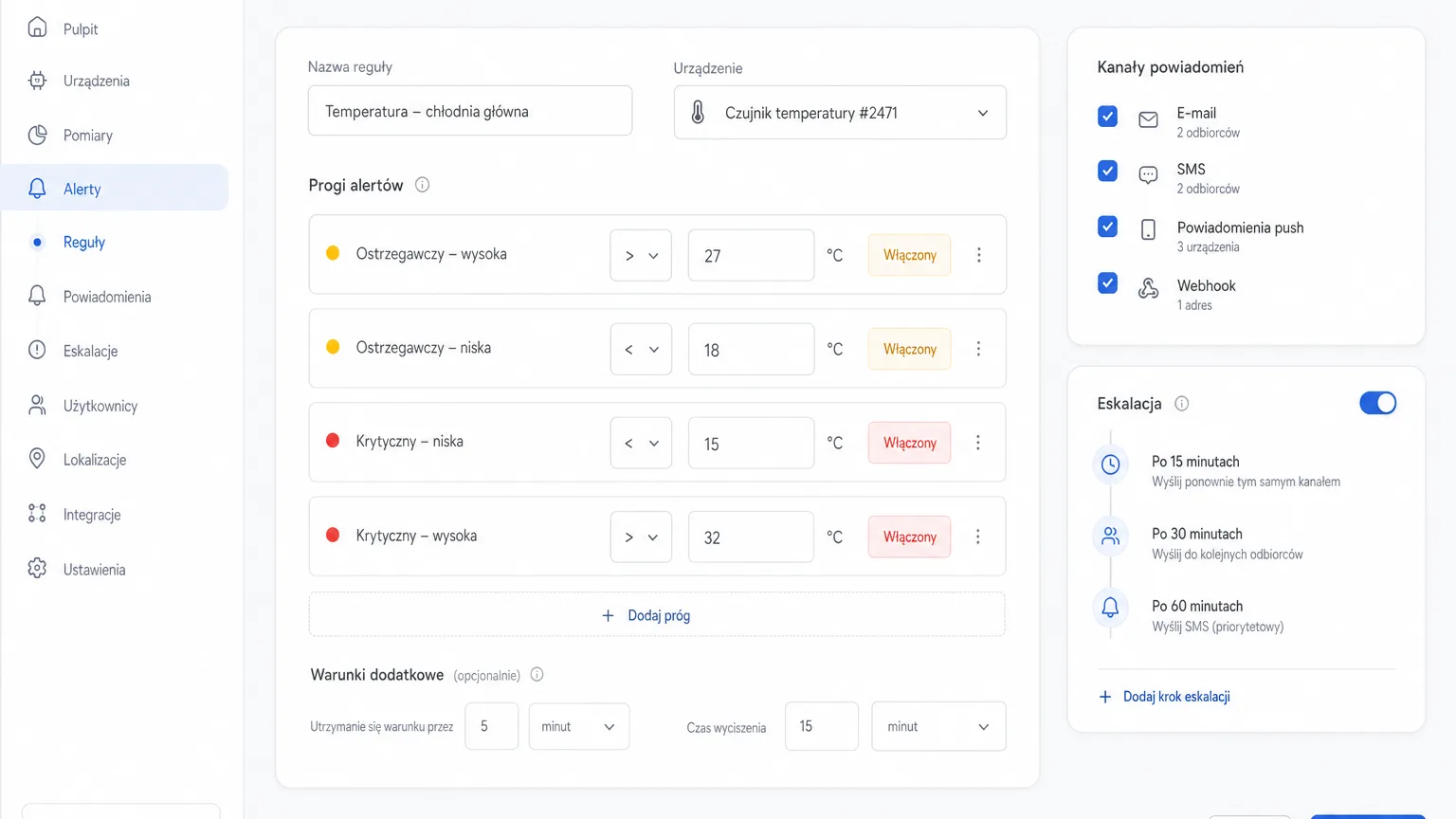
The greatest advantage of the ASHRAE guidelines is that they almost directly dictate the alert configuration. The Nextriv platform supports four thresholds per metric — two warning and two critical, on both sides — which maps perfectly onto the standard's two envelopes:
- Warning thresholds = the limits of the recommended range: 18 °C and 27 °C. A breach means "nothing is wrong yet, but we have left the design operating point" — a signal to check the cooling during working hours.
- Critical thresholds = the limits of the allowable range for the equipment class: for class A1 that is 15 °C and 32 °C. A breach is real risk — this alarm is meant to wake up the person on call.
Every event gets a code, a severity and a status, and deduplication makes sure one overheating rack does not flood the team with a hundred notifications. Escalation policies hand an unacknowledged alarm upwards, and notifications go out on a channel the team actually reads — from email and SMS to Microsoft Teams and Discord.
The cooling installation: where an ordinary sensor cannot go
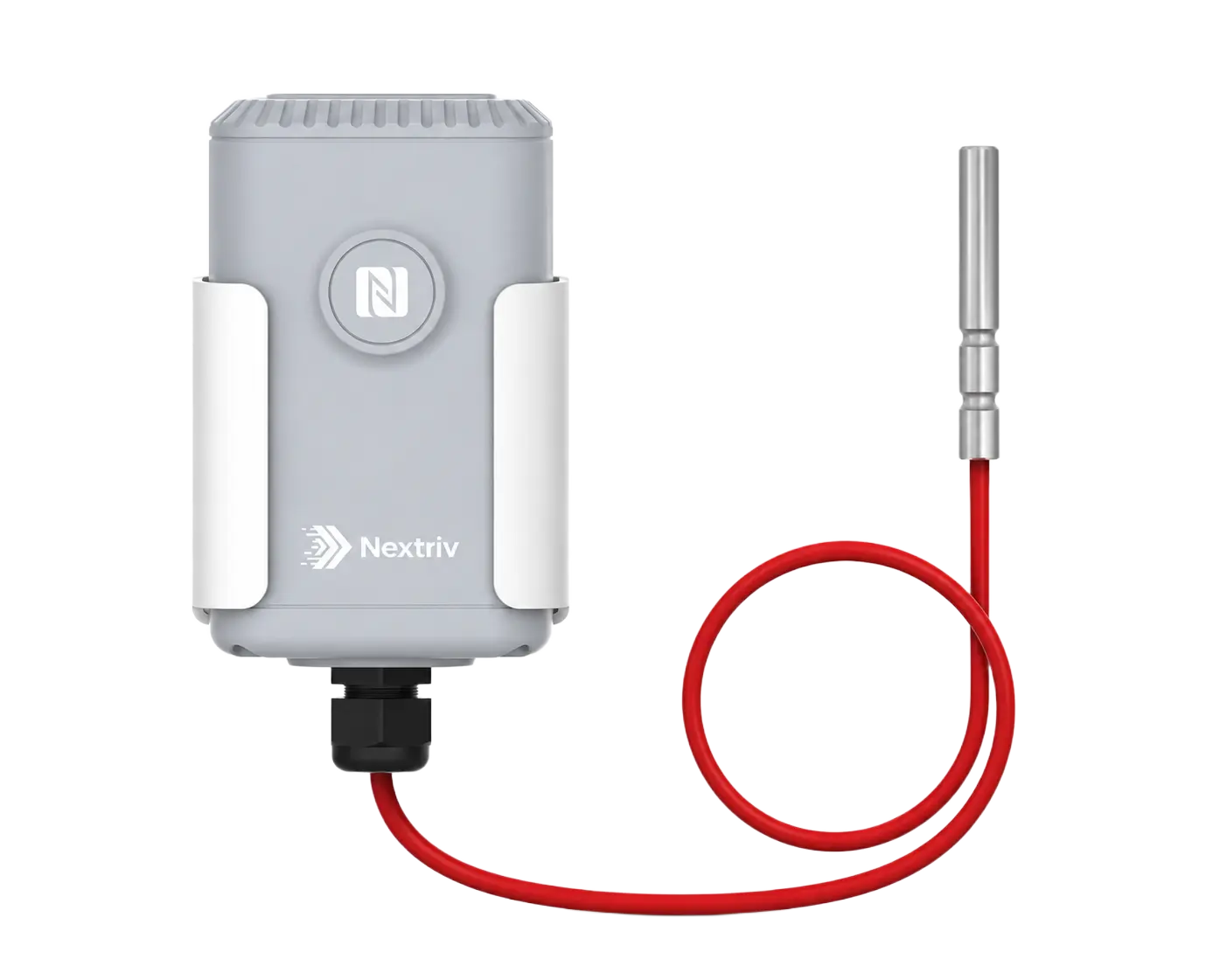
Rack inlets are the heart of the monitoring, but the causes of problems are born earlier — in the cooling installation. Chilled-water supply temperature, air in the supply ducts, heat exchangers: this is where the industrial Nextriv Probe PT100 works, with a platinum sensing element, ±0.5 °C accuracy and range variants covering every point of the installation. The electronics and radio sit in a sealed IP67 transmitter outside the measured medium, a local buffer of around 1000 readings with retransmission keeps the history continuous, and the battery lasts up to 10 years — the probe watches the installation longer than the typical life cycle of the servers it cools.
Compliance has to be demonstrable
A standard whose compliance cannot be documented exists only in theory. PDF reports with charts and measurement summaries show the time spent inside and outside the ranges, and XLSX/CSV exports feed your own analyses and reports for colocation customers. The Nextriv free plan includes 10 sensors and a full year of raw history — enough to cover the critical inlets and get through a first full seasonal cycle.
How monitoring along the ASHRAE guidelines comes together as a whole — with leak detection, power supervision and night-time alerts — is described in our data center solution. Check the pricing or book a demo: we will show the 18/27/15/32 thresholds configured live, together with an escalation that actually wakes someone up.


