
CO₂ in meeting rooms — standards and alarm thresholds
Indoor CO2 standards without the myths: what EN 16798-1 and the Pettenkofer number say, and which alert thresholds — 800, 1000, 1400 ppm — to set.
Zespół Nextriv4 min read

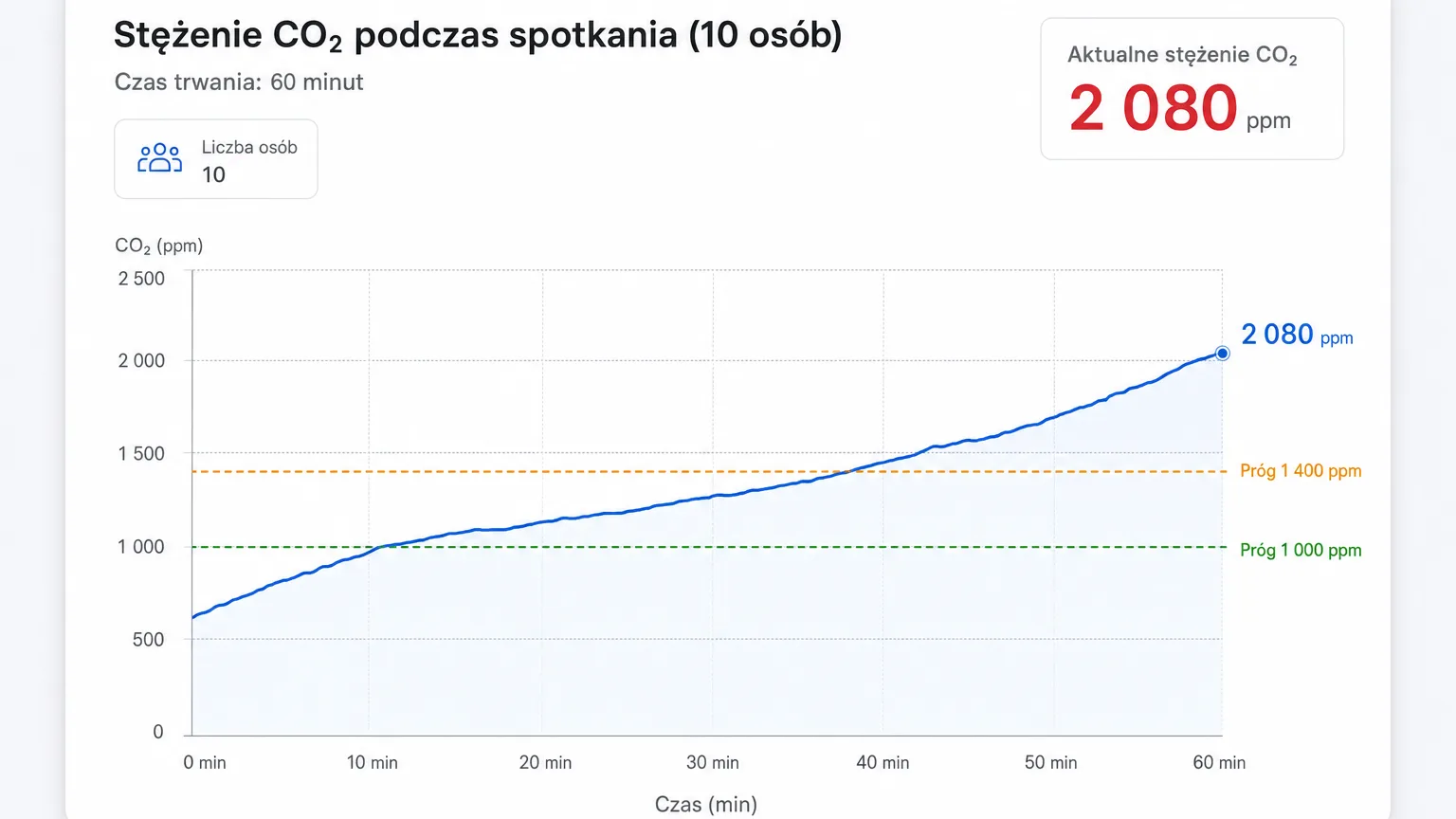
Indoor CO2 standards are a topic full of numbers torn out of context — and the meeting room is where wrong thresholds take their revenge fastest. A small volume, doors closed "so as not to disturb anyone", ten people and an hour-long meeting: the carbon dioxide concentration can pass 2000 ppm long before the meeting ends. The participants only feel that "it got heavy" — and nobody knows it is the air, not the agenda. Below we sort out where the specific threshold values come from and how to turn them into working alarms.
Where the CO₂ in the room comes from in the first place
From people. Outdoor air contains around 420 ppm of carbon dioxide; every person in a closed room steadily raises that concentration by breathing. The rate of increase depends on three things: the number of people, the room volume and the air exchange. That is why the same room behaves completely differently with 4 and with 12 participants — and why a fixed ventilation schedule never matches the actual need.
CO₂ itself is not toxic at these concentrations. It is, however, an excellent proxy indicator: it tells you how much "spent" air — along with bioaerosol and odours — is circulating in the room, and it correlates directly with the drop in participants' concentration.
Indoor CO₂ standards: EN 16798-1 and the Pettenkofer number
Two sources of values worth citing:
The Pettenkofer number. Back in the 19th century, Max von Pettenkofer identified around 1000 ppm as the limit above which indoor air stops being perceived as fresh. That value has survived 150 years of research and remains the most commonly used reference point for offices, schools and meeting rooms.
EN 16798-1. The European standard for indoor environmental parameters (successor to EN 15251) does not give a single "permitted" number — it defines indoor air quality categories (from the highest I to the lowest IV) according to the CO₂ concentration above the outdoor air level. The higher the building's category, the smaller the allowed increase over the roughly 420 ppm outside. That is an important nuance: the standard speaks of a difference, not an absolute value, so thresholds in the platform should be set with the local background in mind.
In deployment practice, both sources yield a consistent, three-step threshold scheme.
Alarm thresholds that work in practice
| CO₂ concentration | What it means | What to do |
|---|---|---|
| up to 800 ppm | comfortable air, close to the higher EN 16798-1 categories | nothing — the desired state |
| 1000 ppm | the comfort limit (Pettenkofer number) — warning threshold | air the room or increase ventilation output |
| 1400 ppm | clearly perceptible stuffiness, a drop in concentration — critical threshold | technical team response, a break in the meeting |
| above 2000 ppm | the typical finale of an hour-long meeting in an unventilated room | proof the room needs ventilation changes, not a one-off intervention |
These values are a good starting point, not a dogma. A building targeting a higher EN 16798-1 category can tighten the warning threshold to 800 ppm; a room with demand-controlled mechanical ventilation can in turn treat 1000 ppm as a signal for the automation, not for people.
From threshold to alarm: how to configure it
Knowing the thresholds does not air the rooms by itself. It is the automatic response that makes the difference — and this is where the monitoring platform earns its keep:
- Four thresholds per metric. In Nextriv, every metric has separate warning and critical thresholds (lower and upper). For CO₂, two upper ones suffice: 1000 ppm (warning) and 1400 ppm (critical).
- Notifications where the team works. E-mail, SMS, web push, Microsoft Teams, Discord or an audible in-app alarm — every breach gets a readable event code (e.g. ALM-2B9X4T), so in communication there is no doubt which alarm is meant.
- Escalation policies. If nobody acknowledges the alarm within a set time, the notification goes one level up — e.g. after 15 minutes an SMS to the facility manager. A stuffy room does not wait for someone to happen to glance at the dashboard.
- Quiet hours and recovery notifications. Nights and weekends can be muted, and when the concentration drops back below the threshold, the system itself sends a back-to-normal message — no manual checking.
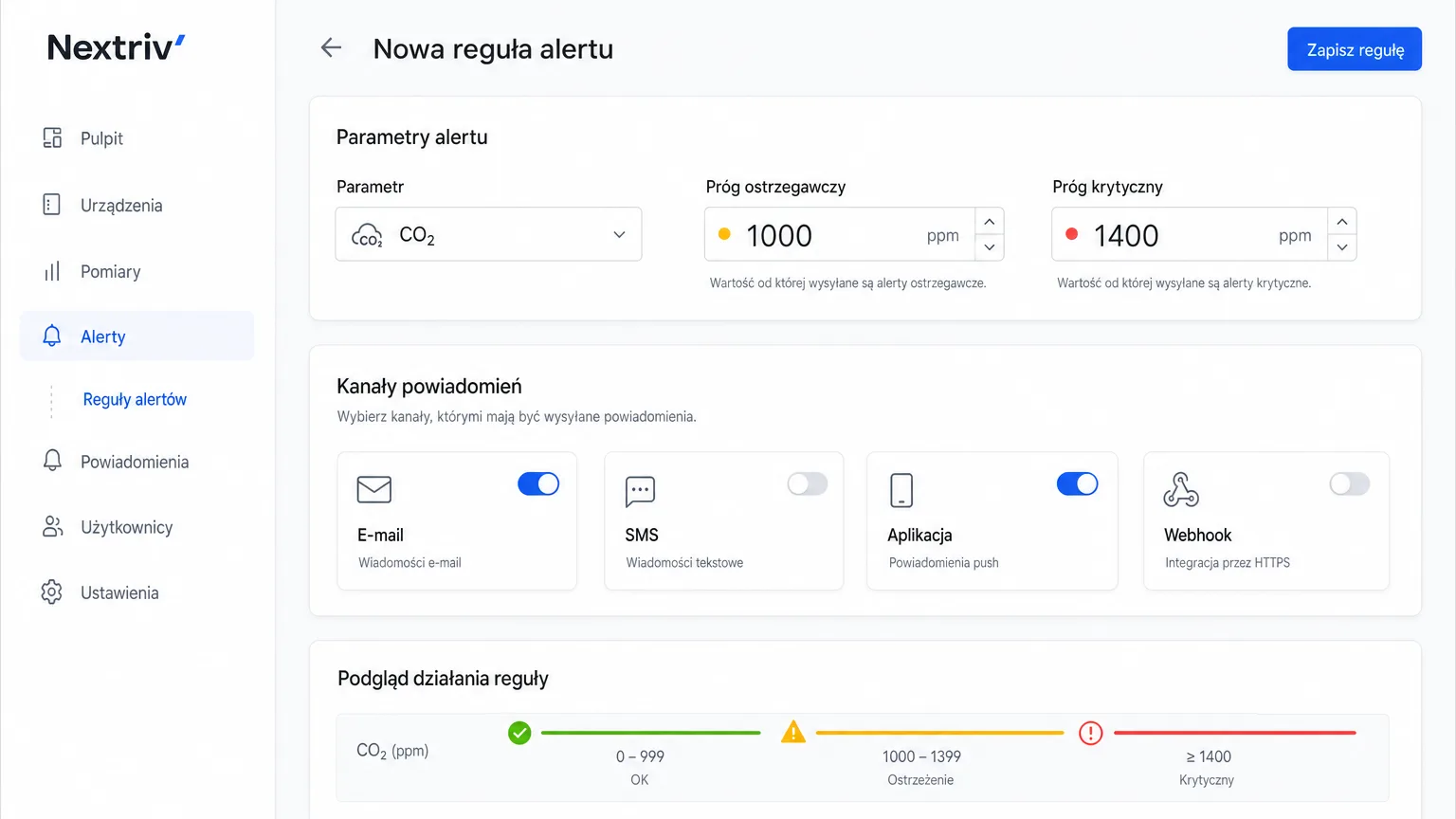
That scenario, step by step — from a threshold breach in a third-floor room to an SMS escalation — is shown on the buildings and offices solution page. In schools, where the problem is even sharper (a full class is 30 people in a small volume), the same mechanism is described in the solution for schools and educational facilities.
What to measure with, so the thresholds mean something
The 1000/1400 ppm thresholds assume the measurement is trustworthy. Two things matter here:
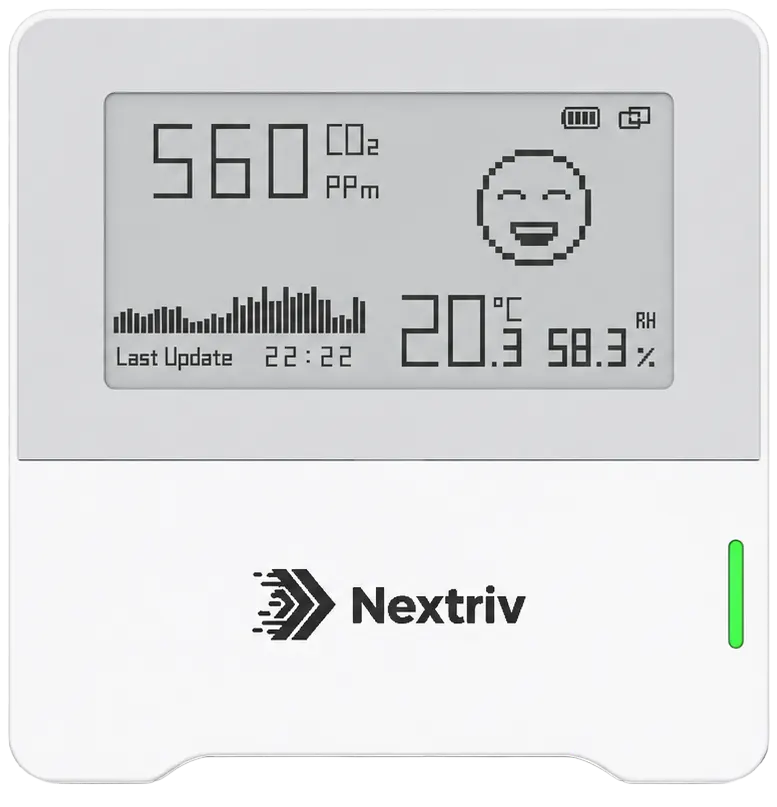
- NDIR technology. Optical CO₂ measurement (non-dispersive infrared) is stable over time and can be calibrated — unlike cheap "eCO₂" sensors, which merely estimate the concentration from other gases. Nextriv Sense CO₂ measures with NDIR across 400–5000 ppm with ±(30 ppm + 3% of reading) accuracy.
- Measurement where the people are. The sensor is mounted in the occupied zone, away from the window and the air vent. The e-ink display variant shows the reading and an emoji on the spot — meeting participants can see for themselves when to air the room, before any notification even arrives.
The sensor runs around 3–5 years on replaceable batteries at a 10-minute measurement interval, and communicates over long-range radio — no cabling and no access to the company Wi-Fi.
Start with one room
The best argument in a ventilation debate is a chart from your own meeting room. Hang one sensor in the most frequently booked room, set the 1000/1400 ppm thresholds and come back to the data after a week — that is usually enough for the full-deployment decision to make itself. The FREE plan covers 10 sensors and a year of measurement history, so the pilot costs nothing beyond the hardware.
Have a look at the pricing or book a demo — we will show CO₂ alerts in action, complete with an escalation and a report you can put on the boardroom table.


