
Sense environmental sensors
Nextriv Sense CO₂NDIR CO₂ sensor for offices and schools
SKU: NX-SN-CO2
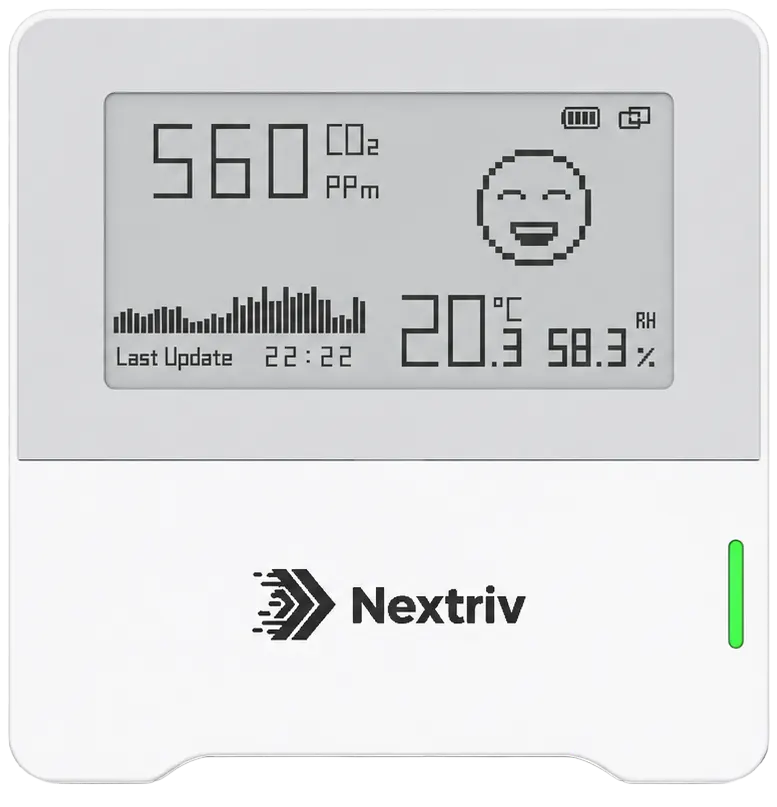
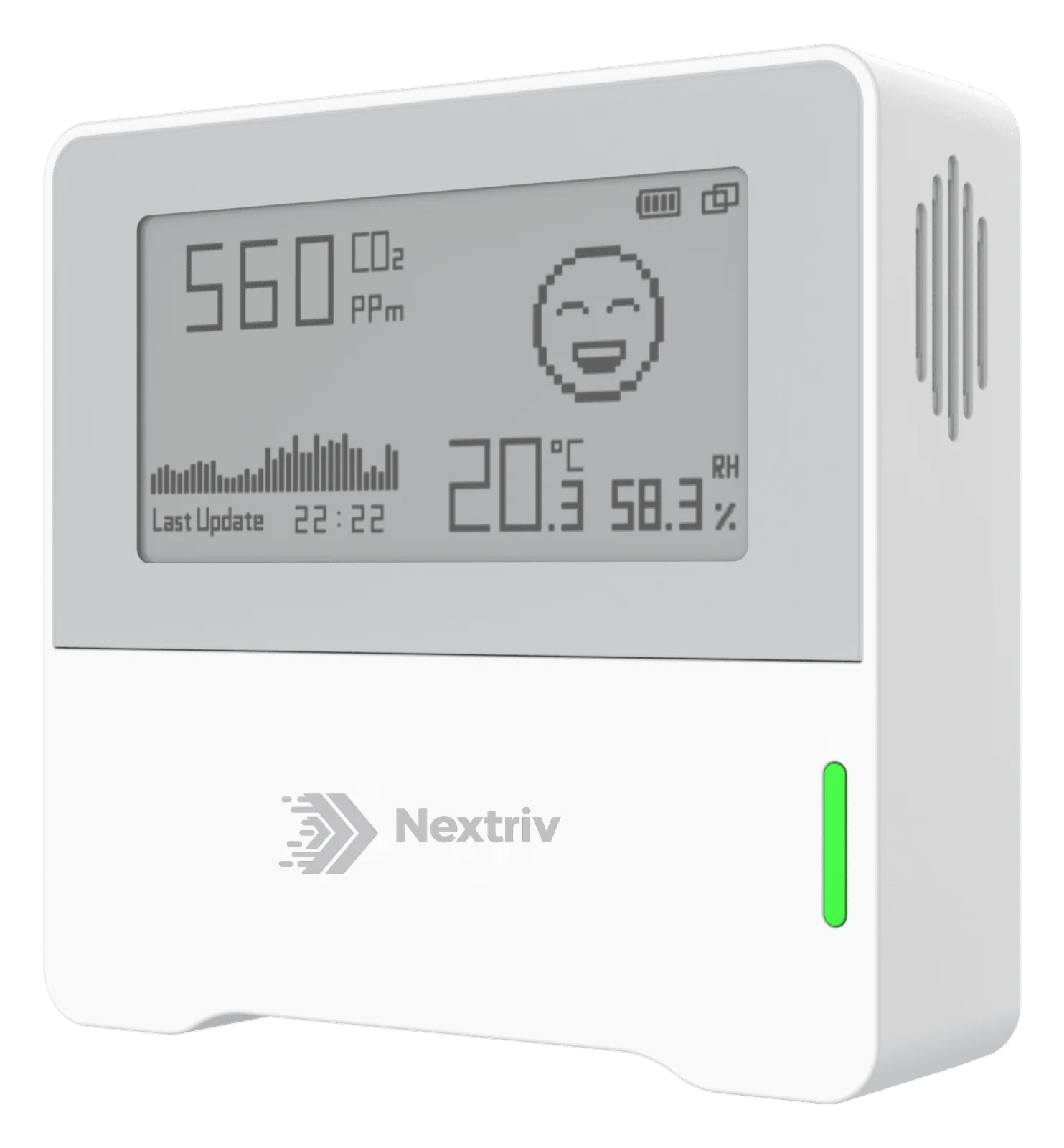
CO₂, temperature and humidity sensor with NDIR measurement and an e-ink display. Shows on the spot when to air the room — and sends the data to the Nextriv platform.
€195net
VAT is added to the price.


Description
- Optical CO₂ measurement — no drift over the years
- An emoticon says when to air the room
- Demand-controlled ventilation, lower bills
- Years of operation on replaceable batteries
- NFC configuration in a minute
What it's for
Carbon dioxide is the quietest thief of productivity: it doesn't smell, it doesn't sting your eyes, yet already at concentrations above about 1000 ppm it starts robbing pupils, employees and guests of their concentration. The optimal zone for mental work is 400–800 ppm — and hardly any meeting room stays inside it by the end of a meeting. Nextriv Sense CO₂ was built to make this invisible variable plain to people: with a green, yellow or red LED on the wall and an emoticon on a paper-like display.
At the device's heart is optical CO₂ measurement using NDIR technology — unlike cheap electrochemical sensors it doesn't age or drift, and it can be calibrated in service. Around it: temperature and humidity measurement of the same class as in Sense Display (±0.2 °C / ±2% RH), an e-ink display with the CO₂ trend and a last-update marker, and years of operation on replaceable batteries. One sensor closes out three comfort parameters.
It earns the most where it drives demand-controlled ventilation: instead of airing "just in case" on a schedule, the building ventilates when CO₂ actually rises. That's a recipe for healthier rooms and lower bills at once — CO₂ concentration doubles as an indirect indicator of human presence, so the same data supports room-utilisation analysis.
Configuration is a single tap of a smartphone (NFC), and remote reconfiguration lets you manage a fleet of hundreds of sensors without taking them off the walls. Two variants let you match the device to its role: where people are meant to see the air, the display version works; in technical zones the discreet LED version is enough.
Use cases
- Spa resort complex: sensors tied into the HVAC automation of several buildings at once — guest comfort rises while energy use falls, because ventilation stops working in empty zones. This is what deployments of this device class look like in European hotel and spa properties.
- University library: reading rooms across several floors under continuous air-quality supervision — the university combines CO₂ data with occupancy analytics to manage study spaces better.
- Social programmes: sensors in the homes of families affected by energy poverty monitor CO₂, temperature and humidity — the data helps cut heating costs without harming residents' health. A scenario known from housing programmes in European cities.
- Dispersed and hard-to-reach sites: long-range radio and years of battery life make servicing practically unnecessary — sensors of this class optimise airing even where a technician visits a few times a year.
- Modern office: CO₂ data combined with occupancy sensors creates a "sensing office" — ventilation and room bookings respond to actual, not declared, use of space.
- Gym and fitness studio: CO₂ measurement keeps the air fresh during peak hours — training in a well-aired room means better results and fewer customer complaints.
Key features
- Optical CO₂ measurement (NDIR) — a technology that doesn't age; can be calibrated in service.
- An emoticon on the display: a smiling, neutral or sad face — an air rating a child in a classroom or a hotel guest understands, no knowledge of "ppm" required.
- A traffic-light LED (green/yellow/red) — the display-less variant communicates the air status on the spot too.
- A 2.13″ e-ink display with the CO₂ trend, large type and a last-update marker — you know not only "how much" but also "when it was measured".
- Configuration with a smartphone tap (NFC) + remote reconfiguration — a fleet of hundreds of sensors without taking them off the walls.
- Smart display mode and hibernation — energy goes into measurements, not into displaying the same thing.
- A measurement buffer with retransmission after a connectivity outage — data continuity for reports and audits.
- Threshold alarms (e.g. 1000 ppm) — a cue to air the room without looking at the app.
- Two variants: with a display (communicating with people) and without (discretion, longer battery life).
In the Nextriv system
In the Nextriv platform every metric — CO₂, temperature and humidity — can carry four thresholds: two warning and two critical. A typical setup for a classroom is a warning at 800 ppm and a critical alarm at 1200 ppm; notifications arrive on the channel the team actually reads — e-mail, SMS, web push, Discord, MS Teams or an audible in-app alarm. Notification rules can be narrowed to selected sensors, locations or severity levels, and quiet hours guard against low-priority night-time alerts. A sensor that goes silent for twice its reporting interval is flagged as offline — the platform distinguishes "the air is fine" from "we have no data". An unacknowledged alarm is passed to the next recipient by the escalation policy.
Dashboards with nearly 20 widget types show current concentrations, trends and room-to-room comparisons; PDF reports and XLSX/CSV exports document comfort for management, tenants or the school authority. The measurement history reaches up to 5 years back.
Typical deployments
- Schools: a sensor in every classroom — the teacher sees the cue to air the room on the display, the administration gets reports from the whole building.
- Offices and buildings: CO₂ data drives floor ventilation and helps manage room bookings based on actual use.
- Hotels and wellness: comfort monitoring in rooms and treatment zones with energy-use optimisation at the same time.
- Healthcare: waiting rooms and consulting rooms monitored for stuffiness and overcrowding.
Specification
| CO₂ (NDIR) | 400…5000 ppm, ±(30 ppm + 3% of reading), resolution 1 ppm |
|---|---|
| Temperature | -20…60 °C, ±0.2 °C (0…60 °C), resolution 0.1 °C |
| Humidity | 0…100% RH, ±2% RH (at 25 °C), resolution 0.5% RH |
| Display | 2.13″ e-ink (display variant) or no display; display operation 0…40 °C |
| Connectivity | Long-range radio (~2 km urban / ~15 km open terrain), internal antenna |
| Power supply | 2× replaceable lithium battery (Li-SOCl₂) 2700 mAh |
| Battery life | approx. 3–4.5 years (display variant) / approx. 3.3–5 years (no display) — 10-min interval, EU868 band, 25 °C; depending on radio configuration |
| Ingress protection | IP30 (indoor use) |
| Dimensions | 68 × 65 × 20.5 mm |
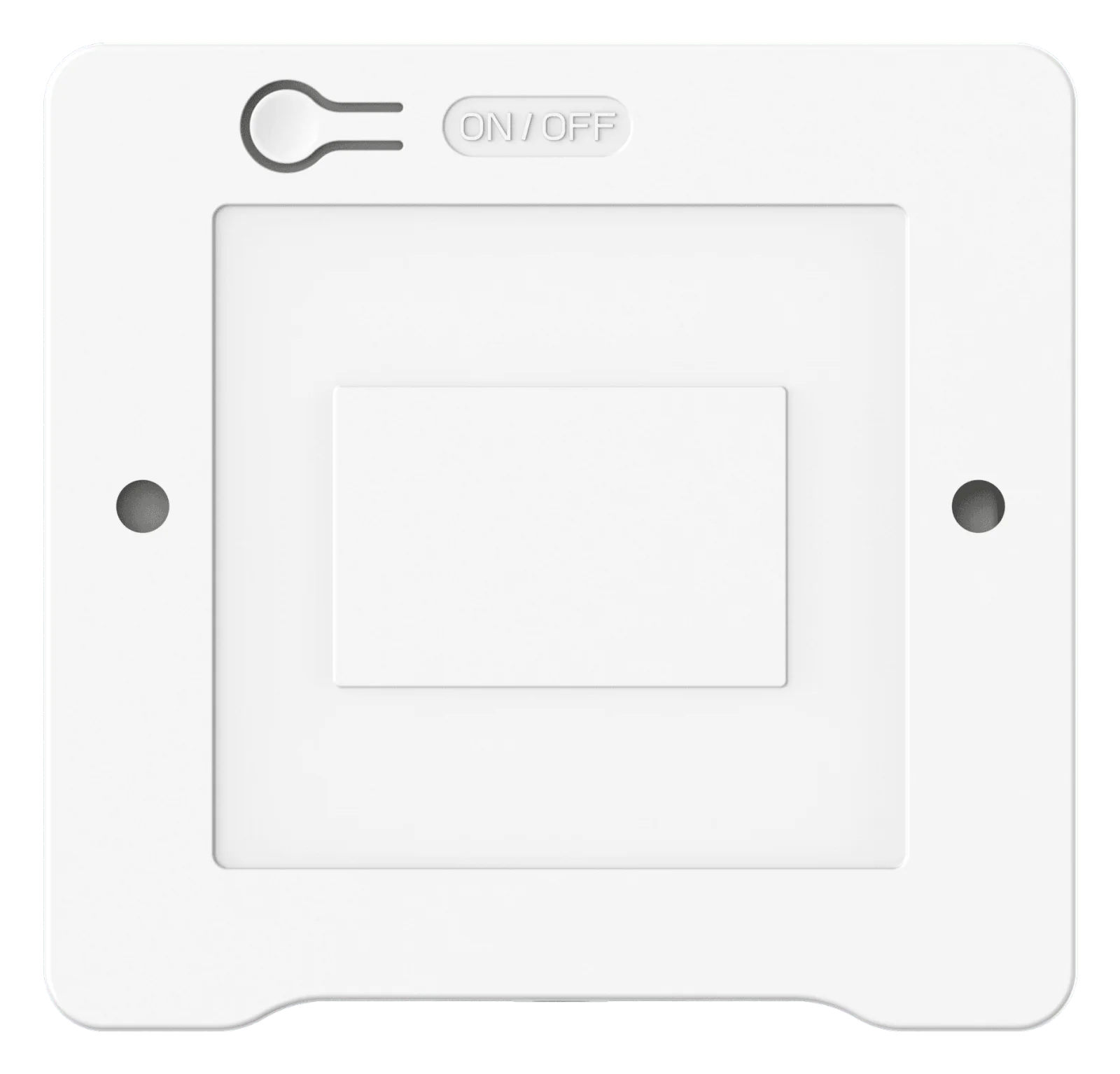
| Mounting | 3M tape or screws |
| Configuration | NFC from a smartphone, remotely via downlink |
Related products
Other devices from the same family.
Nextriv Sense Display
SKU: NX-SN-DISP
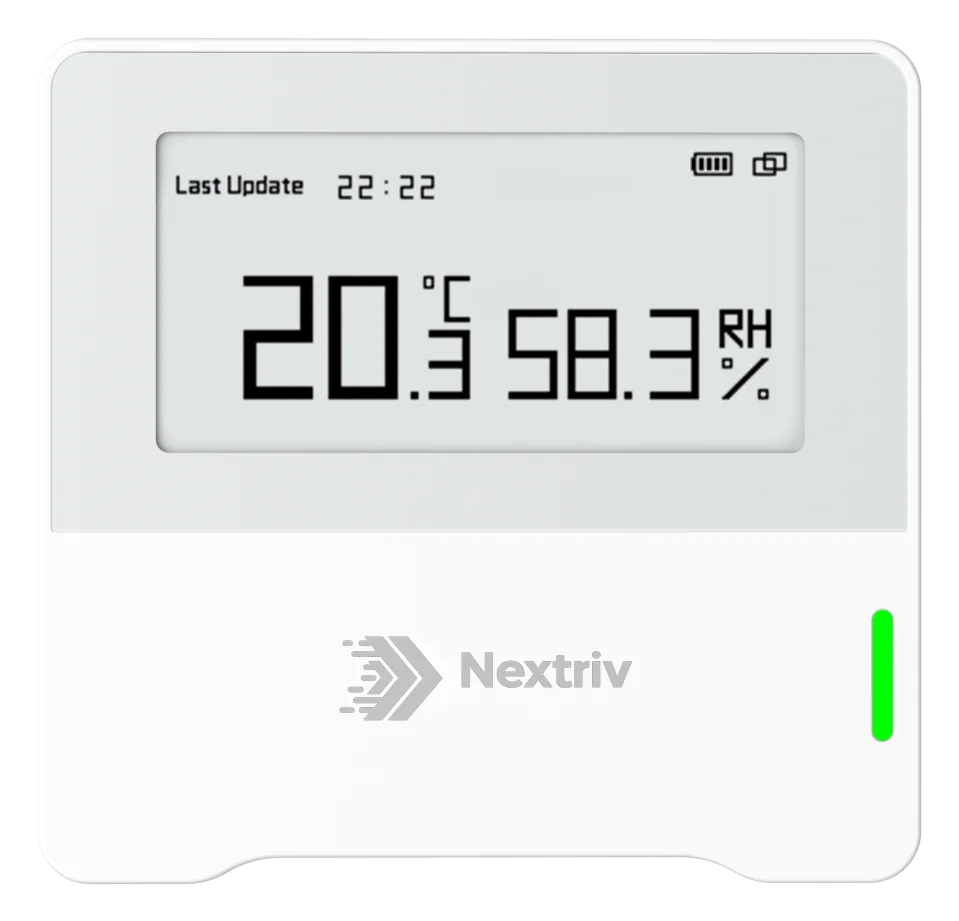
Temperature and humidity sensor with a 2.13″ e-ink display — readings on-site and in the Nextriv platform. Over 7 years on replaceable batteries.
- Temperature
- Humidity
Nextriv Sense IAQ
SKU: NX-SN-AQ7
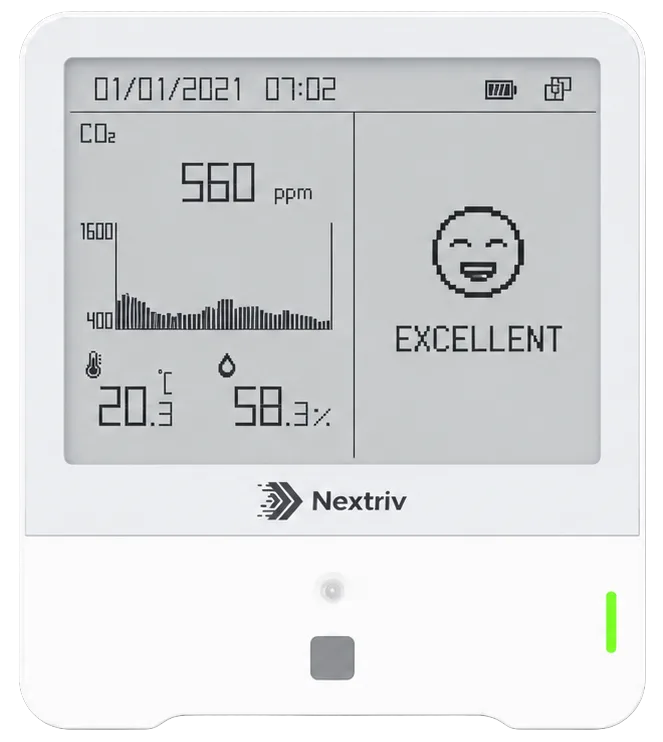
7-in-1 air quality station: temperature, humidity, CO₂, TVOC, pressure, light and occupancy — with a 4.2″ e-ink display and an 18,000-record buffer.
- Temperature
- Humidity
- CO₂
- TVOC
- +3
Nextriv Sense IAQ Comfort
SKU: NX-SN-AQ8C
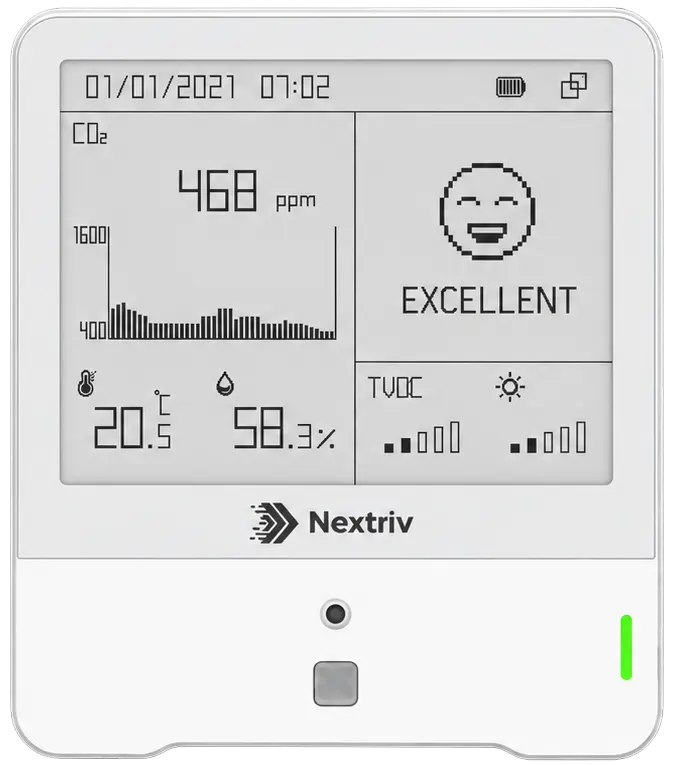
8-in-1 climate monitoring with laser PM2.5/PM10 particulate measurement — the full picture of air health in facilities with elevated dust levels.
- Temperature
- Humidity
- CO₂
- TVOC
- +4
Nextriv Sense IAQ Pro
SKU: NX-SN-AQ9P
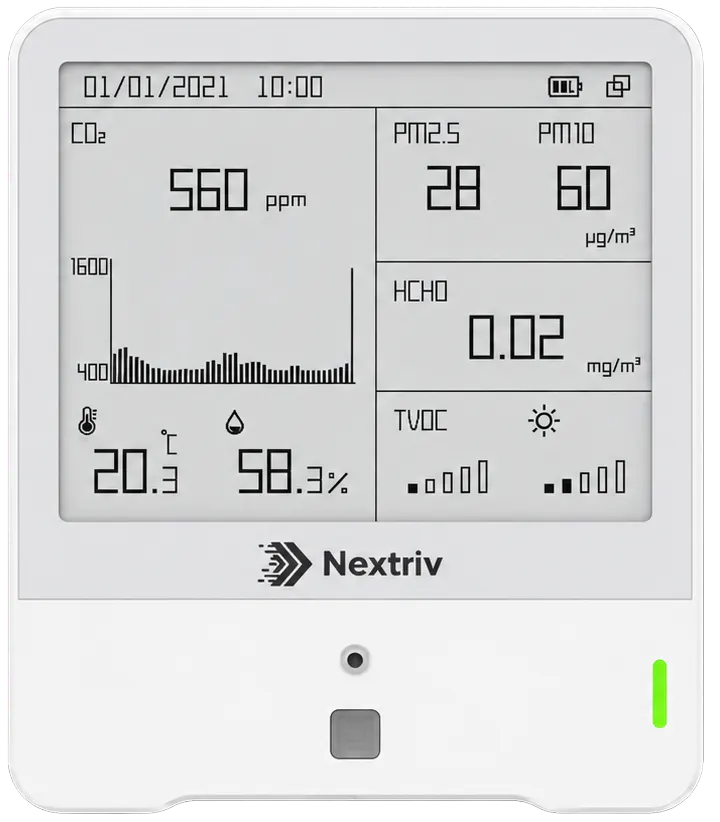
The richest 9-in-1 air quality station — choose formaldehyde (HCHO) or ozone (O₃) measurement. Always-listening radio with instant response to commands, WELL programme compliance.
- Temperature
- Humidity
- CO₂
- TVOC
- +5
Not sure which set to choose?
Tell us about your facility and we'll match sensors and a gateway to the exact rooms you need to monitor — no unnecessary hardware.