
Wireless sensors in heritage buildings — monitoring without drilling into walls
Sensors in heritage buildings without chasing walls: tape or cable-tie mounting, years of battery life and long-range radio through metre-thick masonry.
Zespół Nextriv4 min read

Sensors in heritage buildings are the rare case where technology has to defer to architecture, not the other way round. In an office building you run cable the shortest way; in a palace, a listed townhouse or a former monastery turned museum, every groove cut into the plaster is an intervention in the historic fabric — with a conservation permit, a design, and the risk that under the plaster lies a polychrome nobody knew about. At the same time it is precisely these buildings that need measurement most: timber ceilings, collections and furnishings respond to humidity swings long before any human notices them. The good news: microclimate monitoring can now be built entirely wirelessly, with fully reversible mounting — without a single drill hole.
Why cables in a heritage building lose at the permit stage
Work on a listed building requires a permit from the regional conservation officer — installation work included. A traditional measurement system means kilometres of signal cable: chases in historic plaster, holes bored through metre-thick walls, cable trays across vaulted ceilings. Even if the conservator allows such an intervention, there remains the cost, months of work in a building that usually has to stay open to visitors, and an aesthetic result nobody wants to see on a baroque wall.
A battery-powered radio sensor reverses that logic. The mounting is reversible: double-sided tape or a cable tie on a structural element, zero traces after removal. No mains power means no new electrical circuits, and no signal cabling means no intervention in the partitions. From a conservation standpoint it is the difference between "rebuilding the building services" and "placing an object on a shelf".
Sensors in heritage buildings: reversible mounting in practice
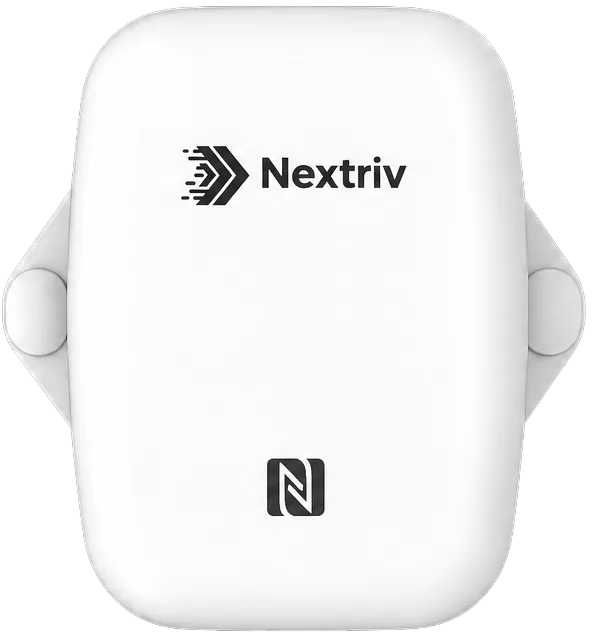
For temperature and humidity in exhibition rooms, collection stores or attics, a universal sensor in a sealed enclosure works well — such as Nextriv Sense Essential: the IP67 enclosure lets you hang it in a heated gallery as readily as in an unheated crypt, an attic or a basement level where condensation and cold rule out ordinary electronics. Accuracy of ±0.3 °C and ±3% RH is enough to talk about the microclimate seriously rather than approximately.
Three design details make the biggest difference in a heritage building:
- Mounting with no invasive tools. The kit includes screws, double-sided 3M tape and cable ties — in a heritage building you use the latter two. A sensor strapped to a roof-truss member or taped behind a display case disappears from view and can be relocated in fifteen minutes.
- NFC configuration. The device is switched on and configured by holding a phone to it — no opening the enclosure, no service cables. Commissioning a few dozen units is an afternoon's work.
- A battery for at least 5 years. No socket within ten metres stops being a problem; you only come back to the sensor to change the battery.

Thick walls versus radio connectivity
The natural doubt: will a radio signal punch through a metre of stone? The long-range radio that Nextriv sensors run on is designed for exactly these conditions — small data packets sent with a large link budget. In open terrain the range reaches approx. 15 km, in dense urban fabric approx. 2 km; inside a building the gateway's signal passes through three storeys up and down. In practice the basement, the attic and the annexe across the courtyard report to the same gateway as the exhibition rooms.
And if connectivity briefly disappears — buildings live, and interference happens — the sensor keeps a local buffer of approx. 2800 measurements and resends the backlog once coverage returns. The microclimate history stays continuous, which matters wherever the data is reviewed by a collections conservator or an insurer.
One gateway for the whole site
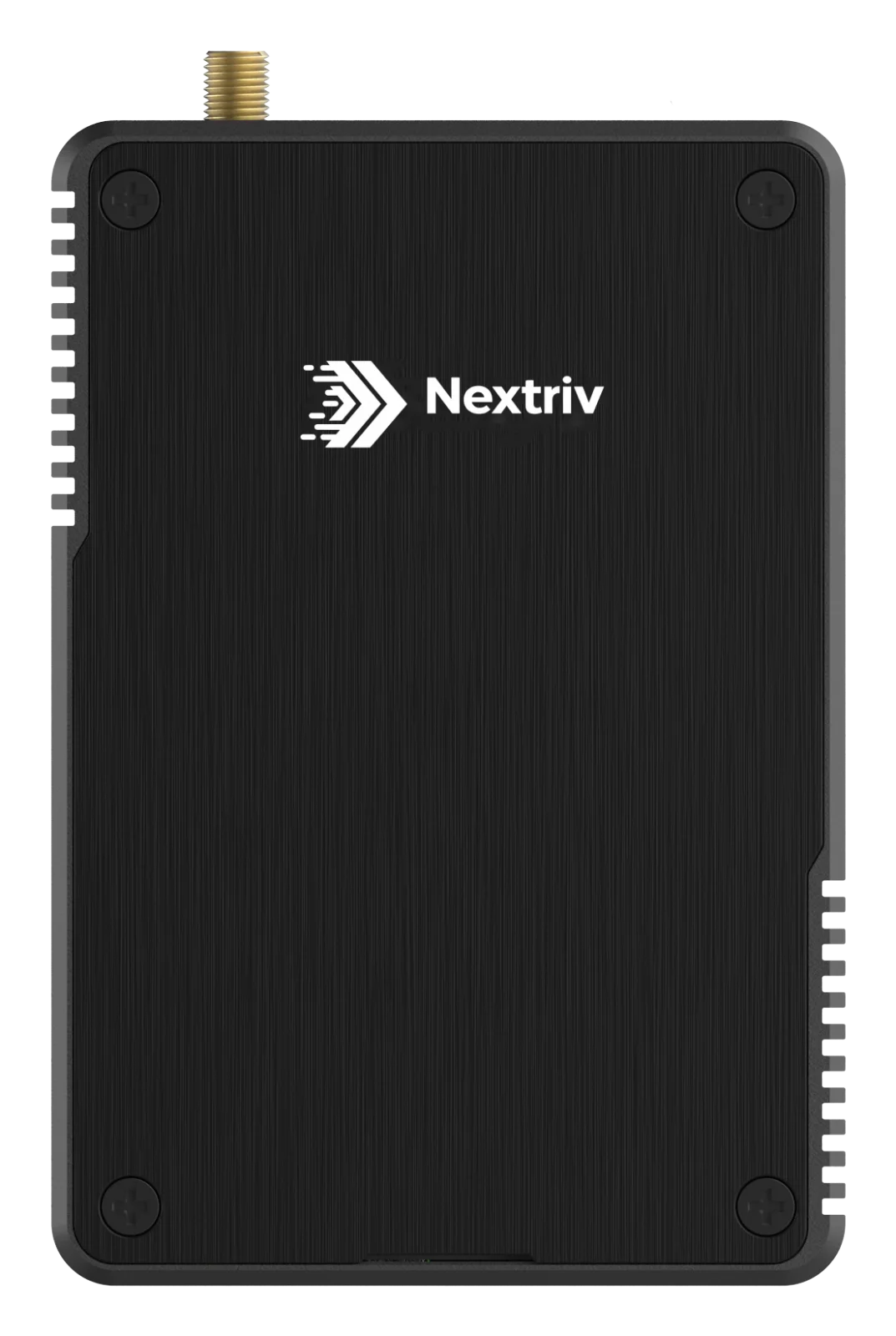
On the infrastructure side, the entire "installation" usually comes down to a single device. The Nextriv Hub Compact gateway handles around 2000 sensors, and it is mounted where the intervention hurts nobody: in an existing comms cabinet, on a DIN rail, in the administration office. Power over a single network cable (PoE) means no new circuits, and triple backhaul — Ethernet, Wi-Fi and optional 4G with automatic failover — solves the problem of buildings where the internet connection is temperamental, or absent altogether in the wing where the gateway hangs.
What to measure: stability, not single readings
In a heritage building the absolute temperature often matters less than its stability. Wood, paper, canvas and paint layers move with humidity — it is the sharp swings, the daily RH jumps after the heating kicks in or after a rainy weekend, that do the worst damage. So monitoring here is set up in two layers:
- Alarm thresholds on both sides. The Nextriv platform provides four thresholds per metric — warning and critical, lower and upper. For humidity in a room with collections this means, say, warnings outside the 45–55% RH band and critical alarms outside 40–60%, with a notification by email, SMS, web push or Microsoft Teams — before the deviation becomes a conservation problem.
- Seasonal trends. History charts show how the building passes through the heating season, which rooms the heating dries out and which the damp from the basement level reaches. That is material for decisions on humidifiers and setpoints — grounded in data, not impressions.
Visitors are a separate topic: a group in a small room can raise both humidity and the CO₂ concentration within half an hour — and the latter is often the best indicator of when to ventilate. We wrote more about driving air exchange by measurement in the article on CO₂-driven ventilation. The full scenario for cultural institutions — from display cases to collection stores — is described in the museums and archives solution.

A pilot in one afternoon
The best argument in a conversation with the director and the conservation officer is a working pilot. This is where the wireless architecture shows its full strength: the gateway connected with one cable, the sensors activated with a phone, and the platform detecting each new device automatically within 30–180 seconds — as we wrote at the launch of Nextriv, from unboxing to first readings takes fifteen minutes, not a week. The free plan covers 10 sensors, a gateway and a full year of measurement history — enough to bring the most valuable rooms and the collection store under monitoring and, after the season, hold hard data instead of suppositions.
Plan details are in the pricing, and if you would rather see the system live — with microclimate charts and alerts — book a short demo. Let's leave wall-chasing to the installation crews that really have to.


