Ammonia (NH₃) and hydrogen sulfide (H₂S) detection — early warning for plants and livestock farms
Ammonia NH3 and hydrogen sulfide H2S detection: readings from 0.01 ppm, thresholds and alerts — early warning in plants and livestock housing.
Zespół Nextriv4 min read
In this article
- Where NH₃ and H₂S come from — and why the nose isn't enough
- Ammonia NH₃ and hydrogen sulfide H₂S detection in numbers
- In livestock farming: ammonia versus animal health and growth
- In the plant: utility rooms, sanitary facilities and waste
- From reading to response: thresholds, escalations, documentation
- Start with one building
Ammonia (NH₃) and hydrogen sulfide (H₂S) detection relied for years on the least reliable instrument there is — the human nose. The problem is that the nose habituates to a constant smell, gives no numbers, doesn't work at night and leaves no record. And both gases build up gradually: in a pig house or poultry house they take their toll on animal health, in a plant's utility and sanitary rooms — on comfort and hygiene, long before anyone decides it "already stinks". Continuous measurement with thresholds turns this into an early-warning system: the alert arrives as the concentration starts climbing, not once the problem has spread through the whole building.
Where NH₃ and H₂S come from — and why the nose isn't enough
Both gases arise from the decomposition of organic matter: animal waste, sewage, scraps and refuse. Ammonia irritates the eyes and airways, hydrogen sulfide is responsible for the characteristic rotten-egg smell — and both turn up wherever organic matter sits longer than it should: in livestock buildings, indoor waste rooms, utility rooms, the sanitary facilities of production halls.
Smell, meanwhile, is the worst detector imaginable. A person working in a room all day stops noticing what a visitor smells from the doorway. A nose can't tell "yesterday was similar" from "the concentration has been rising for a week", won't wake anyone at three in the morning and won't print a chart for an inspection. Electrochemical measurement does all of that — down to hundredths of a ppm.
Ammonia NH₃ and hydrogen sulfide H₂S detection in numbers
A single compact wall-mounted detector provides continuous supervision of both gases.
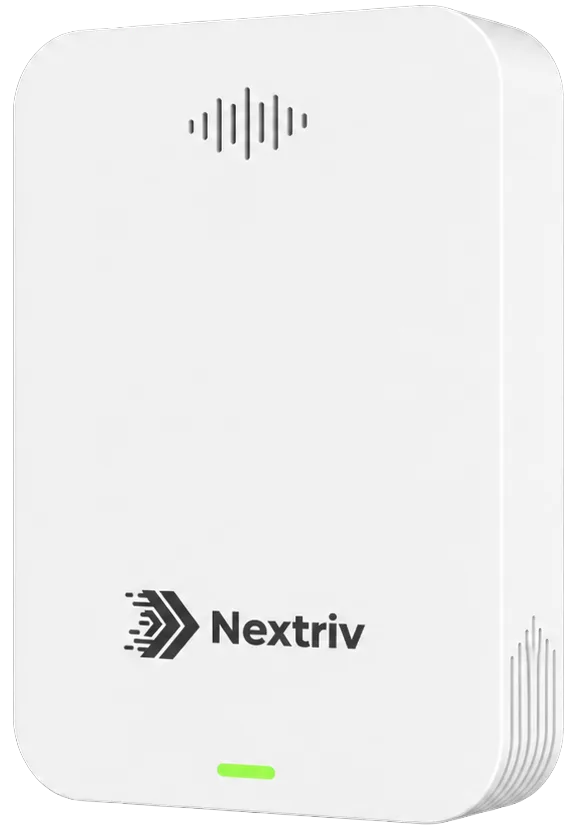
Nextriv Sense Gas measures ammonia electrochemically across 0–10 ppm and hydrogen sulfide across 0–5 ppm, with 0.01 ppm resolution and ±5% accuracy (up to 35 °C) — meaning it reacts long before the threshold of human discomfort. The sensing modules keep working for over 3 years with drift below 1% a month, so the measurement stays trustworthy across the device's whole life. The same unit also reports temperature (±0.2 °C) and humidity (±2% RH) — four parameters from one installation.
Two traits make the difference in practice. First, the local alarm: a built-in sounder and a traffic-light LED communicate the state of the air to everyone in the room — no app, no training. Second, battery power (a set of replaceable batteries lasting approx. 3 years) and NFC configuration from a phone: mounting means two screws, no chasing walls or pulling cables. The device is intended for indoor rooms, and a moisture-resistant coating protects the electronics — steamy sanitary rooms included.
In livestock farming: ammonia versus animal health and growth
In a pig or poultry house ammonia directly affects animal health and growth rates — and its concentration climbs fastest in winter, when ventilation is throttled back to save heat. It is the farmer's classic dilemma: ventilate and pay extra for heating, or save heat at the cost of the air. Continuous measurement settles it with data — ventilation runs when the concentration actually calls for it, not by a rigid clock.

A threshold breach can also trigger a response automatically: the webhooks integration passes the event to the ventilation controls, while a notification lands on the staff's phones in parallel. Together with temperature and humidity from the same device you get the full picture of the building's microclimate — three pillars of welfare under one supervision. What a complete deployment looks like in a barn, pig house or poultry house is described on the solutions page for livestock buildings.
In the plant: utility rooms, sanitary facilities and waste
In a manufacturing plant, NH₃ and H₂S are above all an indicator of neglect that is easy to miss: an indoor waste room emptied too rarely, a utility room with no ventilation, hall sanitary facilities cleaned "by the rota" rather than by need. A rising concentration trend detects the problem before the odour spreads into the common areas — and before it reaches staff conversations or an auditor's remarks.
The data also changes how facilities teams work: a ticket for the cleaning crew is generated from the warning threshold, and the concentration trend becomes an objective measure of service quality — harder than any survey. One caveat is only fair: this is an early-warning and hygiene-control system, not a substitute for portable safety gas meters where regulations require individual worker protection. The remaining measurements that round out hall supervision — from temperature to tank fill levels — are gathered on the solutions page for manufacturing.
From reading to response: thresholds, escalations, documentation
In the Nextriv platform each of the detector's four parameters has its own set of thresholds — two warning and two critical. That separates routine from intervention: a slight NH₃ rise creates a ticket for the service crew or steps up ventilation, a critical breach sends an SMS and web push, and the escalation policy notifies the next people in line until someone acknowledges the event. Every alarm has an ALM code, a status (active → acknowledged → resolved) and comments — the full path from detection to clean-up or airing-out stays in the system.

Documentation is rounded out by PDF reports from the measurement history and XLSX/CSV exports — material for an inspection, for SLA settlements with the cleaning company or for a conversation with the vet about conditions in the building. The platform watches the detector itself too: a device that stops reporting for twice its interval gets offline status and can raise a separate notification.
Start with one building
The best pilot is a single detector in the spot that generates the most complaints — the warmest section of the poultry house, the indoor waste room, the hall's sanitary facilities. After two weeks of charts you can see in black and white when concentrations rise and how fast the response works. The FREE plan covers 10 sensors, a gateway and a full year of measurement history, so the pilot costs nothing beyond the hardware — details in the pricing. And if you would rather first see the thresholds, escalations and trends on live data, book a short demo.