
Noise and Air Quality on the Factory Floor — Monitoring for Workplace Safety
Workplace safety monitoring: continuous noise and air measurements on the factory floor — decibels, ammonia and hydrogen sulfide with alerts and history.
Zespół Nextriv4 min read

Occupational noise and air monitoring looked the same everywhere for years: every so often a laboratory arrives, measures selected workstations, produces a report — and the subject goes back in the drawer until the next due date. The problem is that a factory floor doesn't run "on average". Specific shifts and specific work cells are the loud ones, odors come in waves, and between periodic measurements there's a months-long gap in which nobody sees anything. Today that gap can be closed cheaply: with battery-powered sensors that hang on the wall and report conditions on the floor continuously — with thresholds, alerts and a history ready for the conversation with the health and safety team.
Workplace safety monitoring: noise and air as numbers, not impressions
One caveat up front, because honesty builds trust: continuous monitoring sensors do not replace accredited workplace environment measurements — those remain a legal obligation and the point of reference. Continuous monitoring does something else: it shows when and where things get loud or stuffy, documents the trend between surveys, gives early warning after changes to the machine park, and suggests which workstations to commission formal measurements for first. Instead of two data points a year, you get a film of the whole year.
Noise: obligations start at 80 dB(A)
The regulations are unambiguous here: the permissible occupational noise exposure level is 85 dB(A) referenced to an 8-hour working day, and employer obligations already begin at 80 dB(A) — from providing hearing protection to preventive health checks. The key word is "exposure": what counts is the equivalent level (Leq), the averaged dose of sound, not a momentary reading. Impulse noise is a category of its own — short bangs and impacts that casual observation never catches.
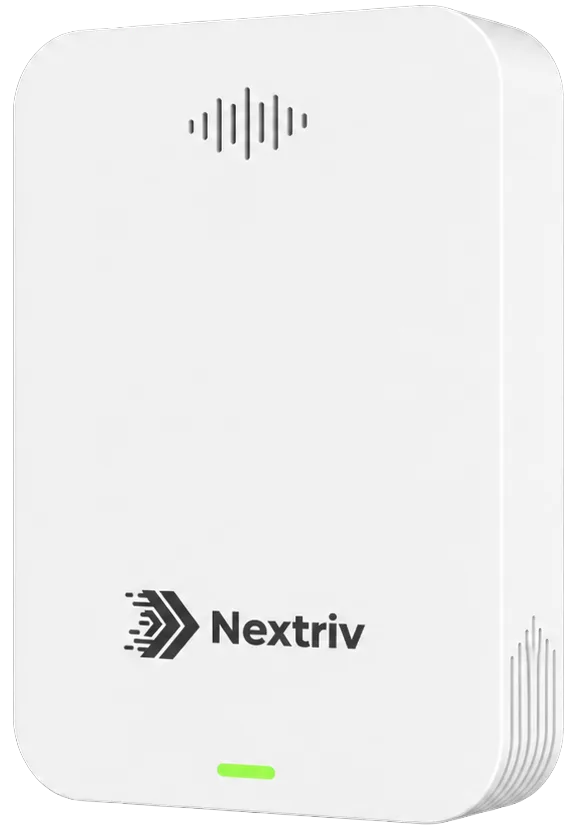
The noise sensor reports all three metrics at once: instantaneous level (SPL), equivalent (Leq) and maximum (Lmax), with a choice of A or C weighting curve and a fast 125 ms time constant that catches impulse events. The 30–120 dBA range covers everything from an office beside the floor to the loudest work cell. The ±3 dB accuracy positions it honestly: it's a screening tool — for building a noise map of the floor, identifying zones and hours, watching the trend after a machine swap — not a laboratory-class meter.
Two characteristics make deployment easier where measurement can be a sensitive topic. First, the device measures sound level only — it records nothing and cannot recognize the content of conversations, which is worth communicating to the workforce directly. Second, the built-in LED acts as a local, visual reminder when a threshold is crossed — the response happens on the spot, before any report lands on a desk. Mounting is tape or screws, power comes from replaceable batteries lasting years — zero cabling on the floor.

Air: ammonia and hydrogen sulfide, before the workforce smells them
The second pillar of oversight is gases. Ammonia and hydrogen sulfide show up in industry more often than intuition suggests: ammonia refrigeration in food processing, on-site wastewater pre-treatment plants and sumps, waste management, wet processes, utility and break rooms under heavy load. The detector with electrochemical sensors measures NH₃ in the 0–10 ppm range and H₂S in the 0–5 ppm range with 0.01 ppm resolution — it reacts at concentrations the human nose is only beginning to register, and turns "something smells off in here" into a chart with thresholds.
And again, honestly: this is not a certified gas detection system for hazardous zones, nor a substitute for the fixed detectors required by regulations in ammonia installations. It's an early-warning and hygiene layer — it catches a growing problem before it becomes an incident, and the built-in acoustic sounder and traffic-light LED communicate the state of the air to everyone on the spot, with no app and no training.
A practical bonus: the same device measures temperature (±0.2 °C) and humidity (±2% RH), so it also watches the thermal minimums in workplace regulations — at least 14 °C for physical work and 18 °C for light work. In the office and break areas of the plant, other parameters rule — CO₂ and TVOC — which we covered in our article on air quality in the office.

From threshold to procedure: alerts, escalations, documentation
Measurement without response is just a pretty chart. In the platform, every metric gets four thresholds — two warning and two critical — with severity levels from information to critical. A sensible starting point for noise: a warning when Leq approaches 80 dB(A), a critical alarm at 85 dB(A); for gases, thresholds are tuned to the specifics of the site and corrected after the first month of data. Notifications go out on the channels where the team actually works: email, SMS, web push, Microsoft Teams, Discord or an in-app audible alarm, and if nobody acknowledges the event, escalation passes it up a level.
Every event has a code, a status history and comments — from detection through acknowledgement to resolution. For the health and safety team it's a ready-made intervention log; for the production manager — hard material for a working conditions review, a conversation about acoustic treatment or a decision to replace the ventilation. The measurement history feeds PDF reports and XLSX/CSV exports, and if the data points to ventilation, its operation can be tied back to the measurements — as in our article on CO₂-controlled ventilation. The whole picture — from noise and air to process temperatures and machine energy — comes together in one system, described in our manufacturing solution.
A pilot on one floor
Starting doesn't require a project: a noise sensor at the loudest work cell and another in the zone the workforce complains about, a gas detector at the most likely source — and a month of data collection. The free plan covers 10 sensors, a gateway and a full year of history, so the pilot doesn't strain the budget, and after a month you have a map instead of opinions: where, when and how often conditions go out of bounds.
Book a short demo — we'll show noise and gas alerts in action, escalation and the report for the health and safety team included. Plan details are in the pricing section.


