
EN 12830 Temperature Recorders — What the Standard Does and Does Not Prove
EN 12830 without marketing shortcuts: scope, supplier evidence, conformity versus calibration, and a practical checklist for selecting a temperature recorder.
Zespół Nextriv4 min read

The phrase “compliant with EN 12830” often appears beside temperature recorders intended for cold rooms, warehouses and transport. It sounds like a complete answer to whether the device is suitable. In reality, it is the start of due diligence. You still need to know which configuration the statement covers, what testing supports it and whether the device parameters match your process.
EN 12830:2018 applies to temperature recorders used during the transport, storage and distribution of temperature-sensitive goods. It sets out technical and functional characteristics and test methods for the recording instrument. It is not a HACCP or GDP certificate, and it does not guarantee that the user's entire quality system meets legal or customer requirements.
What EN 12830 covers
The standard addresses recorders and the elements of their measuring chain used to record temperature under specified conditions. The 2018 edition covers applications within an approximate span from −80 to +85 °C. This does not mean that every device associated with the standard operates across that entire span. A particular configuration may have a narrower range determined by its sensor, probe, electronics and intended operating environment.
Assessing the recorder involves more than comparing a single reading with a reference thermometer. Relevant characteristics include:
- measurement errors across the declared range and conditions;
- the response of the measuring system to temperature change;
- correct operation of timekeeping and recording;
- behaviour when the power supply changes or fails;
- resistance to the intended environmental and mechanical conditions;
- access to records and reliable data identification;
- conformity of the complete device variant submitted for assessment.
The detailed criteria and methods belong to the paid standard. A buyer does not need to reproduce its tables in a request for quotation. The buyer does need evidence that explains exactly what was assessed.
A device standard does not approve a process
Even a properly assessed recorder can be used incorrectly. A probe in the supply-air stream may not represent the goods. An excessively long recording interval may hide a short event. Without a response procedure, an alarm remains only an entry in the history. Poor calibration control or missing periodic checks can undermine confidence in readings over time.
Device conformity does not automatically demonstrate:
- organisational compliance with HACCP, GDP, GxP or another quality system;
- correct mapping of a cold room or warehouse;
- suitable placement of permanent measuring points;
- maintenance of temperature in a particular vehicle or chamber;
- integrity of the entire review, alarm and data-retention process;
- suitability for every temperature-sensitive product.
In practice, the recorder is one component of the control system. For a cold facility, combine instrument requirements with process risk assessment and a planned cold-storage monitoring system.
Certificate, declaration and test report are not interchangeable
Commercial material sometimes uses these terms loosely, although they carry different evidential weight. A manufacturer may issue a declaration of conformity under its own responsibility. A test report describes samples, methods and results, but its scope must be checked. A third-party certificate may provide stronger evidence if it identifies the correct model, configuration and edition of the standard.
Ask the supplier for:
- the full standard designation, including year of publication;
- the document on which the conformity statement is based;
- the laboratory name and evidence of relevant competence or accreditation;
- unambiguous identification of the model, probe and version assessed;
- the declared measuring and operating ranges;
- limitations, exclusions and variants that the document does not cover.
If a report concerns a one-probe version, do not automatically extend its conclusion to another probe, cable, enclosure or software variant. When the relationship is unclear, the supplier should identify the document connecting the product offered with the variant assessed.
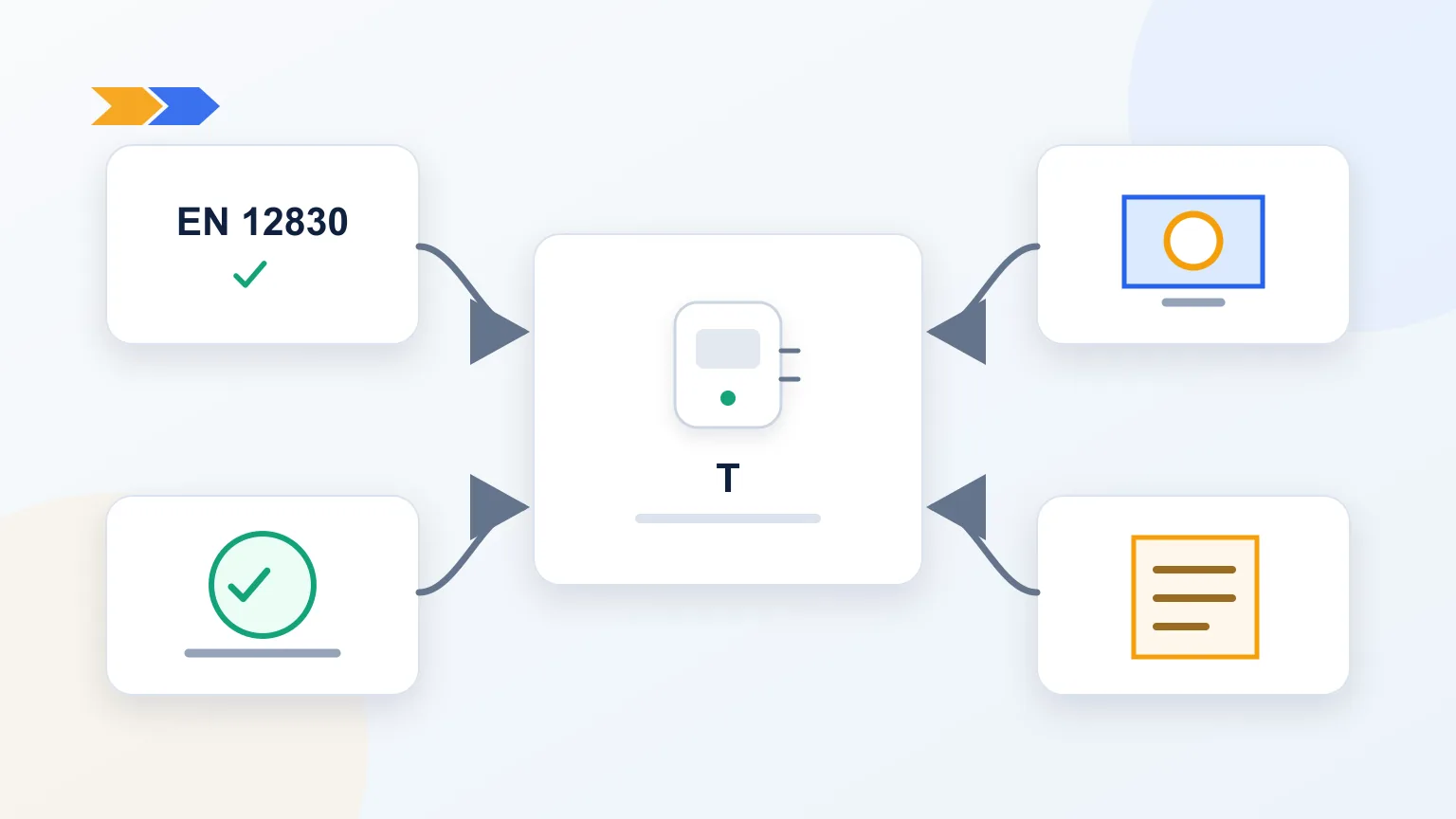
EN 12830 conformity versus calibration
These answer different questions. Conformity assessment asks whether the design and performance of a recorder type meet specified requirements. Calibration establishes the relationship between indications from one physical unit and reference values at defined points on the date of the service.
A new unit may belong to an assessed type, while the organisation still needs metrological evidence for each unit in use where its risk assessment or procedure requires it. Conversely, a current calibration certificate does not show that the design has passed every test in EN 12830.
Choose calibration points near actual process temperatures. A 2–8 °C cold room needs different points from a freezer or an ultra-low-temperature cabinet. Define the acceptable in-use error and account for measurement uncertainty when deciding whether the result is satisfactory. Our guide to temperature sensor calibration explains this in more detail.
Reading a recorder data sheet critically
A broad range alone does not establish quality. Compare at least the following:
| Parameter | Purchasing question |
|---|---|
| Measuring range | Does it cover the process with a sensible margin? |
| Accuracy and uncertainty | How do they change within the relevant span? |
| Resolution | Is it being confused with accuracy? |
| Response time | Can it reveal an event soon enough? |
| Recording interval | Can it be matched to process dynamics? |
| Local memory | What happens during connectivity loss? |
| Power | How are low battery and failure indicated? |
| Probe | Is it integrated, replaceable and practical to calibrate? |
| Data export | Does the record contain time, identity and context? |
The broader guide to reading a sensor data sheet helps separate useful parameters from impressive-looking numbers. Also make a deliberate choice between an external probe and an integrated sensor. A probe can measure inside a chamber while the electronics remain outside, but its cable and connector become part of the measuring chain that requires consideration.
How to assess a Nextriv offer safely
For a Nextriv solution such as Nextriv Probe Solo, compare the current product data and documents for the supplied configuration against your application requirements. The presence of a device in the catalogue is not, by itself, a declaration that it is certified to EN 12830.
If conformity is a purchasing or audit condition, request the relevant evidence before ordering and verify the model, probe, range and standard edition. Available technical material can be checked in downloads; any missing evidence should be clarified with the supplier in writing.
Acceptance checklist
- Do the model number and probe match the supporting document?
- Does the declared range cover every operating point?
- Do you know the accuracy in your relevant span, not only a “typical” figure?
- Does the calibration certificate identify the individual serial number?
- Are its date and calibration points suitable for the process?
- Has recording during power or communication loss been checked?
- Does the instruction explain time, interval and data-export settings?
- Does the user procedure define periodic checks and excursion handling?
EN 12830 is a valuable technical filter, but it does not remove the need to evaluate evidence. The safest question is not “does the device have the standard?” It is “which document confirms which characteristics of this exact configuration, and how will we place it inside our controlled process?”.