Calibrating temperature sensors in pharma — when, how and why
Temperature sensor calibration in pharma: when to calibrate, how it works step by step, what auditors expect and how a calibration log tracks due dates.
Zespół Nextriv4 min read

Calibrating temperature sensors is the kind of pharma task that's easy to put off "for later" — until an auditor asks for the certificate and it turns out it expired three months ago. An out-of-date certificate is one of the most common and most easily avoided inspection findings. A sensor's accuracy means nothing on its own if you can't prove its readings are trustworthy. In this guide we explain what calibration actually is, when and how to carry it out, and how to make a system — rather than a manager's memory — keep track of the due dates.
Temperature sensor calibration — what it actually is
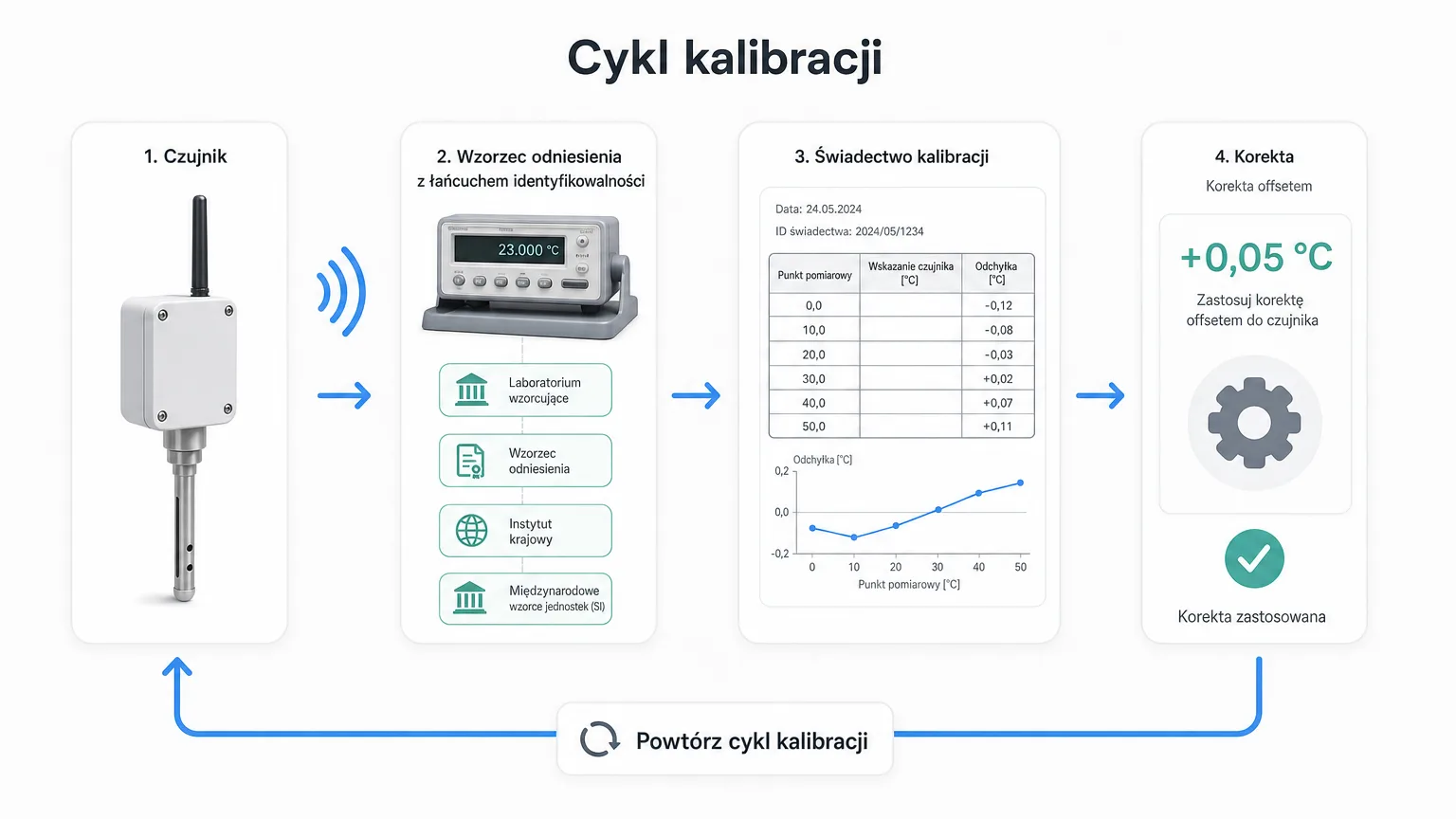
Calibration is the comparison of a sensor's readings against a reference standard of known, traceable accuracy, and the documentation of the difference between them. The result is a calibration certificate: a document stating by how much the sensor errs at a given temperature point and with what uncertainty. It's worth distinguishing two terms that often get mixed up:
- Calibration — checking and describing the deviation. The sensor stays as it was; you get information about its error.
- Adjustment (correction) — setting the device so that it reads correctly. In digital sensors this is done in software, as an offset.
Traceability is the key word: the standard used for the calibration must be linkable, through an unbroken chain of comparisons, to the national standard. Without that, the certificate is just a piece of paper.
When to calibrate — schedules and triggers
In pharma, calibration frequency follows from risk analysis, but in practice it comes down to a few moments:
- At commissioning — every new measurement point should enter service with a fresh certificate.
- Periodically — most often every 12 months; for critical points (2–8 °C fridges, vaccine chambers) sometimes more frequently.
- After an event — an impact, a repair, an excursion beyond the permitted operating range or a suspected error all force a calibration outside the schedule.
- When drift grows — every sensor "drifts away" over time. The lower the design drift, the longer you can safely stretch the intervals between calibrations.
That's why drift is a parameter worth watching at purchase. A dual-parameter probe with drift below 0.03 °C per year lets you plan calibrations on data rather than guesswork. We described the logic of documenting the entire cold chain in the guide on GDP and temperature monitoring — calibration is an inseparable part of it.
How calibration works, step by step
- Choosing the points — you calibrate at points representative of the application. For a pharmacy fridge that's usually around 0, +5 and +8 °C; for high-temperature processes — points spread across the full operating range.
- Comparison against the standard — the sensor and the standard go into a stable environment (a bath, a dry-block calibrator) and the differences are recorded.
- The certificate — the laboratory (ideally an accredited one) issues a document with the deviations and the measurement uncertainty at each point.
- Correction and return to service — if the deviation exceeds the allowance, the device is corrected with an offset; the point returns to supervision and the certificate goes into the records.
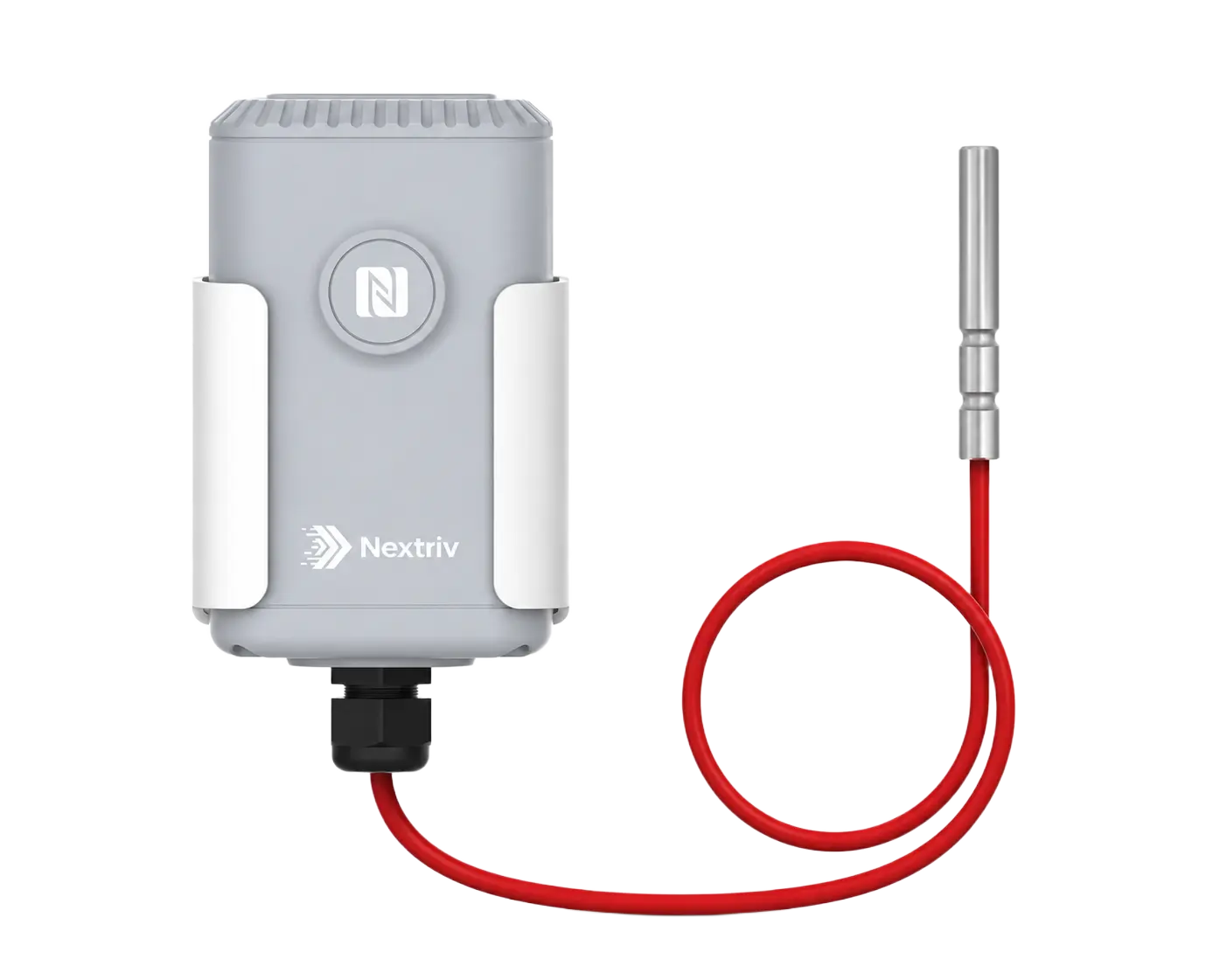
This is where recorders with a detachable probe show their advantage. In the Nextriv family the probe has an M12 connector and its own identifier reported in the data. Only the probe travels to the calibration laboratory — or you swap it for a freshly calibrated one — without dismounting or reconfiguring the transmitter. Supervision of the point never pauses, and the traceability of the specific probe stays in the history.
Why calibrate — or what the audit expects
There are exactly as many reasons as there are roles calibration plays in the quality system:
- Data credibility. A 2–8 °C alarm threshold only makes sense if you know the sensor measures within its uncertainty. Half a degree of error at a critical threshold is the difference between an alarm and no alarm.
- Regulatory compliance. Good distribution practice and national requirements explicitly demand serviceable, calibrated measuring equipment with current certificates.
- Defence against findings. A current certificate is proof that the measurement you base batch-quality decisions on is documented. A missing certificate undermines the entire temperature record.
For laboratory and process applications, where ranges go far beyond refrigeration, the industrial platinum probe Nextriv Probe PT100 fits the bill: ±0.5 °C accuracy and 0.1 °C resolution across −200 to +800 °C, with a 3-wire connection eliminating lead-resistance error. It's a sensor for validating test chambers and documenting process runs.
A calibration log in the platform — the end of tracking dates in a spreadsheet
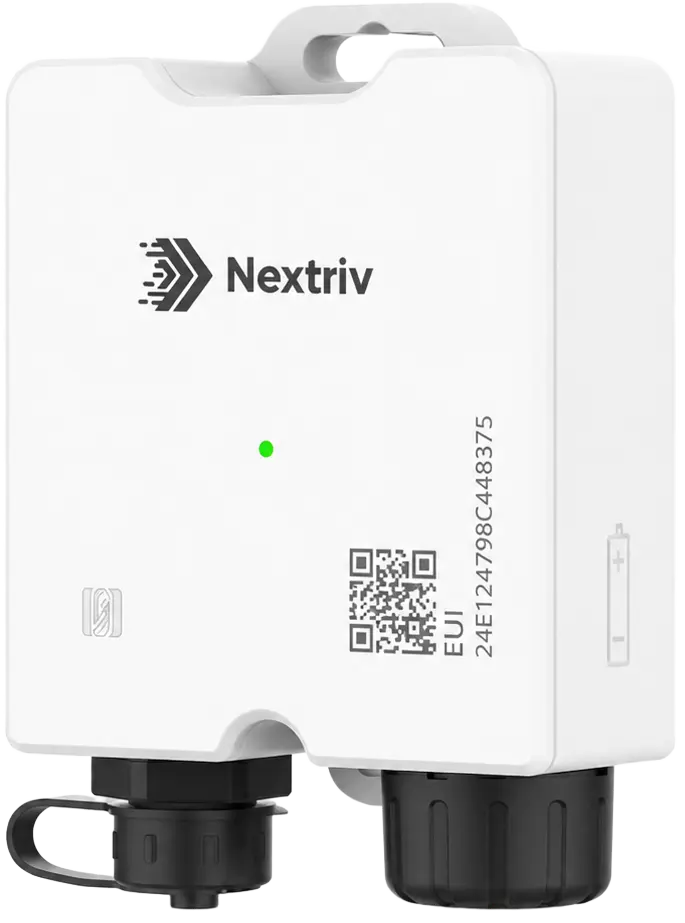
The weakest link in calibration isn't the measurement itself but keeping track of the dates. A certificate tucked into a binder won't remind you of itself. That's why the Nextriv platform keeps a calibration log with every sensor, containing:
- the calibration date — when the last calibration was performed,
- the next due date — calculated or entered manually, visible at a glance,
- the certificate — attached to the sensor's record, available on the spot for an auditor,
- notes — who calibrated, where and at which points,
- reminders — the system warns you before a certificate expires.
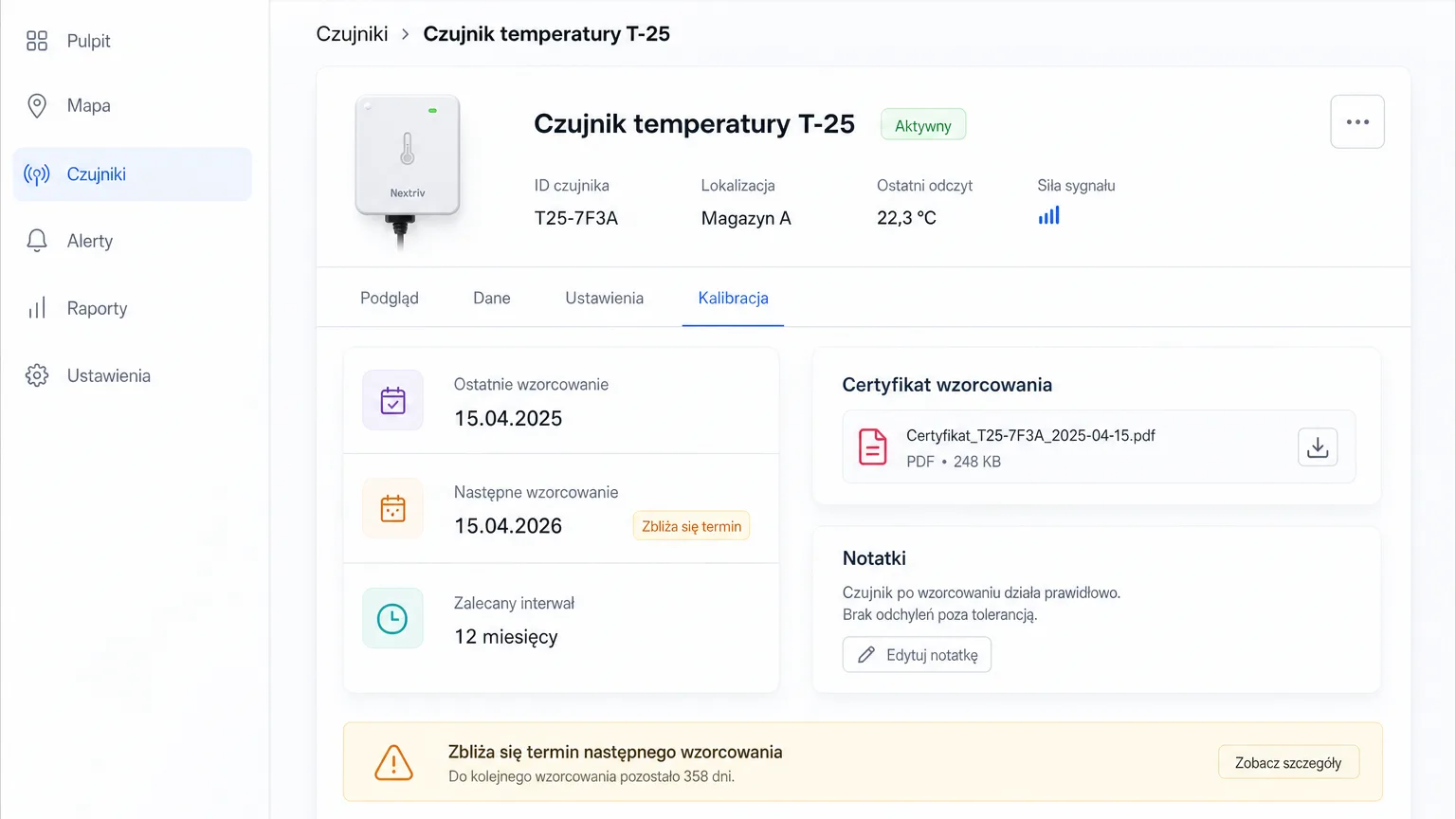
With this, preparing for an inspection stops being a race against the clock. Instead of digging through binders, you open the sensor list and see which certificates are current and which need renewing. It's the same philosophy as with pharmacy fridge monitoring: less manual work, more certainty.
A short calibration checklist
- Did every sensor enter service with a fresh certificate?
- Does the calibration frequency follow from a risk analysis, with shorter intervals for critical points?
- Is the probe detachable, so you can calibrate without a gap in supervision?
- Are the dates, due dates and certificates kept in one log with reminders — not in a spreadsheet?
- Can you produce the current certificate for any point within seconds?
Calibration run this way completes the documentation expected of pharmacies and pharmaceutical wholesalers and of laboratories.
Want to see the calibration log and the reminders on a live platform? Book a short demo or check the pricing — starting out with 10 sensors and a year of history is free.