
Safe food storage temperatures — the complete chart
Food storage temperatures in one chart: frozen goods ≤ −18 °C, cold room 0–4 °C, danger zone 5–60 °C — and how to keep them in check automatically.
Zespół Nextriv4 min read

Food storage temperatures are the foundation of safety in every kitchen, shop and food warehouse — and at the same time a topic where things get messy fast: one range for meat, another for dairy, yet another for frozen goods, plus the manufacturers' recommendations on the labels. Below we gather the generally accepted rules into a single chart and show how to make a system — not the team's memory — keep watch over those ranges.
One caveat up front: the values in the chart are widely used rules of good practice. The manufacturer's label and the limits written into your own HACCP plan always take precedence.
The food storage temperature chart
| Zone / product group | Temperature range | Notes |
|---|---|---|
| Freezer — frozen foods, ice cream | −18 °C or below | deep-frozen storage; every warm-up episode shortens shelf life |
| Cold room — raw meat, poultry, fish | 0–4 °C | fish ideally as close to 0 °C as possible |
| Cold room — dairy, cured meats, deli products | 2–8 °C | in practice most venues aim for 0–4 °C |
| Fruit and vegetables | approx. 4–10 °C | depends on the produce; some vegetables dislike the cold |
| Danger zone | 5–60 °C | rapid bacterial growth — minimise the time food spends in this range |
| Hot holding | above 60 °C | bains-marie and keeping dishes warm |
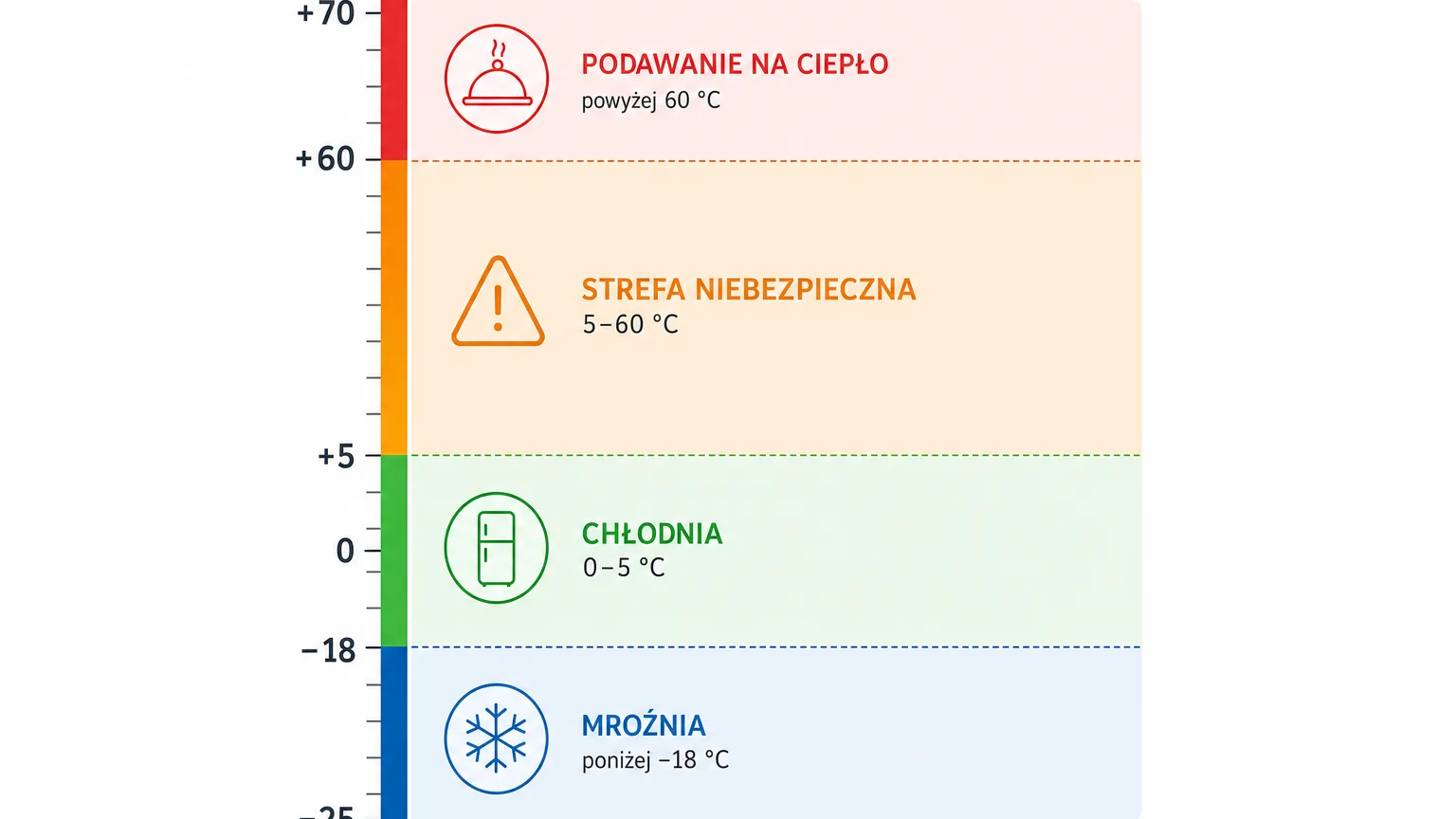
The danger zone: 5–60 °C
The most important row of the chart is not the freezer at all — it is the middle of the scale. Between roughly 5 and 60 °C bacteria multiply fastest, hence the general rule: food should spend as little time in this zone as possible. In practice that means three things:
- Cooling after cooking should carry a dish through the danger zone as quickly as possible — not "until it cools down on the counter".
- Defrosting is done in the fridge, not at room temperature.
- Buffets and service counters are by definition work at the edge of the zone — cold below, hot above, and exposure time under control.
Note that a typical fridge running at 0–4 °C has only 1–5 degrees of headroom before the danger zone begins. A failed compressor, a door left ajar or an overloaded chamber can consume that headroom in less time than the gap between two manual readings.
Frozen goods: −18 °C and not a degree warmer
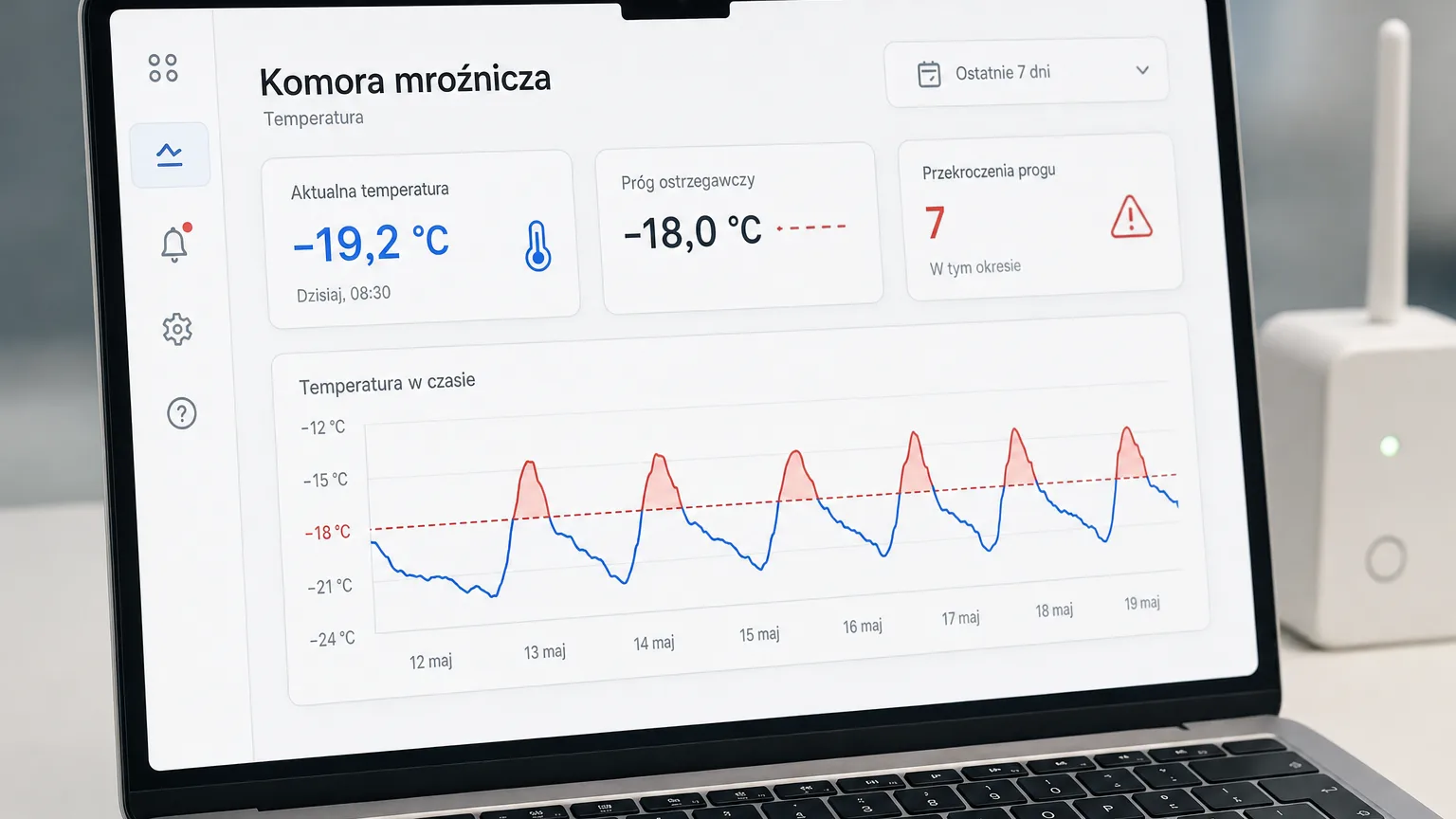
For deep-frozen food the generally accepted limit is −18 °C. Importantly, an elevated temperature does not "spoil" frozen goods instantly — it shortens their shelf life and degrades quality cumulatively, with every warming episode. Which is why a failure alarm alone is not enough; continuous history matters too: only a 24/7 record shows that the chamber balanced at −15 °C for three nights in a row because the compressor is losing capacity.
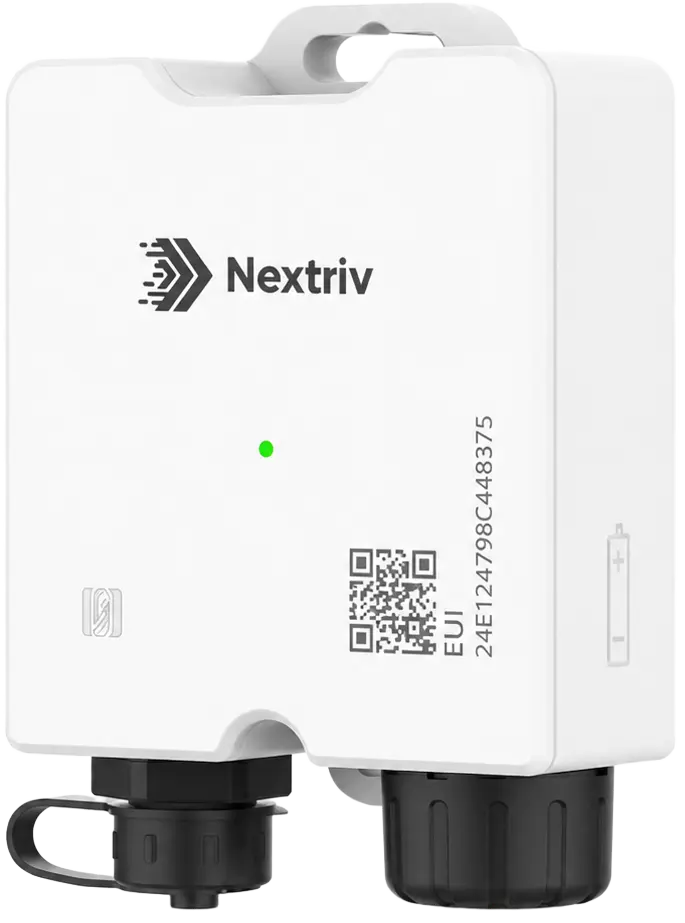
In freezer chambers the "probe inside, transmitter outside" layout works well — the measurement reaches down to −40 °C, and the metal enclosure does not block connectivity.
Cold room: 0–4 °C and 2–8 °C
The chilled section runs on two typical ranges. Raw meat, poultry and fish are stored at 0–4 °C — the closer to zero, the slower microbial growth. For dairy, cured meats and deli products you will often see 2–8 °C, although in practice most kitchens run all their fridges in the lower range and end up with one standard instead of three.
Two traps worth remembering:
- Air temperature is not product temperature. When the door opens, the air warms up instantly — the goods only much later. Measuring inside the product itself (or in a thermal buffer imitating the product) filters out that noise.
- Temperature is not distributed evenly inside the chamber. The area near the door and the top shelves can be noticeably warmer than the interior — the measurement point should match the spot where the goods actually sit.
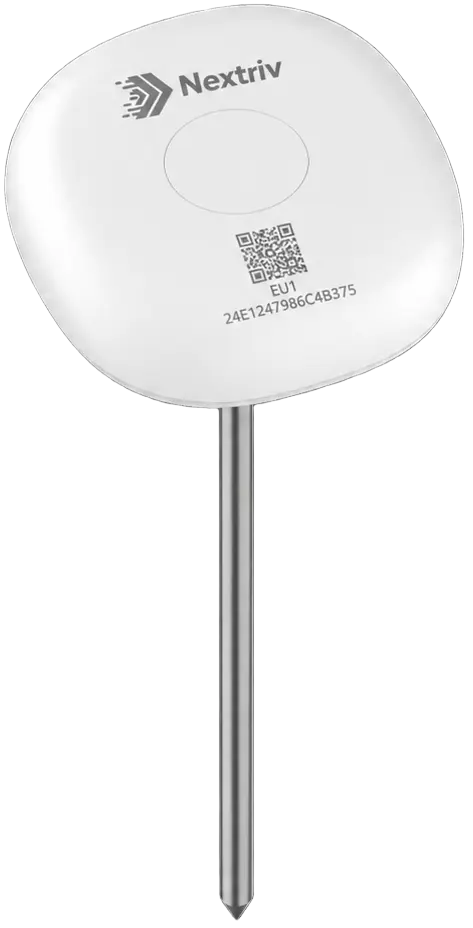
For measuring inside stored products and loose ingredients there is Nextriv Probe Food — a 40 cm spike probe in food-grade 316 stainless steel that measures the temperature deep inside the material rather than the air around it, and raises an alert on a sudden change in the reading.
Goods receipt: the first control point
The chart applies not only on the shelf but already at the loading dock. Goods that arrived too warm will not become any safer just because they go into a working cold room — which is why checking the temperature of every sensitive delivery on receipt is standard practice: frozen goods around −18 °C, chilled goods within the range on the label. A delivery outside the range is an "accept with a note or refuse" decision that has to be made immediately and documented.
It is also worth remembering that the first hours after a delivery put the heaviest load on the chamber: the incoming goods and frequent door openings push the temperature up, and the compressor needs time to claw it back. A continuous record shows how long the return to range takes — and whether the chamber keeps up at full load at all.
How to watch these ranges automatically
A chart on the wall will not protect the stock — continuous measurement and an alarm that reaches a human will. In a monitoring system it looks like this:
- A sensor at every storage point measures temperature every few to a few dozen minutes, around the clock, and buffers readings locally in case connectivity drops.
- Four thresholds per metric mirror the chart: for a 0–4 °C fridge you set a warning threshold of 5 °C and a critical one of 8 °C; for the freezer — a warning at −18 °C and a critical alarm at −15 °C.
- Notifications over multiple channels — email, SMS, web push, Teams or Discord — reach the team immediately, not on the next walkround.
- Measurement history (a full year already on the free plan, up to 5 years) documents that the ranges from the chart were actually maintained — ready-made material for a food safety inspection or an audit.
The complete scenario for food service — from sensors in display counters to signed PDF reports — is described on the HACCP monitoring for food service page.
From a chart to working supervision
Safe food storage temperatures have been well known for decades — the challenge is not the knowledge but enforcing it 24 hours a day, 7 days a week, including the night from Saturday to Sunday. Automatic monitoring costs less than people tend to assume: the FREE plan with 10 sensors and alert rules covers a small venue and costs nothing, and the PRO plan is 99 PLN net / 30 days (excl. VAT).
Check the pricing and count how many storage points you could bring under supervision this very week.


