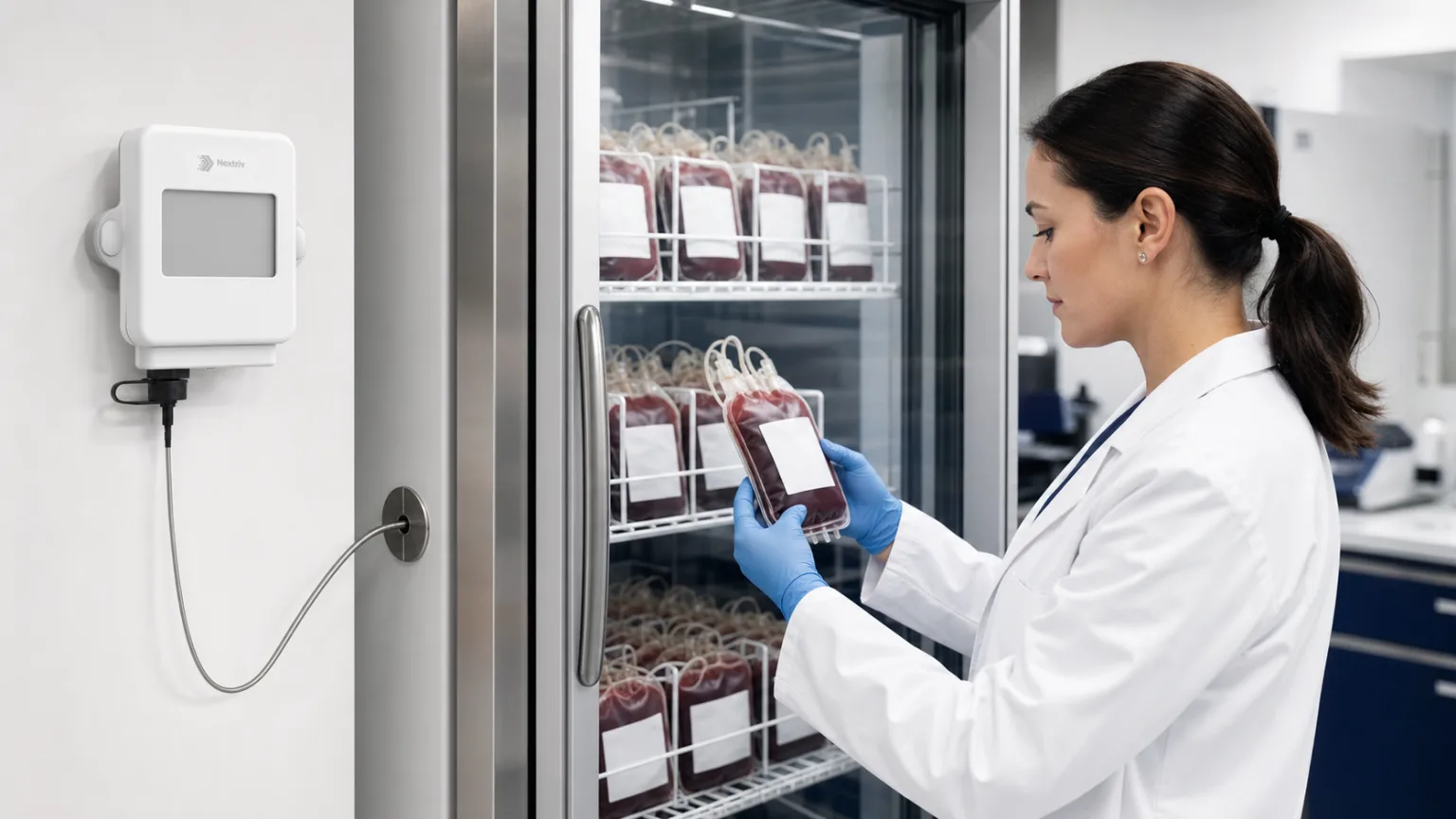
Laboratory Freezer Monitoring — Protecting Samples and Responding to Failure
How to design laboratory freezer monitoring: independent measurement, probe placement, alarms, backup capacity, calibration and a practical sample rescue plan.
Zespół Nextriv5 min read
In this article
A laboratory freezer failure rarely begins with a spectacular temperature jump. More often, the compressor runs for longer, recovery after a door opening slows down, a seal deteriorates, or temperature starts to rise gradually as cooling performance fails. The built-in controller may still display a value and operate its own alarms, but high-value material needs an independent record and a procedure that turns a signal into action.
Well-designed laboratory freezer monitoring protects three things at once: samples, continuity of operations and the credibility of records. It does not replace the freezer controller, preventive maintenance or backup capacity. Its role is to reveal risk early enough, preserve the history and give the team information for a safe decision.
First define what you are protecting
There is no universal alarm threshold for every freezer. Biological material, reagents, reference standards, clinical specimens and working stock may have different requirements defined by a manufacturer, study protocol or quality system. Even two freezers with the same set point may justify different responses if one contains replaceable material and the other an irreplaceable collection.
The risk assessment should answer five questions:
- Which storage range is specified for each material group?
- How long may the material remain outside its target conditions?
- How quickly does temperature change after loss of power or cooling?
- What backup space is available, and how long would transfer take?
- Who decides whether samples are moved, quarantined or kept in use?
Thresholds, recording intervals, any duration logic and escalation follow from these answers. Copying settings from a neighbouring unit is convenient, but may not match the risk of a particular collection.
Independent monitoring: what should be independent?
An external monitoring system should be sufficiently independent of the freezer controller that one fault does not remove both control and notification. In practice, that means a separate measuring chain, local memory, an independent communication path and planned backup for components that rely on mains power.
Two probes attached to the same electronics provide two measurement points, but do not necessarily create two fully independent protection layers. A common power supply, memory or communication channel may remain a single point of failure. The arrangement is valuable for comparing zones or detecting disagreement, while full redundancy still requires a separate assessment.
It also helps to distinguish:
- the local freezer alarm, which can prompt rapid action by someone nearby;
- independent monitoring, which retains history and sends notifications beyond the room;
- the continuity plan, including backup freezer space, transfer equipment and on-call staff.
None of these elements replaces the others.
Where to position the probe
The probe should not be installed solely where mounting is easiest. The measuring point needs to represent sample risk. In large or unevenly loaded units, use mapping data, a temperature-distribution study or the freezer manufacturer's guidance to support placement.
A point beside the evaporator may behave differently from a shelf near the door. A free-air probe responds quickly to door openings and cooling cycles, producing a more variable graph. Placing the sensing tip in a thermal buffer slows its response and can better approximate the inertia of stored material. That is not automatically “better”: an excessive buffer can delay fault detection. The choice should follow the monitoring objective and a response test.
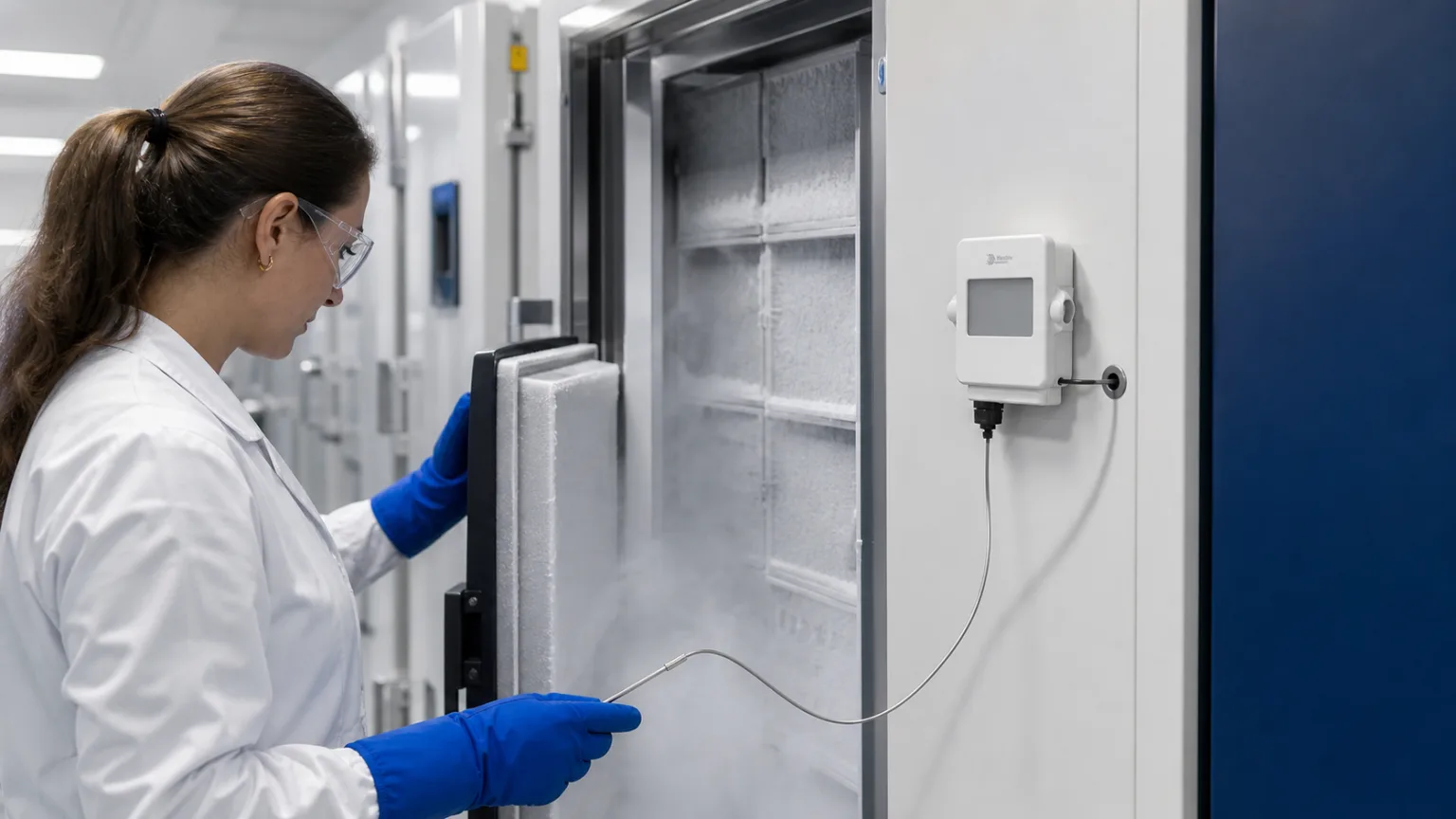
Keep transmitter electronics outside the chamber when their permitted operating range does not cover the freezer interior. A suitable low-temperature probe and cable then enter the chamber. Use a designated access port in accordance with the equipment instructions; a cable trapped in the door seal can cause leakage and frost and become a source of failure itself.
Thresholds and alarms without false confidence
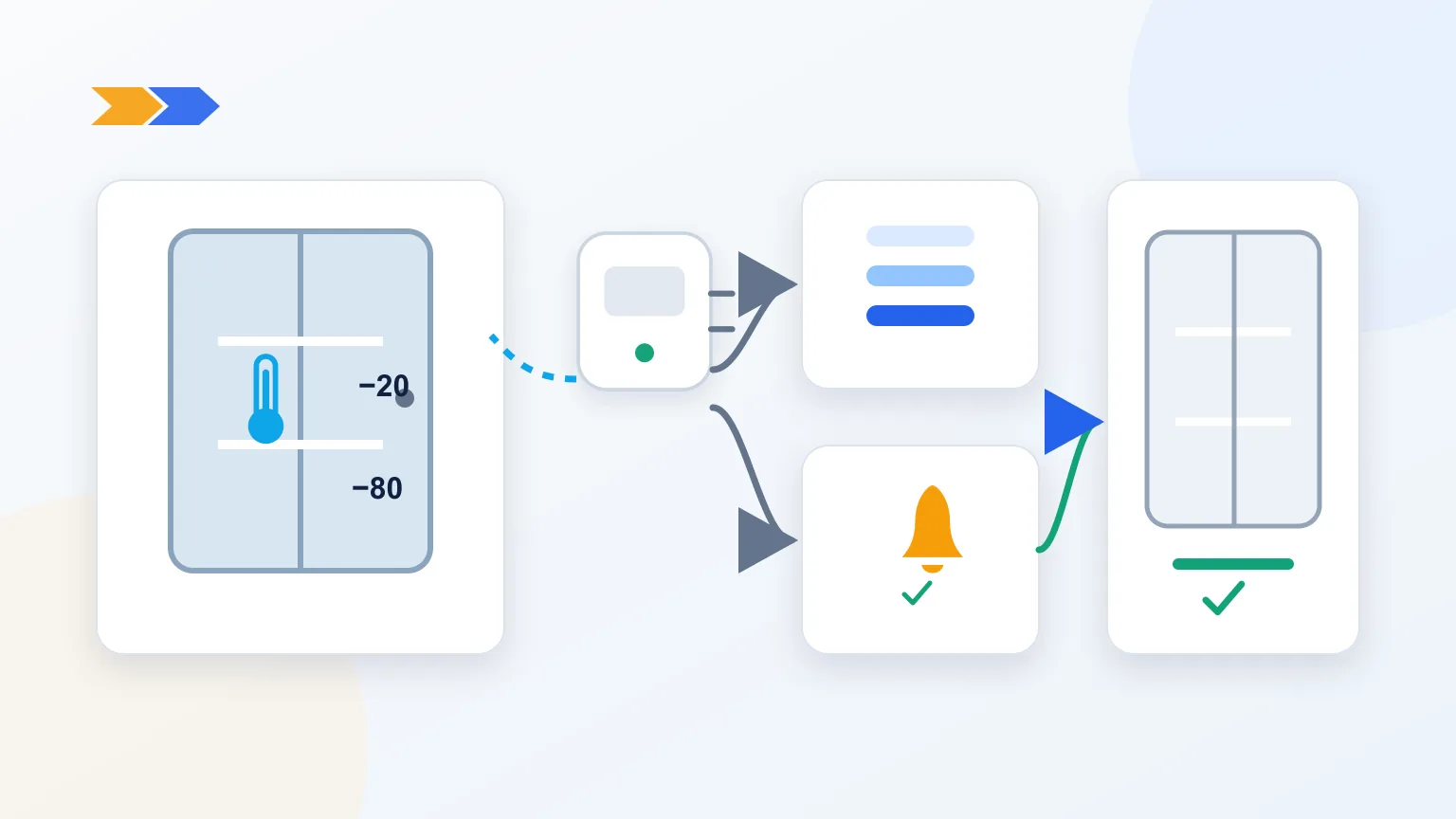
The controller set point is not necessarily the right alarm threshold. A defensible margin considers normal variation, measurement uncertainty, intervention time and the limits accepted for the material. Separating an early warning from a critical alarm can be operationally useful. If the process requires an excursion to be filtered by duration, confirm that logic in the selected device or integration and validate it separately. A standard Nextriv rule evaluates every reported result immediately; delays in the escalation policy apply only to later notifications after an event has been created.
Alarming should cover more than a high-temperature excursion. Depending on the architecture, monitor missing readings, low battery, lost communication and power status. At the same time, avoid flooding staff with repeated messages that add no context. Acknowledgement and escalation rules should name the next recipients when the first person does not respond. Our overview of alert notification channels is useful when designing the on-call path.
The crucial question is practical: at 03:00, does the notified person have authority, building access, free backup capacity and instructions for a safe transfer? If not, even the fastest text message will not rescue the collection.
A step-by-step response procedure
The procedure should be short, available during an IT outage and rehearsed. A typical sequence includes:
- acknowledging the alarm and confirming that data are still arriving;
- verifying the reading independently without unnecessary door opening;
- checking power, refrigeration status, the door and visible damage;
- assessing the trend: stable, rising slowly or losing cooling rapidly;
- notifying the person accountable for the material;
- preparing backup space and a controlled transfer;
- labelling moved samples and preserving identification;
- documenting times, temperatures, actions and the final quality decision.
Do not automatically open the freezer after every alarm. Opening accelerates heat exchange and may make the situation worse. Initial action should follow the trend, manufacturer instructions and the approved contingency plan.
Calibration, testing and records
Every probe used to support a quality decision needs metrological control proportionate to risk. Select calibration points near its actual operating temperature and assess the result together with uncertainty. A certificate without an acceptance criterion does not answer whether the probe is fit for purpose. Our guide to temperature sensor calibration provides practical selection criteria.
Periodically test the full chain from stimulating an alarm condition, through recording and notification, to acknowledgement by the correct person. A planned test does not need to expose a valuable collection to warming. A controlled input simulation, test probe or separate unit may be used where the procedure permits. In a regulated environment, scope and evidence should be consistent with the approach to GxP monitoring validation.
The history must still be intelligible months later: freezer and probe identity, time, unit, data gaps, configuration changes, alarms, acknowledgements and comments. A report without context may show a temperature but fail to prove how the organisation responded.
What a Nextriv setup can look like
For low-temperature work, Nextriv Probe Pro allows the transmitter to remain outside the chamber while a suitable external probe measures inside. The low-temperature probe variant covers measurements down to −200 °C. Local memory protects the record during temporary communication loss. The current standard Nextriv rule editor for Probe Pro and Pro Duo accepts temperature thresholds from −40 to +125 °C. Alarms below that range, including typical ULT-freezer thresholds, require separately confirmed integration logic or an extension of the rule range before deployment.
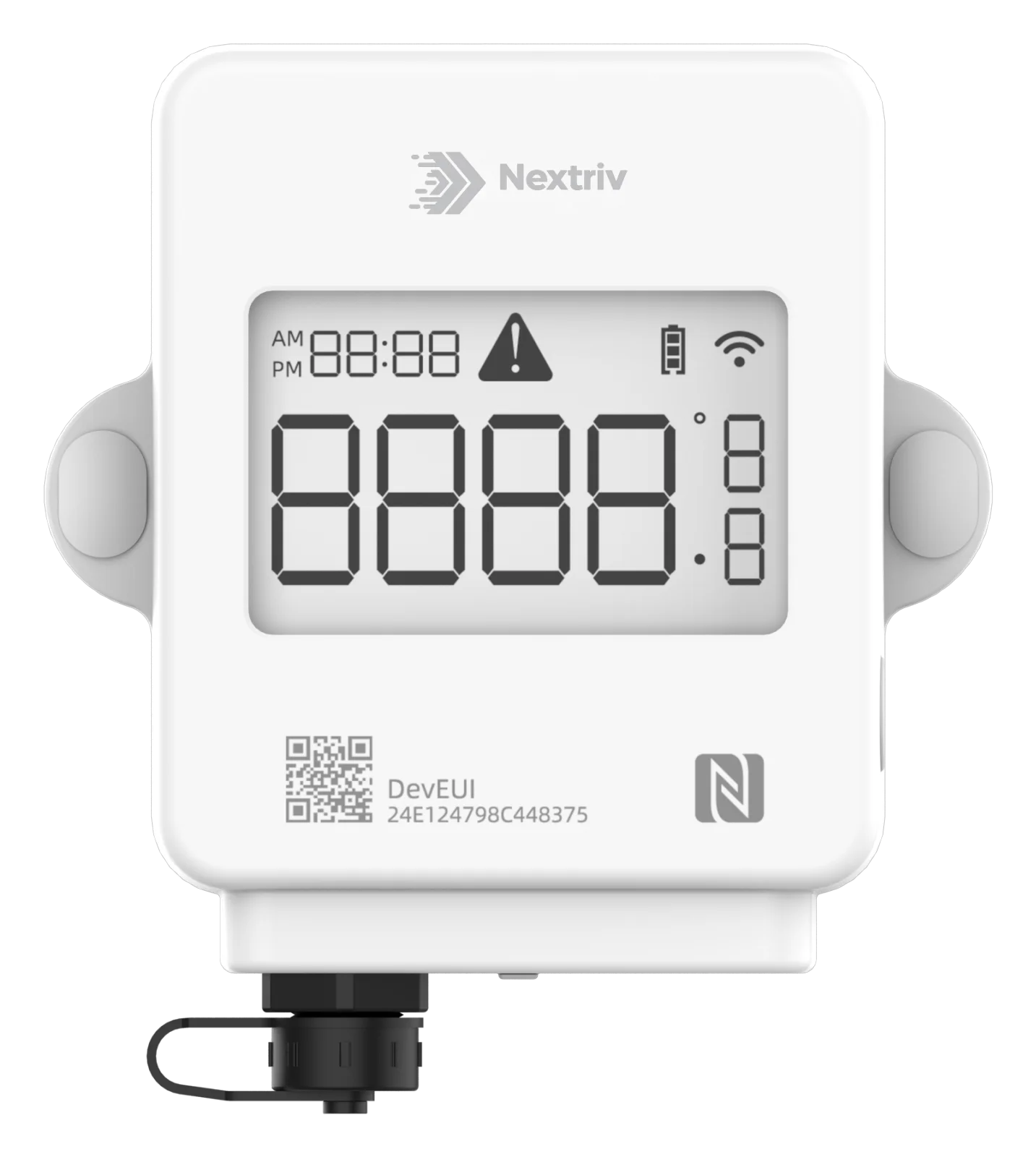
Where two points in one cabinet or a comparison between units is required, Nextriv Probe Pro Duo accepts two inputs and records both channels against a common timebase. Two probes on one transmitter should not, however, be described as full redundancy without assessing shared failure points.
Select the solution against measurement range, required uncertainty, alarm architecture and laboratory procedures. The laboratory monitoring page shows possible system elements, but the final configuration needs an application assessment, not merely a match between product name and equipment type.
Deployment checklist
- Identify the requirements for each sample group and the decision owner.
- Estimate the warming rate and realistic transfer window.
- Choose a representative probe location and document the rationale.
- Verify probe range and the transmitter's permitted operating temperature.
- Set thresholds and escalation from the risk assessment; confirm and validate any required duration logic separately.
- Provide backup capacity, access and suitable transfer materials.
- Calibrate probes at relevant points and define acceptance criteria.
- Test the full alarm path, including on-call response and records.
The best monitoring system does not promise that a freezer will never fail. It ensures that deterioration is noticed early enough, evidence remains complete and the team executes a previously rehearsed sample-protection plan.