
Microclimate in protected crops — a polytunnel is not a greenhouse
Microclimate in protected cropping: how a polytunnel differs from a greenhouse, how to measure temperature, humidity and CO₂, and which alarm thresholds to set.
Zespół Nextriv5 min read

It is tempting to treat the microclimate of protected crops as a single topic: under film and under glass it is "warmer than in the field", end of story. In practice a polytunnel and a greenhouse are two different environments that only look alike from a distance. A greenhouse dampens weather swings — it has the mass of glass and structure, often heating and climate automation. A tunnel amplifies them: a single layer of film heats up and cools down almost instantly, and the only "air-conditioning system" is often the sides rolled up by hand. Anyone who carries greenhouse habits into a tunnel, or runs both types of structure on a single schedule, pays for it in yield. Below — what really happens to the climate under cover and how to measure it, so that decisions are made on data, not on gut feel.
A greenhouse dampens swings, a tunnel amplifies them
The difference starts with physics. A greenhouse has mass: glass, steel structure, floors, water tanks, plus heating, screens and controlled vents. That mass works like a flywheel — it heats up and releases heat slowly, so the daily temperature chart is a gentle wave. A tunnel is a few dozen kilograms of film stretched over hoops. Film stores practically nothing: on a sunny late morning the temperature in a closed tunnel can climb a dozen or more degrees in an hour, and after a cloudless night it can drop almost to the outside temperature.
Three tunnel risks follow from this difference — risks a greenhouse with automation barely knows:
- Daytime overheating. A closed tunnel in full sun quickly climbs above the crop's comfort range — plants slow their growth, flowers set worse, and the reading taken "while doing the rounds" usually comes after the fact.
- Frost under cover. In spring and autumn a single layer of film provides only a small buffer against the surroundings. The regional forecast will not tell you what it is at plant level in your tunnel at four in the morning.
- Night-time condensation. After sunset the humidity in a closed tunnel rises to saturation, and water settles on the chilled film and leaves. A wet leaf for several hours every night is an open door for grey mould and other fungal diseases.
The conclusion is not "the tunnel is worse". The tunnel is simply more dynamic — and a dynamic environment cannot be managed on the basis of two readings a day.
Microclimate of protected crops: three parameters, one picture
Temperature at plant level. Not by the entrance and not under the ridge of the hoop — at crop height, deep inside the structure. Gradients under cover can be surprising: cooler at ground level than a metre higher, different at the end of the bay than by the door, different again near a running heater. In longer structures it pays to measure at two points (start and end of the bay), because the difference between them is often a ready-made diagnosis of a circulation problem.
Humidity and condensation. A temperature–humidity pair from the same point lets you judge how close the air is to saturation and whether the moment is approaching when water will settle on the leaves. This is the data behind the evening airing decision: a brief air exchange before closing the structure can lower night-time humidity and disease pressure — at the cost of a little heat.
CO₂. In a tightly closed structure the crop can consume carbon dioxide faster than air exchange replenishes it. The concentration drops below the outdoor level and photosynthesis slows down, even though there is no shortage of light. In winter, when every airing means losing heat, such a deficit can last for hours — and in greenhouses with CO₂ enrichment, measurement in turn checks that the installation is not dosing too much.

Measurement that survives a season under film
The environment under cover is merciless to electronics: humidity reaches saturation at night, condensate settles on enclosures, and on top of that come spraying, fogging and washing. An "office-grade" sensor ends its season here prematurely. Basic temperature and humidity measurement is therefore best built on hardware made for harsh conditions:
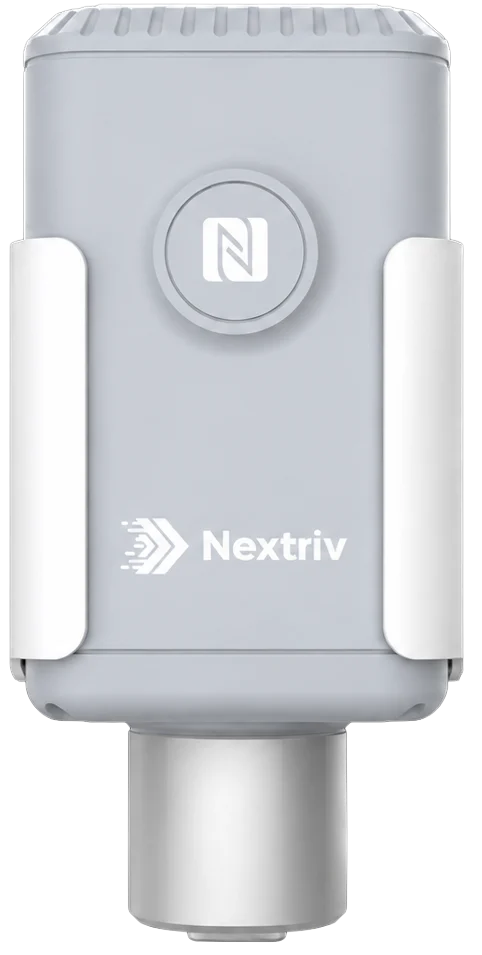
Nextriv Sense Industrial measures temperature to ±0.2 °C and humidity to ±2% in a sealed IP67 enclosure, operates from −30 to 60 °C — including winters in an unheated tunnel — and its two replaceable lithium batteries typically last up to 5 years. The 18 mm profile fits against a structural post, the magnetic variant holds onto steel elements without drilling, and a local log of 3,000 measurements with automatic retransmission closes the history even after a connectivity outage. Configuration happens over NFC — a tap of the phone, no opening the enclosure.
Where the carbon dioxide balance matters too — in a greenhouse with enrichment, in a tightly closed winter tunnel — the fourth parameter is added by the industrial Nextriv Sense CO₂ Industrial: in a single IP65 enclosure it measures CO₂ by the NDIR method (400–5,000 ppm), temperature, humidity and atmospheric pressure, operates from −30 to 70 °C, and a single battery lasts up to 10 years. The infrared sensor is stable over the long term and can be calibrated, so readings do not "drift away" after a season.
Alarm thresholds instead of morning rounds
In the Nextriv platform every metric gets up to four thresholds: two warning and two critical, on both sides of the range. For a tunnel, a sensible starting point looks like this: a lower warning a few degrees above the crop's safety limit (time to react — fleece, a heater), a lower critical threshold right at that limit, and upper thresholds set for overheating on sunny days. For humidity — an upper threshold that warns of night-time condensation before the leaves are wet.
The notification arrives over a channel that will actually wake someone: SMS, email, web push, Microsoft Teams, Discord or an audible in-app alarm. If nobody acknowledges the event, the escalation policy passes it to the next person, and when the temperature returns to the safe range, the system reports the all-clear by itself. The platform also watches the installation itself: a sensor that falls silent for twice its reporting interval immediately gets an offline status — you will learn about a dead battery before the frost does.

Thresholds can drive more than the duty grower's phone — events can be passed via webhooks to the facility's automation. How such a loop works, using ventilation driven by CO₂ measurement as the example, is described in our article on CO₂-controlled ventilation — in a growing structure the principle is identical, only the thresholds change.
One gateway for the whole farm
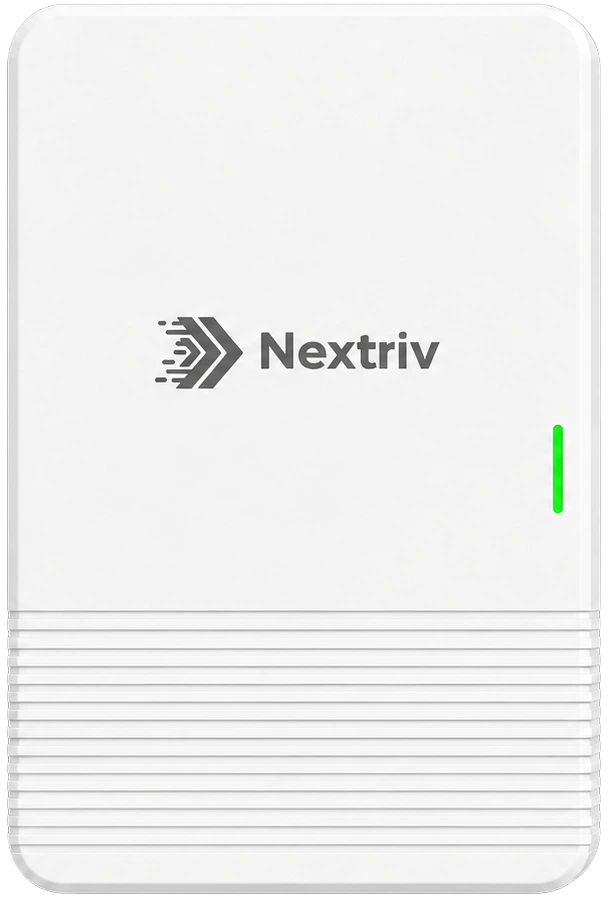
The sensors connect to the gateway over long-range radio — up to roughly 15 km in open terrain and around 2 km in built-up areas. In practice one gateway in a farm building covers tunnels, the greenhouse and the storage facility scattered across the whole farm: no cables run between structures and no SIM card in every sensor. Moving a measurement point to another tunnel is a matter of lifting the sensor off the post.
To start, the free plan is enough: 10 sensors, a gateway, 5 alert rules and a full year of measurement history — enough to get through an entire season and see on the charts where the yield is escaping. What a complete deployment looks like, from sensors to reports, is covered in our solution for agriculture and protected crops. Plan details are on the pricing page, and if you would rather see charts from a real structure — book a demo.


