
Temperature monitoring in crop storage facilities
Crop storage monitoring: which temperatures to hold for potatoes, apples and onions, where to mount the sensors and how to set up alarms that wake you.
Zespół Nextriv4 min read

The easiest way to think about a crop store is as a safe: inside lies the result of an entire season — potatoes, apples, onions, carrots — and the value of the deposit depends on the price its owner intends to wait for. The safe has one weak point, though: its contents are alive. Crops respire, transpire, give off heat and react to every deviation in conditions. Crop storage monitoring therefore comes down to watching two numbers — temperature and humidity — except around the clock, from autumn to spring, at several points at once. Below: what specifically threatens the stock, which conditions to maintain and how to build oversight that wakes you at the right moment.
What threatens the harvest between autumn and spring
- Frost. The zones along walls, gates and uninsulated corners cool down fastest. Frost-damaged produce is unsaleable, and one frosty night with a gate ajar, or a heater failure in January, is all it takes.
- Too warm. Potatoes sprout, onions start growing, apples keep ripening. Worse, respiring produce heats the pile from within — the problem feeds itself, while from the outside the chamber looks normal.
- Condensation. When warmer, humid air reaches a chilled chamber — a thaw, airing at the wrong time — water settles on the produce. A wet surface is the start of storage diseases and rot, which spreads through the pile for weeks.
- Drying out. Too dry an atmosphere means weight loss: the produce simply gets lighter and shrivels, and it is sold by the kilogram.
The common denominator of all four scenarios: they start inconspicuously, at a single point in the chamber, and are cheap to stop only at the beginning.
Crop storage monitoring: which conditions to maintain
Indicative values — the exact ranges depend on the species, the variety and the batch's destination:
- Apples: around 0–4 °C at high humidity (in the region of 90–95% RH); the cooler — short of freezing — the slower the ripening.
- Table potatoes: about 4–6 °C; at lower temperatures starch converts to sugars and the potatoes turn sweet, at higher ones they start to sprout.
- Onions: cool and dry — around 0–2 °C at about 65–75% RH; moisture wakes them up faster than warmth does.
- Carrots and root vegetables: close to 0 °C and humid, otherwise they lose firmness.
A glance at these brackets shows the scale of the problem: the permissible range is often just two or three degrees wide, with loss waiting on both sides. That is a job for continuous measurement with alarms, not for a thermometer by the entrance read in passing.
Where to mount the sensors

A single sensor in the middle of the chamber measures an average — and produce spoils at the extremes. The minimum sensible layout of measurement points:
- The coldest point: by the gate, the north wall or the floor — frost will appear here first.
- The warmest point: the top of the pile or the upper layer of box pallets — that is where the heat of the produce's respiration collects.
- The ventilation outlet: answers the question of whether the installation is actually doing what it is supposed to do.
- A reference sensor outside: night-time airing only makes sense when it is cooler outside than in the chamber, but not freezing — without a reference measurement that decision is a lottery.
The differences between points can be larger than the entire width of the permissible bracket — and it is those differences, not the average, that decide the losses.
A sensor that can take the chamber
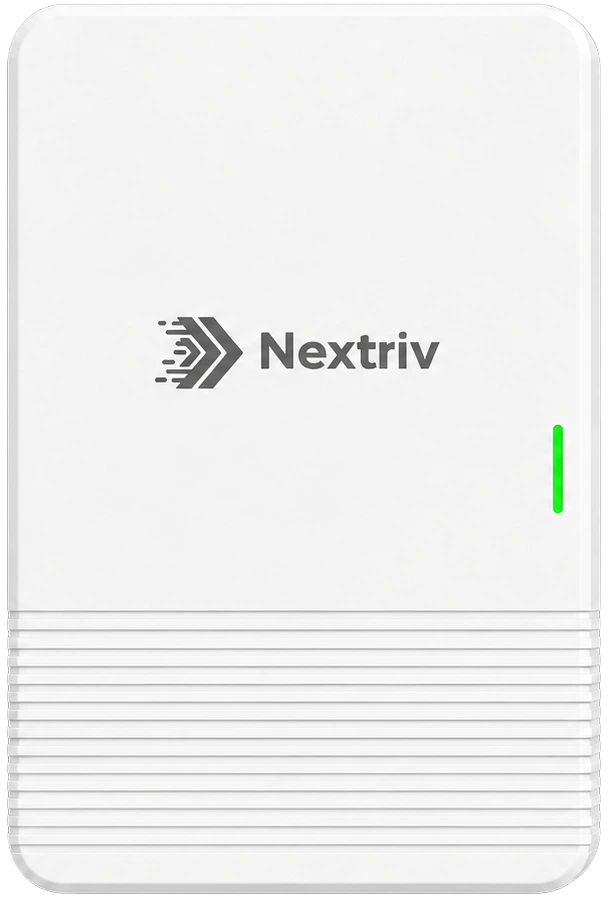
Nextriv Sense Industrial was built for exactly these places: it measures temperature to ±0.2 °C (±0.3 °C below zero) and humidity to ±2%, operates from −30 to 60 °C in a sealed IP67 enclosure, and the magnetic variant holds onto the chamber's steel elements without drilling. The food-grade enclosure (FDA-accepted material) can hang right next to foodstuffs with no sanitary concerns, the EN12830 certificate meets the requirements for temperature recording in refrigeration, and a local log of 3,000 time-stamped measurements backfills the data after every connectivity outage — the chamber's history has no gaps. Two replaceable lithium batteries typically run up to 5 years, i.e. several full seasons without maintenance.
In controlled-atmosphere stores a third parameter joins the temperature–humidity pair: CO₂ concentration. Here the industrial Nextriv Sense CO₂ Industrial does the work, measuring CO₂ by the NDIR method, temperature, humidity and atmospheric pressure in a single enclosure — a complete picture of the chamber's atmosphere from one mounting point. CO₂ is also a matter of human safety: in a sealed chamber full of respiring produce, the concentration can climb to levels dangerous for a worker walking in, and a threshold alarm warns before anyone crosses the doorway.
Alarms that wake you — and a history that stays
In the Nextriv platform every metric gets up to four thresholds: two warning and two critical, on both sides of the range. The warning ones are set tightly around the target bracket — the "check before something happens" signal. The critical ones go where real loss begins: at the freezing boundary and at the temperature where sprouting starts.
Notifications arrive over six channels — email, SMS, web push, Microsoft Teams, Discord and an audible in-app alarm — and escalation policies make sure an alarm on a frosty night does not get stuck on a muted phone: lack of acknowledgement passes the event to the next person. When the temperature returns to the bracket, the system reports the all-clear. The installation itself is under watch too: a sensor with no report for twice its interval gets an offline status, the gateway — after 15 minutes of silence.

After the season you are left with what no notebook can give: a full year of measurement history on the free plan, charts for comparing seasons and chambers, PDF reports with a summary and charts, and XLSX/CSV exports for buyers who ask about a batch's storage conditions. A similar pattern — measurement points, thresholds, escalation policies, documentation — is described step by step for cold zones in a warehouse, and if you also store grain, see our piece on silo level measurement.
From one chamber to the whole farm
The sensors connect to the gateway over long-range radio — up to roughly 15 km in open terrain and around 2 km in built-up areas — so a single gateway in a farm building will cover the store, the tunnels and the remaining structures without cabling. The free plan includes 10 sensors, a gateway, 5 alert rules and 365 days of history — more than enough for the first chamber.
The full scenario for farms is described in our solutions for agriculture and for cold and crop storage. Compare the plans on the pricing page or book a demo — we will show you a frost alarm and a season report on live data.


