
Industrial process temperature monitoring — the PT100 probe in practice
Industrial process temperature monitoring with a PT100 probe: ranges from −200 to +800 °C, ±0.5 °C accuracy, alerts, reading buffer and a calibration log.
Zespół Nextriv4 min read

In this article
- Why PT100: a platinum benchmark instead of a compromise
- Process temperature monitoring with a PT100 probe: electronics away from the heat
- History without gaps: buffer, retransmission and a decade on one battery
- Thresholds, escalations and the calibration log
- Process data ready for an audit
- Your first probe within an hour
Industrial process temperature monitoring is a discipline where ordinary electronics quickly give up — which is exactly why the PT100 probe has ruled it for decades. A platinum sensor does not enter a furnace "for a moment": it lives there. A hardening shop reaching +800 °C, a blast-freezing tunnel going deep below zero, a boiler, a pasteurisation line, a gearbox bearing vibrating twenty-four hours a day — these are environments where a compact room sensor has no business being, and yet the process still has to be measured, documented and alarmed. Below we show how to build that measurement without pulling signal cables across the shop floor and without a cabinet full of transducers.
Why PT100: a platinum benchmark instead of a compromise
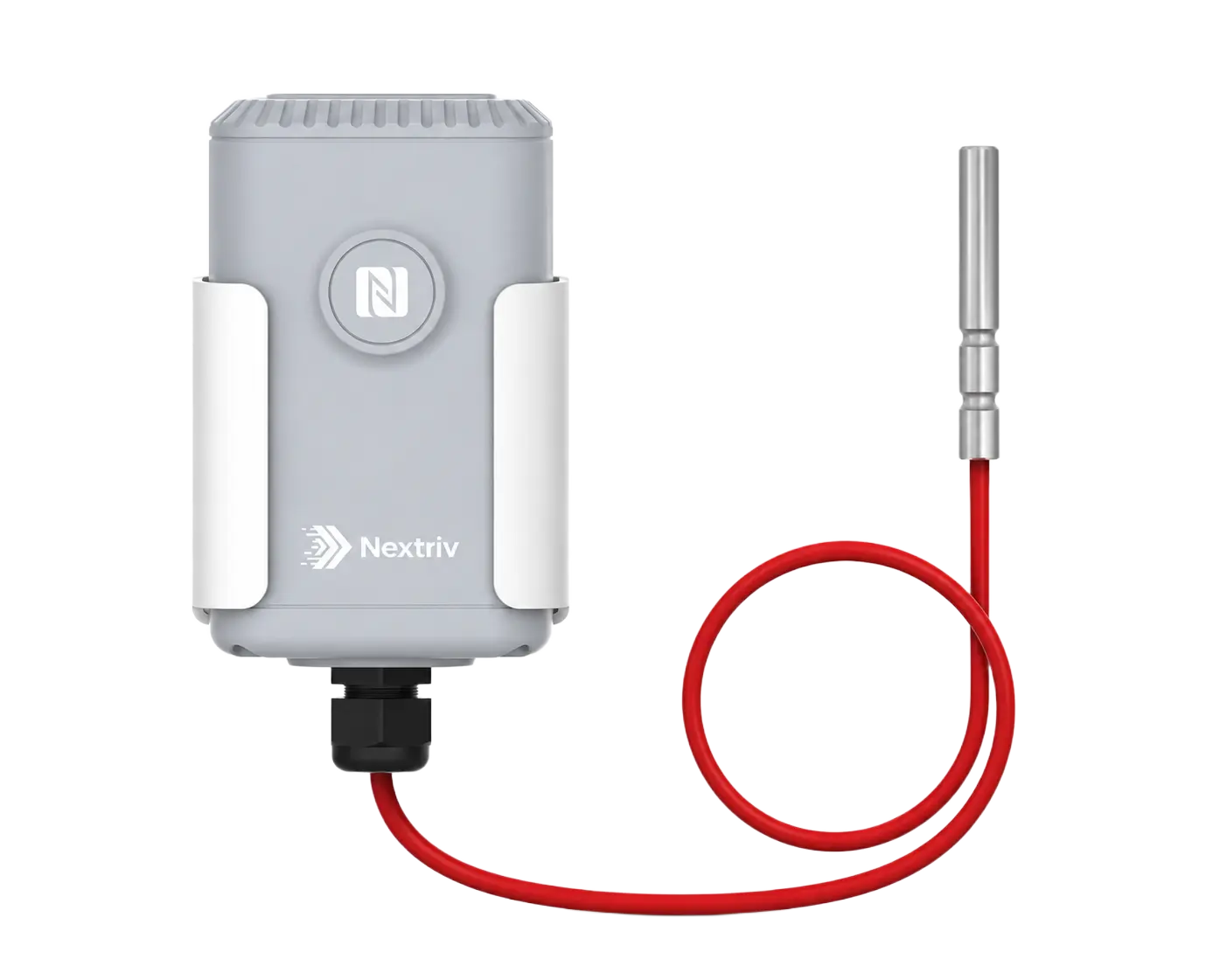
PT100 is a resistance temperature sensor with a platinum element — a material that has been the industrial benchmark of thermal stability for decades. In the Nextriv version, the measurement probe works in a 3-wire connection, which eliminates the error introduced by the resistance of the lead itself, while ±0.5 °C accuracy at 0.1 °C resolution is enough both for safety supervision and for documenting process runs. Four factory range variants (−200…+50, −50…+200, −50…+500 and −50…+800 °C) cover everything from cryogenics to heat treatment, and when the process calls for something unusual, the probe can be ordered to spec: tip type, cable length, any range within the full −200…+800 °C span. You buy a measurement matched to the process, not a compromise from a catalogue.
Process temperature monitoring with a PT100 probe: electronics away from the heat
The key design trick is simple: separating the measurement from the electronics. Only the probe works in the measurement socket, the boiler thermowell or the furnace chamber; the radio and battery sit in a separate IP67-rated transmitter, resistant to vibration and UV, connected by a cable (1.5 m as standard, configurable) and mounted where it is safe — on a wall, a pipe or a DIN rail. In a freezer the transmitter hangs outside the chamber, in the warmth; at a furnace — outside the heat zone. As a result, one device handles conditions that a sensor with electronics in the head simply would not survive.
Data flows to the platform over a long-range radio link — up to about 2 km in built-up areas and up to 15 km in open terrain — so a single gateway collects readings from the whole plant: the boiler room, the production hall, the warehouse and outdoor installations. Zero signal cables, zero intermediate transducers, and thresholds and intervals are configured by tapping your phone (NFC), without opening the enclosure.
The same design serves very different processes: a process engineer in the hardening shop gets a chart of the full heating cycle and an alert on deviation from the profile, a dairy documents temperatures in tanks and on the pasteurisation line, and the maintenance team mounts a probe on a gearbox bearing to catch a rising temperature trend weeks before a failure.

History without gaps: buffer, retransmission and a decade on one battery
In process measurement, a gap in the data can cost more than the failure itself — because gaps are where the evidence disappears. The transmitter keeps a local buffer of around 1000 readings and automatically retransmits the backlog after a connectivity outage, so a momentary radio dropout leaves no hole in the process history. A threshold breach is sent immediately, outside the regular reporting rhythm — the alert does not wait for the next transmission window.
Then there is service logistics: a replaceable high-capacity battery runs for up to 10 years in a typical configuration. You install the probe once and come back only to change the battery — which, with dozens of measurement points across a plant, makes the difference between monitoring and a full-time job of walk-arounds.
Thresholds, escalations and the calibration log
Four thresholds per metric capture the full process logic: warning bands for the process engineer — deviation from the heating profile, temperature drift in a tank — and critical ones for maintenance, when the response has to happen now. Notifications go out via email, SMS, web push, Microsoft Teams, Discord or an audible in-app alarm; every event has a code, a status and comments, and an escalation policy makes sure an unacknowledged alarm moves a level up. A bearing temperature creeping up week after week is, in turn, the classic leading indicator — we showed how to read such trends using refrigeration as the example in our article on predicting cooling failures.
There is one more element industry remembers painfully well: measurement credibility. The platform keeps a calibration log for every sensor — date of the last calibration, due date of the next one, certificate and notes, with automatic reminders. For readings that end up in quality documentation, the question "what was this measured with and when was it calibrated" always comes up; why it pays to have the answer in the system rather than in a binder is explained in our article on temperature sensor calibration.

Process data ready for an audit
Probe readings feed trend charts with automatic resolution selection — continuous aggregates (1 min / 5 min / 1 h / 1 d) mean a full quarter opens just as briskly as yesterday's shift, while zooming in reaches the complete raw data. PDF reports with summaries and charts, plus XLSX/CSV exports, turn the process history into material ready for a quality audit or a process engineer's analysis. How process temperature measurement connects with the rest of plant supervision — machine energy, noise, shop-floor conditions — is covered in our manufacturing solution.
Your first probe within an hour
A pilot deployment is one probe at the most critical point of the process: a boiler thermowell, a furnace chamber, a pasteurisation tank. Mount the transmitter on a wall or DIN rail, configure it via NFC, set the thresholds with your process engineer — and from that moment the process has history, alerts and evidence. The free plan includes 10 sensors, a gateway and a full year of raw measurement history, so the pilot does not require a budget decision.
You will find plan details in the pricing, and if you want to see a heating-cycle chart and a deviation alert on live data — book a short demo.


