
Predicting cooling failures — what temperature and power draw trends reveal
Predicting cooling failures without algorithms: how temperature and power trends expose a failing unit weeks ahead and how to set warning thresholds.
Zespół Nextriv4 min read

In this article
Predicting cooling failures sounds like a project for a data science team: models, algorithms, a budget. In practice, the vast majority of compressor, condensing unit and air conditioner failures don't come suddenly — the unit weakens for weeks, and the symptoms record themselves in two curves anyone can measure: temperature and power draw. All it takes is logging them, watching the trend instead of a single value, and setting warning thresholds well below disaster level. We show how to do it — without a line of code and without reading tea leaves.
A cooling failure is rarely sudden
From the shop floor's or the store's perspective, the failure looks sudden: it worked yesterday, today the goods are thawing. From physics' perspective, it's the finale of a process that lasted weeks:
- A fouled condenser rejects heat ever more poorly — the compressor runs longer and harder to hold the same temperature.
- Refrigerant loss stretches the run cycles and gradually raises the chamber temperature, even though the setpoints haven't changed.
- Wearing bearings in the fans and compressor increase resistance — and therefore current draw — long before anything starts making noise.
- An iced-up evaporator chokes heat exchange: the unit runs almost non-stop, yet cools ever more weakly.
Each of these mechanisms leaves a trace in the data long before the day the phone rings. The trouble is that the trace is subtle: half a degree here, a few percent of power there. A single reading looks perfectly normal — only the trend reveals the direction.
Predicting cooling failures in practice: two trends instead of fortune telling
The temperature trend — not the value, but the shape
On a temperature chart, weakening cooling shows up in three signals:
- Drift of the mean. The average temperature of the chamber or zone creeps upward by fractions of a degree per week at unchanged setpoints. Invisible in the live view — obvious on a one-month chart.
- Lengthening recovery. After defrosting, a delivery or a door opening, the temperature takes longer and longer to return to setpoint. Recovery time is the most sensitive indicator of melting cooling headroom.
- Growing cycle amplitude. The "saw teeth" on the chart get taller and less frequent — the unit is losing the ability to pull the temperature down quickly.

The power draw trend — the unit's ECG
The electrical measurement tells you about the machine's condition what the temperature doesn't show yet. Rising power at the same setpoint means falling efficiency — the classic symptom of a dirty condenser. Rising daily kWh at unchanged load means the unit runs longer and longer for the same effect. And a current spike above the threshold is no longer prediction but an overload alarm — the last bell before the protection trips.

The most telling view is both curves on a single chart. Stable temperature with rising power means the unit is compensating for lost efficiency with power; when the temperature starts rising too — the headroom has just run out.
What to measure with: a measurement point in an hour
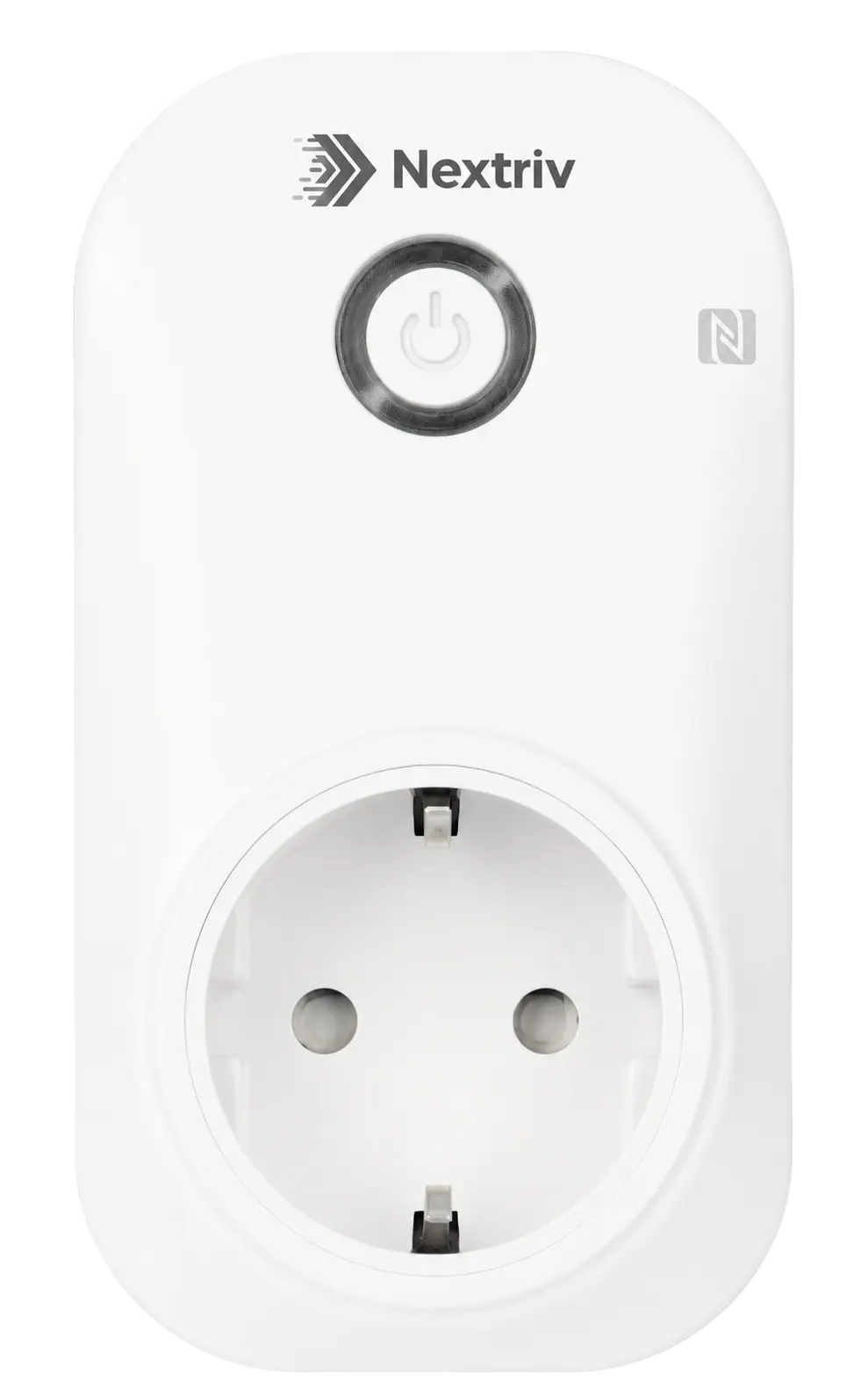
For plug-in equipment — a display case, a laboratory refrigerator, a portable air conditioner — you measure power draw without an electrician. A smart pass-through plug logs voltage, current, active power, power factor and cumulative kWh separately for each load, and on top of that alarms on overload and power loss.
Where the machine itself needs measuring — a bearing, a compressor, a chilled water line — the industrial platinum probe Nextriv Probe PT100 does the job: ±0.5 °C accuracy, a vibration-resistant IP67 transmitter, a battery lasting years of operation and a local measurement buffer with retransmission after connectivity outages, so the trend has no gaps.
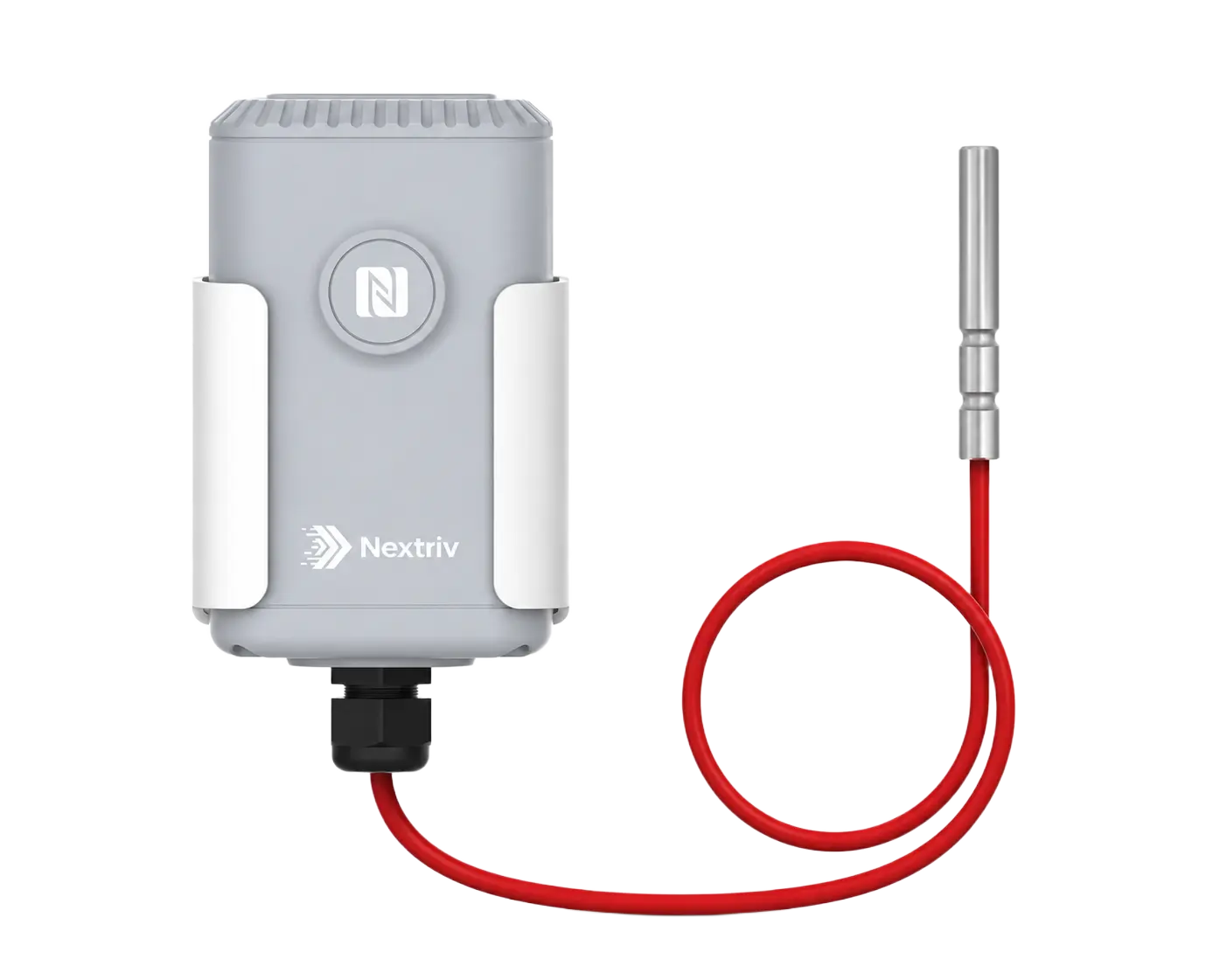
Both devices connect to the platform over long-range radio, whose signal passes through the walls of halls and chambers — with no cabling. Automatic discovery registers a new device in the platform within 30–180 seconds of power-up.
Four thresholds: the warning one is your prediction
In Nextriv every metric has four thresholds: warning and critical, lower and upper. This distinction is the heart of the whole method. The critical threshold protects goods and equipment — that's the "here and now" reaction. The warning threshold, set just above the normal operating range, catches the drift — and it's the one that plays the role of prediction.
A practical recipe: after the first month of measurements, read the normal range of temperature and power draw off the charts and set the warning thresholds 10–15% above the typical peaks. Crossing them doesn't mean failure yet — it means a maintenance order: condenser cleaning, refrigerant check, defrosting. Cheap planned servicing instead of expensive emergency servicing.
Every breach opens an event with a unique code (e.g. ALM-7C2F19) and a severity level, and deduplication makes sure one problem stays one event. The notification goes through the channel the team actually reads — email, SMS, push, MS Teams, Discord or an audible alarm in the app; the webhooks integration passes the event straight into the maintenance ticketing system — and escalation policies make sure an unacknowledged alert moves a level up. One more thing: the worst trend is no data. A sensor that goes silent for twice its reporting interval automatically gets offline status — because silence can be a symptom too.
History that turns a trend into a forecast
A weekly chart shows the drift; a yearly one gives context. A July rise in power draw may be degradation — or simply summer. The comparison with the same period settles it: the same season, similar load, clearly higher power — efficiency is falling. The free Nextriv plan stores raw measurements for 365 days, the paid one for 1825 days (5 years) — enough to compare season against season across the unit's whole life cycle.
On a dashboard you'll overlay both curves on one multi-series chart, the sensor comparison widget will show which of five display cases is the outlier, and virtual sensors will compute e.g. the zone's average temperature as a separate metric. PDF reports and XLSX/CSV exports turn the trend into a hard argument at the technical review.
The same method works wherever cooling is critical: in the server room and data center, where the rising draw of precision cooling foreshadows hot spots, and in a manufacturing plant, where a chiller, a machine cooler or a storage chamber rarely fails during service business hours.
Start with the most expensive failure
You don't need a six-month pilot programme. Pick the device whose failure would hurt the most, hook up power measurement, add a temperature probe and give the data a month to show the norm. The free plan — 10 sensors, one gateway, a year of history — is enough to start without any subscription.
Compare the plans in the pricing or book a demo — we'll show on live data what a weakening unit looks like on a chart before it becomes the title of a service ticket.


