
CO2 standards for public buildings — what the guidelines say
CO2 standards for public buildings without the myths: EN 16798-1, the Pettenkofer number and Polish ventilation guidelines turned into alert thresholds.
Zespół Nextriv4 min read

CO2 standards for public buildings are a topic where the first surprise arrives quickly: Polish law contains no single number saying how much carbon dioxide is "allowed" in a classroom, a public office or a library. Instead of a concentration limit, the regulations govern ventilation, while the specific ppm values come from standards and guidelines — European and historical. The good news: those sources agree with each other surprisingly well, and a coherent, defensible set of thresholds can be assembled from them. Below we sort out where the specific numbers come from and how to translate them into monitoring that works just as well in a school as in an office building.
CO2 standards in buildings: three sources of guidance
The Pettenkofer number — about 1000 ppm. As early as the 19th century, Max von Pettenkofer identified a concentration of around 1000 ppm as the limit beyond which air stops being perceived as fresh. That value has survived 150 years of research and remains the most frequently cited reference point for occupied spaces — from classrooms to customer service halls.
EN 16798-1 — categories, not one limit. The European standard for indoor environmental parameters (the successor to EN 15251) defines air quality categories from I (highest) to IV (lowest) — and, importantly, describes them as CO₂ concentration above the outdoor air level, which today is around 420 ppm. The higher the category, the smaller the allowed increment. In practice, buildings aiming at the middle categories stay below roughly 1200 ppm in absolute terms, and the more ambitious ones — below roughly 950 ppm. The standard speaks of a difference against the background, so thresholds should be set with local outdoor conditions in mind.
Polish regulations — via ventilation, not ppm. The technical conditions for buildings refer to ventilation standards, which define the minimum outdoor air flow — for rooms intended for permanent occupancy, at least 20 m³/h per person is assumed (more in air-conditioned rooms and rooms without operable windows). This is an indirect approach: if the ventilation delivers the required flow, the CO₂ concentration should stay within reasonable limits. "Should" — because an overcrowded room or a neglected air-handling unit can invalidate that calculation, and without measurement nobody will notice.

What the guidance means in practice: school, public office, workplace
Theory meets reality in cubic metres. A school classroom is the extreme case: 25–30 people in a room of a few dozen square metres means the CO₂ concentration climbs by several hundred ppm every lesson without airing. Measurements taken in schools — Polish and European alike — regularly show readings above 2000 ppm before the bell rings, especially in winter, when the windows stay shut. A customer service hall in a public office or a library reading room behaves more gently, but the mechanism is the same: the number of people divided by the volume and the air exchange.
An important practical conclusion follows: a standard met "on paper" in the ventilation design does not guarantee the guidelines are met in operation. Occupancy runs higher than designed, diffusers clog up, heat recovery units run in economy modes. The only way to know how the building really behaves is continuous measurement in the rooms — not a one-off audit on a random Tuesday.

From guidelines to alarm thresholds
The three sources above combine into a coherent, three-step setup that proves itself in deployments:
| CO₂ concentration | Interpretation | Action |
|---|---|---|
| up to 800 ppm | fresh air, around the higher EN 16798-1 categories | the desired state |
| ~1000 ppm | the comfort limit (the Pettenkofer number) | warning threshold — air the room, increase ventilation |
| ~1400 ppm | noticeable stuffiness, falling concentration | critical threshold — response from facility staff |
| above 2000 ppm | the typical end of a lesson or a meeting without airing | evidence of a systemic ventilation problem |
In the Nextriv platform every metric has up to four thresholds (warning and critical, lower and upper) — for CO₂ the two upper ones are enough. Breach notifications reach the right people on a channel they actually read: email, SMS, web push, Microsoft Teams, Discord or an audible in-app alarm. Escalation policies make sure an unacknowledged alarm goes a level up, and PDF reports document the conditions for the head teacher, the governing body or the facility manager.
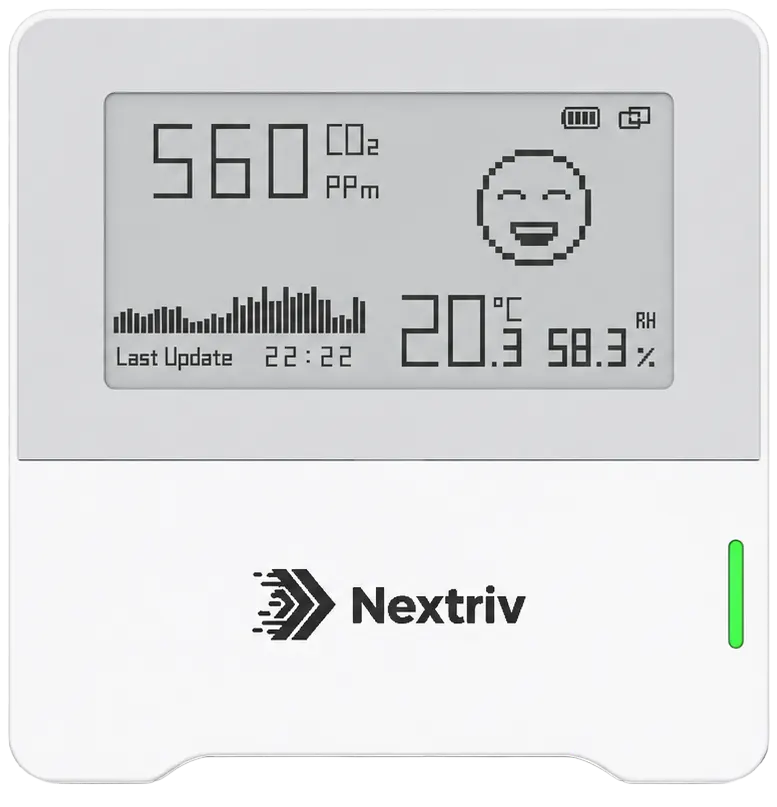
The credibility of the thresholds, however, starts with the credibility of the measurement. In public buildings, optical NDIR measurement proves itself — stable over the years and calibratable, unlike cheap sensors that estimate CO₂ indirectly. Nextriv Sense CO₂ measures by the NDIR method across 400–5000 ppm with ±(30 ppm + 3% of reading) accuracy, and the e-ink display variant shows an emoticon anyone can understand — pupil, visitor and teacher alike — with no knowledge of "ppm" required. Years of operation on replaceable batteries and a long-range radio link mean installation without cabling: tape or screws plus configuration via NFC.
From measurement to better ventilation
CO₂ monitoring in a public building pays off twice. First — in the health and concentration of the occupants: airing stops being a ritual and becomes a response to data. Second — in energy: the same readings let you run demand-controlled ventilation instead of airing empty rooms on a schedule. How to connect the sensors to the air-handling unit and how much can be saved is described in our article on CO₂-controlled ventilation. And if CO₂ is only your way into the topic, you will find a guide to all the parameters — from humidity to particulates — in our piece on air quality in the office.
Full deployment scenarios are shown in our industry solutions: for schools and educational facilities (a sensor in every classroom, reports for the management) and for buildings and offices (zones, floors, tenant reporting).
Start with one room
There is no need to instrument the whole facility at once. One sensor in the busiest room — the one everyone complains about — and two weeks of data are enough to see how far from the guidelines the building really is. The free plan includes 10 sensors, a gateway and a full year of measurement history, so the pilot costs nothing beyond the hardware.
Check the pricing or book a short demo — we will show you a daily CO₂ profile from a real classroom and the alerts that watch the guidelines for you.


