
Air quality in schools — a principal's guide
Air quality in schools: how much CO₂ a classroom reaches by the end of a lesson, which alarm thresholds to set and how to report it to the authorities.
Zespół Nextriv4 min read

In this article
- Air quality in schools starts with CO₂
- Measurement instead of impressions: what and where to measure
- A sensor nobody needs to have explained
- "CO₂ in every classroom" without breaking the budget
- Thresholds and notifications: 800 ppm is a signal, 1200 ppm is an alarm
- A report that will convince the school authority
- From a pilot to the whole school
Air quality in schools rarely makes it onto the staff meeting agenda — until someone measures what is really happening in a classroom by the end of third period. Thirty people in a closed room for 45 minutes guarantees a rise in carbon dioxide, and with it drowsiness, falling concentration and a wave of complaints about "stuffiness" that, in winter, a short airing at break does not fix. The good news: this is one of the easiest parameters of a school building to measure — and one of the cheapest to improve. This guide organises the topic from a principal's perspective: what to measure, with what, which thresholds to adopt and how to turn the measurements into a report that will convince the school authority.
Air quality in schools starts with CO₂
Carbon dioxide at the concentrations found in buildings is not toxic — but it is the best indicator of whether the ventilation is keeping up with the number of people in the room. The optimal zone for mental work is taken to be 400–800 ppm; above roughly 1000 ppm concentration starts to drop noticeably — for pupils and teacher alike. A full classroom can cross that threshold long before the bell, and after a short airing the concentration climbs back to its previous level within a dozen or so minutes.
The trouble is that CO₂ cannot be seen or smelled — the nose acclimatises to "heavy air" within a few minutes, so someone who has been sitting in the room since morning judges it completely differently from someone who has just walked in. The "is it stuffy in B12" debate without a measurement is futile: everyone is right and nobody is.
Temperature and humidity complete the picture. Overheated rooms on the south elevation, a chilled wing above the passageway, parched air in the middle of the heating season — all of these gut-feel complaints only become concrete once a chart can be laid down next to them.
Measurement instead of impressions: what and where to measure
Three parameters are enough to start with: CO₂, temperature and relative humidity. When choosing hardware, it's worth insisting on two things. First, optical (NDIR) CO₂ measurement — unlike cheap sensors it doesn't age or drift, and it can be calibrated in service. Second, accuracy in the ±0.2 °C and ±2% RH class — enough to settle disputes rather than fuel them.
The sensor goes on the wall at the height of a seated pupil, away from the window, the door and the radiator — a measurement above the radiator measures the radiator, not the classroom. Battery devices with long-range radio (around 2 km in town, up to 15 km in open terrain) need no cabling whatsoever: a single gateway covers the whole building, gym in the separate wing included, and mounting a sensor means tape or two screws plus configuration by holding a smartphone to it over NFC.

A sensor nobody needs to have explained
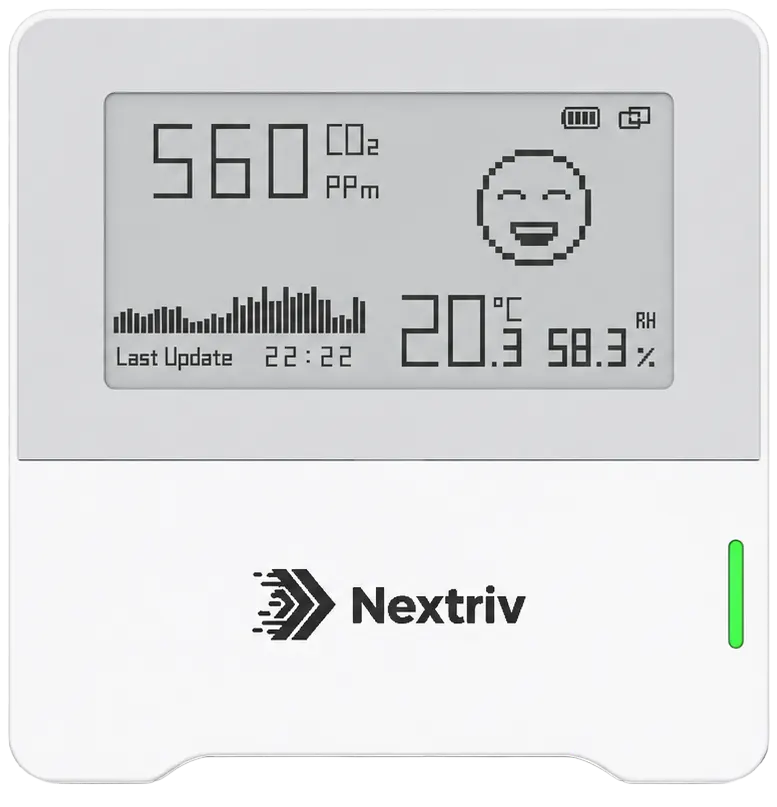
In a classroom, the best device is one that communicates the state of the air on the spot, with no app and no training. The Nextriv Sense CO₂ shows an emoticon on its e-paper screen — a smiling, neutral or sad face — readable by a first-grader, and a traffic-light LED signals when it's time to air the room. The teacher doesn't need to know what "ppm" means: a red light means "open the window". Replaceable batteries last years, so a fleet of sensors creates no chores for the caretaker.
"CO₂ in every classroom" without breaking the budget
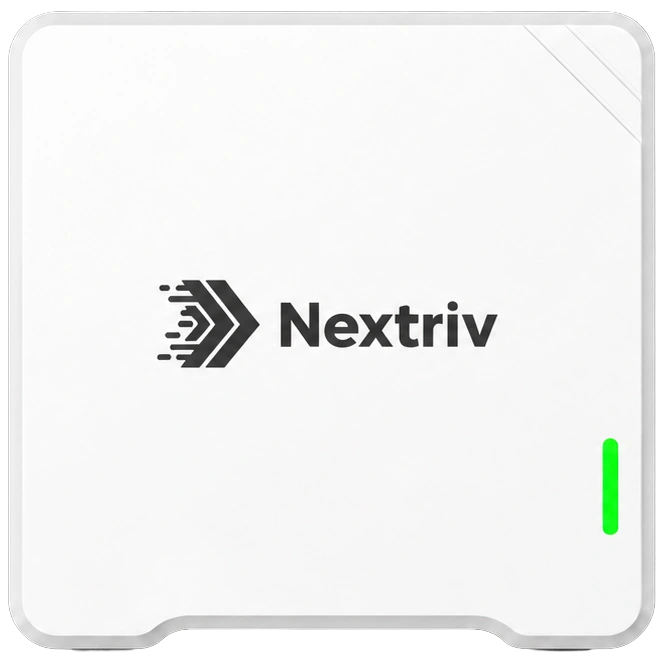
With a dozen or several dozen rooms, the price of a single measurement point starts to decide everything. For equipping an entire building there is an economy variant: a 5-in-1 sensor that measures CO₂ with the same optical NDIR system as the higher-end models, plus temperature, humidity, light and motion. No screen — discreet and tamper-resistant — but with a bonus: the motion and light data show the actual use of classrooms, the common room or the library. Around 6 years on replaceable batteries means the cost of maintaining the fleet over a principal's entire term is practically zero.
Thresholds and notifications: 800 ppm is a signal, 1200 ppm is an alarm
In the Nextriv platform, each metric can carry four thresholds — two warning and two critical. A typical setup for a classroom is a warning at 800 ppm and a critical alarm at 1200 ppm; it's worth setting analogous bands for temperature and humidity. Notifications arrive over the channel the team actually reads: email, SMS, web push, MS Teams, Discord or an audible alarm in the app. Notification rules can be filtered by location and severity — the front office gets its own floor, the administrator gets everything.
An important detail: a sensor that goes silent for twice its reporting interval is marked offline, and the platform reports it. The system tells "the air is fine" apart from "we have no data" — a difference appreciated by anyone who has ever discovered a dead logger after the fact.

A report that will convince the school authority
Measuring in the classroom is half the value; the other half emerges at building level. Dashboards with nearly 20 widget types set classrooms side by side and show where the problem is chronic and where it is incidental. PDF reports with a summary and charts, plus XLSX/CSV exports, go straight into official reporting — and a "before and after" comparison for a ventilation upgrade or window replacement stops being a claim, because the free plan stores raw measurements for a full 365 days and the paid plan for up to 5 years. A funding application with that attachment is not an opinion — it's evidence.
A school is more than its classrooms, too. The canteen and its cold storage have their own, stricter requirements — we wrote about them in the article on critical control points in food service. The same gateways and the same platform will handle both topics at once.
From a pilot to the whole school
You don't have to start with a tender. The free plan includes 10 sensors, a gateway, 2 users and 5 alert rules — just right for a pilot: the busiest classrooms, the common room, the staff room. After a term of data, the decision to expand makes itself; and we wrote about how the whole platform works at Nextriv's launch.
The full deployment scenario — from a sensor in the classroom to reports for the school authority — is described in our solution for schools. Plan details are in the pricing, and if you'd rather see a school dashboard on live data — book a short demo.


