
BMS vs Independent Monitoring — Control, Evidence and Alarms
BMS or independent monitoring? Compare their roles, common-mode failures and a hybrid model combining building control with credible environmental records.
Zespół Nextriv5 min read
In this article
- BMS and monitoring answer different questions
- Two probes do not necessarily mean independence
- When the BMS alone may be sufficient
- When a separate layer adds real value
- The hybrid model: integration without surrendering separation
- A test that examines the architecture, not just the dashboard
- A three-step decision
- Sources
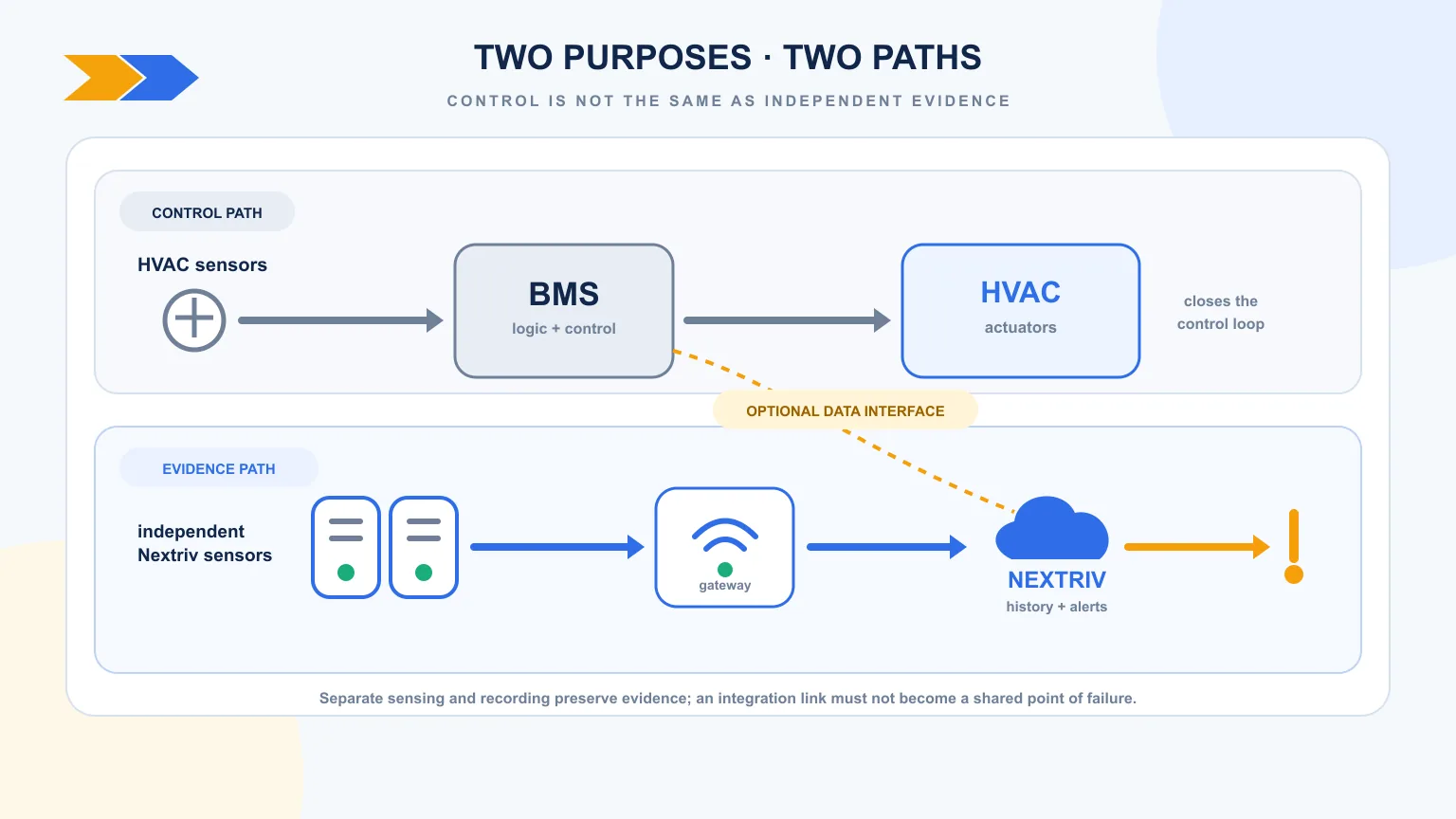
BMS or independent temperature monitoring? In many facilities, that is the wrong either/or question. A building management system is very good at controlling air-handling units, valves and chillers, while a separate monitoring layer can provide an independent record, alarm over another route and cover locations the BMS does not see. The objective is not to duplicate every probe or assume one system is inherently superior. It is to separate three roles: controlling the process, documenting conditions, and notifying people when control may have been lost. The degree of separation should follow the consequences of failure and an analysis of common failure points.
BMS and monitoring answer different questions
A BMS is normally designed to make the building operate: maintain supply temperatures, switch pumps, regulate airflow, run schedules and help reduce energy use. Its sensors are part of control loops. A reading primarily supports a decision such as “open the valve or close it slightly”. This matches the role of building automation and control in the EU Energy Performance of Buildings Directive: supporting efficient, economical and safe operation of technical building systems through automatic controls and facilitating manual management.
Independent monitoring focuses on other questions: “What conditions actually prevailed beside the product or equipment?”, “Is the record complete?”, “Who received the alarm?” and “Can we reconstruct the event after a failure?” It may cover a cold room, a pharmacy refrigerator, a server rack inlet or the warmest warehouse point identified during mapping.
The boundary is not absolute. A capable BMS can archive data and alarms, and a monitoring platform can pass measurements to other systems. The difference comes from project objectives, validation, data retention and resistance to a common failure — not the label on the screen.
| Area | BMS | Independent monitoring |
|---|---|---|
| Primary objective | control and optimise building services | evidence of conditions, alarm and history |
| Typical points | AHUs, plant rooms, loops and HVAC equipment | risk locations defined by the process and mapping |
| Configuration changes | part of automation and service work | should be controlled and historically traceable |
| Response | automatic actuation | notification, escalation and a documented human decision |
| Common-mode risk | control and recording may use the same path | sensing, power and communications can be designed as a separate path |
Two probes do not necessarily mean independence
The most common mistake is counting points without examining dependencies. Two inputs on one controller share electronics and power. Two systems writing to one server share storage and administration. Two alarms sent through the same internet gateway can fall silent together. Independence should therefore be examined layer by layer:
- Sensing element — can one probe failure affect the other reading?
- Electronics and power — is there a shared controller, power supply or UPS?
- Communications — do both data paths use the same bus, network and uplink?
- Processing and storage — do both paths terminate on the same machine or database?
- Notification — can the alarm travel over another route to the right person?
- Maintenance — can one software update, administrator account or configuration mistake disable both paths?
Complete separation at every layer would be costly and often unnecessary. One well-maintained system may be proportionate for ordinary office comfort. A warehouse holding sensitive product, a refrigerator containing biological material or a temperature SLA may justify separate measurement and alarming because the cost of lost evidence is much higher. The decision belongs in a risk assessment, not under a generic “redundant” label.
When the BMS alone may be sufficient
Using one system can be rational when the consequence of error is low, the BMS points truly represent the monitored space, the record meets the required retention period, and alarms and calibration are tested regularly. Ordinary comfort and energy analysis in a small office is one example, provided a temporary data gap does not affect product safety or a contractual obligation.
The facts still need checking rather than assuming them from a brochure. Does the BMS keep raw values or only averages? Does an export include timestamps and quality status? Is there a record when an integrator remaps a point? Can history be recovered after a server replacement? Does the alarm travel beyond the control room? Combine this review with the questions in our guide to choosing a monitoring system.
When a separate layer adds real value
Independent monitoring is particularly defensible when:
- temperature determines product quality or whether it can be used;
- an auditor, insurer or customer expects reproducible evidence;
- the BMS measures technical plant but not the point representing the product;
- a facility has an old or closed automation system that is expensive to extend;
- multiple sites have different BMS platforms and head office needs a common view;
- loss of the automation server must not also silence the environmental alarm;
- changes, calibration and event acknowledgements need a separate control trail.
In a data centre, the BMS may control cooling while independent sensors at rack inlets document the conditions covered by a customer contract. Our article on temperature SLA evidence shows how to build that record. Across a retail or healthcare estate, a common view above different local automation systems is another benefit — the core use case in multi-site monitoring.
The hybrid model: integration without surrendering separation
The most useful result is often a hybrid design. The BMS continues to control the building, while an independent platform measures risk-based points, retains history and manages escalation. The systems can exchange data through a controlled interface: for example, Nextriv can send measurements and events to customer tools through the options described on the integrations page. Integration does not require turning everything into one common point of failure.
Define the data direction and accountability:
- which system is the source of the measurement used for control;
- which record is treated as reference evidence during an excursion;
- whether an integration failure removes only the combined view or also the alarm;
- how missing or stale data is identified;
- who approves changes to point mapping and thresholds;
- how the two systems maintain a consistent time base.
Nextriv should not be presented as a functional-safety system or a controller replacing certified safeguards for machinery, burners or process installations. Critical interlocks and the safe state belong in correctly engineered local automation. A cloud monitoring layer provides observability, history and notification — not a SIL claim or a guarantee that a safety function will operate.
A test that examines the architecture, not just the dashboard
Acceptance should not stop after comparing two values on two screens. Simulate independent and common failures:
- disconnect one sensor and confirm that missing data is recognised;
- interrupt BMS communications while leaving monitoring active;
- interrupt monitoring communications, check the offline alarm and — only if the selected device model supports a local buffer — confirm that history is backfilled after reconnection;
- remove shared power, if any, and verify the backup duration;
- change a threshold under controlled conditions and inspect the change record;
- run an escalation in which the first recipient does not acknowledge;
- reconstruct the event from both systems and compare their time lines.
The result reveals the real level of independence. Without this test, two green dashboards may simply hide the same single point of failure. Access control and resilience should also follow the principles on the Nextriv security page.
The acceptance record should include more than “passed”: note detection time, notification delivery time and recovery of the complete history. If testing reveals a shared dependency, the answer is not always a second complete system. Separate power, a backup recorder or another notification channel may be enough. What matters is that the limitation is understood, documented and proportionate to the consequence of failure.
A three-step decision
First, define the consequence of losing control, the record and the alarm separately. Second, draw every shared dependency from the sensing element to the recipient's phone. Third, select separation proportionate to the risk and prove it with a failure test. Sometimes the result will be a properly maintained BMS with no extra layer. Sometimes it will require two fully separate paths. Most often it is a hybrid in which automation does what it was engineered to do and monitoring supplies independent observation and evidence.
The buildings solution covers wider HVAC and facility-management scenarios. If you would like to map common failure points and the right integration boundary for your facility, book a demo.
Sources
- WHO — Supplement 6: Temperature and humidity monitoring systems for fixed storage areas
- Directive (EU) 2024/1275 on the energy performance of buildings — definition and role of building automation and control systems
- European Commission — Guidelines on Good Distribution Practice, 2013/C 343/01
- CDC Pink Book — Vaccine Storage and Handling (an example of backup monitoring guidance, not Polish law)
- NIST SP 800-34 Rev. 1 — Contingency Planning Guide for Federal Information Systems