
Multi-site monitoring — managing a network of facilities from one dashboard
Multi-site monitoring from a single dashboard: identical sensors at every facility, per-location alerts, team roles and reports for the whole network.
Zespół Nextriv4 min read

Multi-site monitoring starts to fall apart at exactly the moment the network grows from two facilities to five. Every store, branch or warehouse has its own logger with its own login, its own paper temperature log and its own manager who "will call if anything happens". Head office knows as much as someone sends it — usually after the fact. We show what working with a network of facilities on one dashboard looks like: from standardising the sensors, through alerts that reach the right people, to an honest answer to the question of what it costs.
Five facilities, five logins, zero overall picture
The problem with scattered monitoring is not a lack of data — every location has some. The problem is that the data cannot be put side by side:
- No comparability. Facility A measures every five minutes with a logger from 2018, facility B once a day with a pen. The question "which display case in the chain performs worst" has no answer.
- Response depends on whoever is on site. A cooling failure on Saturday evening waits for the Monday shift — the stock does not.
- Audits multiply by the number of facilities. Every inspection means collecting documentation separately, in a separate format, with separate gaps.
- Knowledge leaves with the employee. The facility's history and its "quirks" exist in someone's head, not in a system.
Multi-site monitoring on one dashboard: what it looks like
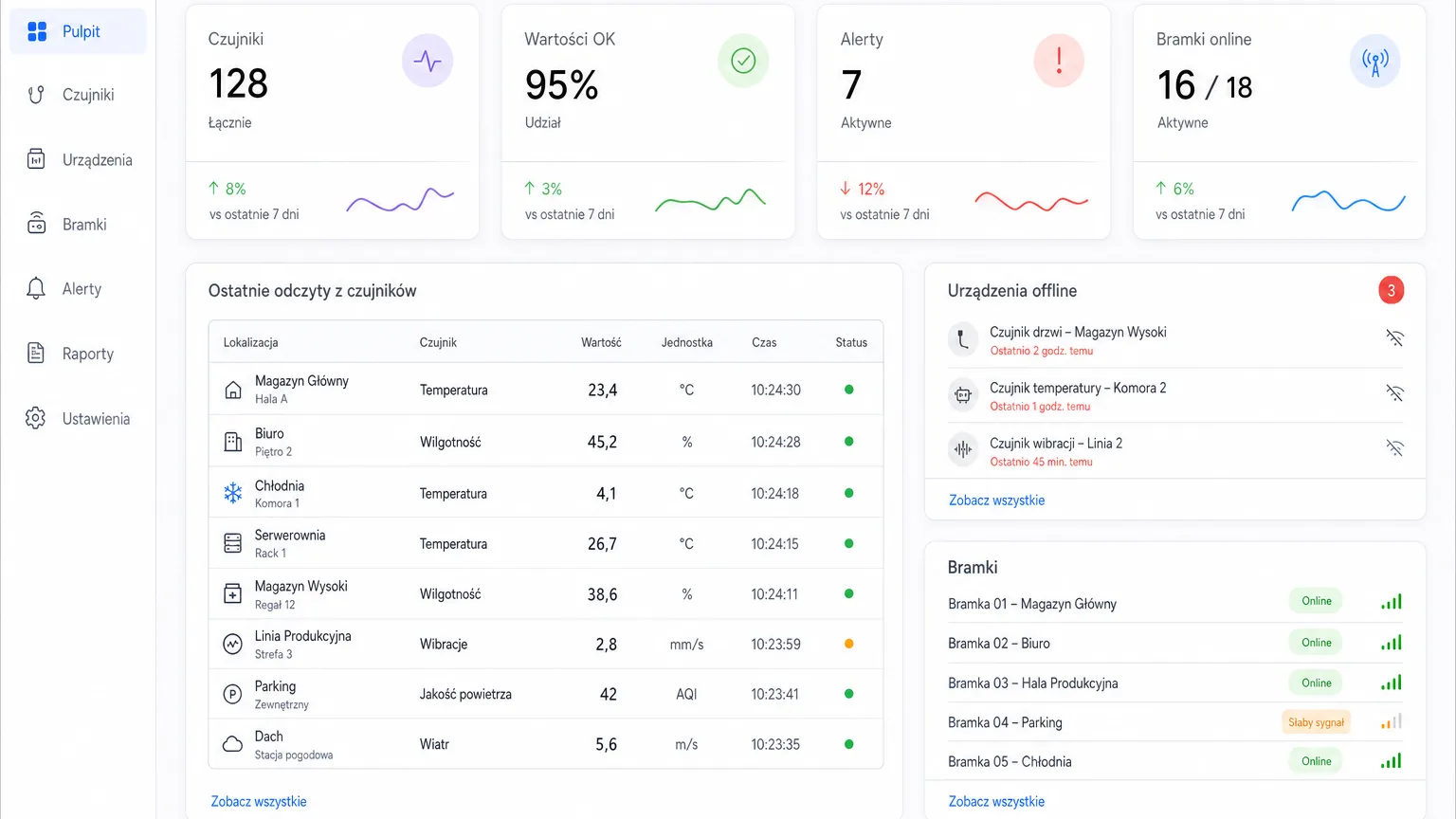
In Nextriv a location is a fully-fledged structure, not a label: a facility, within it a building and floors with assigned sensors, and wherever a map works better than a list — a floor plan with device markers and per-floor alerts.
The whole network is visible on a shared dashboard: a sensor table across all facilities, a list of offline devices, gateway status, KPI tiles and charts comparing the same metrics between locations. Dashboards are built from nearly 20 widget types — from a single value with a trend to sensor comparisons across facilities. The regional manager's morning ritual changes from ringing around store managers to ninety seconds over one screen: what is offline, what alarmed overnight, which location stands out from the rest.
One measurement standard at every facility
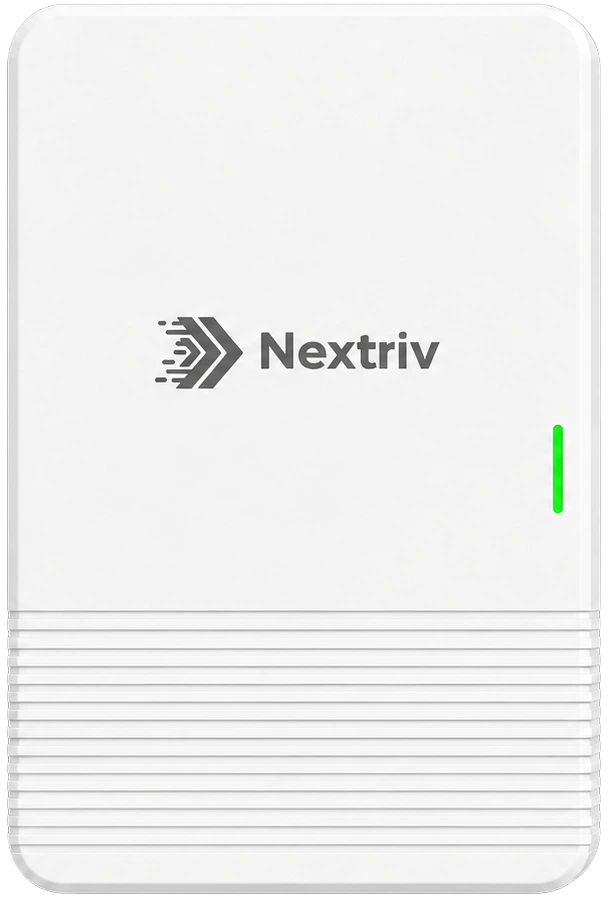
A network of facilities needs a single standard for the measurement point — the same sensors, the same thresholds, the same procedure. An industrial-grade sensor proves itself here: Nextriv Sense Industrial measures with ±0.2 °C accuracy, has a food-grade enclosure with EN12830 certification, and the magnetic variant holds onto the metal wall of a cooler without drilling.
The deployment logistics are mundanely simple: sensors go out to the facilities by courier, on site anyone presses them onto the display case wall, and automatic discovery registers the device in the platform within 30–180 seconds of powering on. No technicians criss-crossing the country and no cabling — the long-range radio link punches through the back-room walls to a gateway by the manager's office.
Alerts per location, people per role
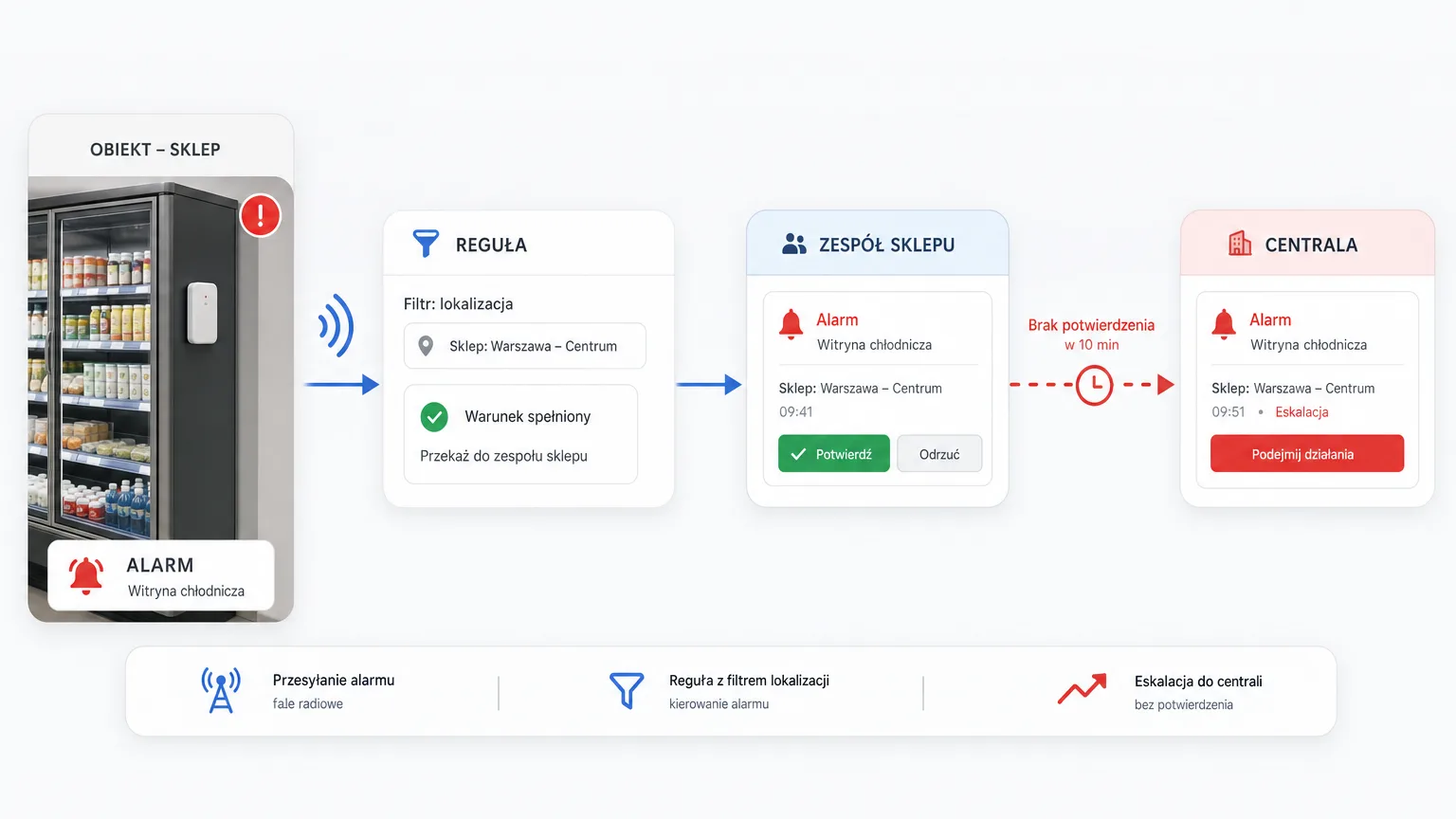
A hundred sensors across twelve facilities cannot send everything to everyone. Notification rules are filtered by location, severity and metric: the store team gets alerts for its own facility, head office — only critical events from across the network. Escalation policies guard the nights and weekends: an alarm not acknowledged within the set time goes a level up, regardless of whether the manager happens to be on holiday. Quiet hours mute low-severity notifications outside working time, a limit of three notifications per five minutes per recipient protects against an avalanche, and six channels — from SMS to MS Teams — let you match the form to the recipient.
Roles keep the team in order: an administrator configures the system, a manager handles alerts and reports, a user sees the data without the right to change the configuration. An email invitation (valid for 7 days) onboards a new facility manager in a minute.
Silence is an alarm too
In a distributed network, the most dangerous failure is the one nobody reported — because they had no way to. The back-room internet went down on Friday, the logger is silent, and head office finds out at the regional manager's next visit. Nextriv treats missing data as an event: a sensor that stays silent for twice its reporting interval gets offline status, and a gateway — after as little as 15 minutes without contact. You know about a cut-off facility 300 kilometres from head office within a quarter of an hour, not next Tuesday.
The other side of the same coin is documentation. Instead of twelve notebooks in twelve formats — PDF reports and XLSX/CSV exports in one standard for the whole network, ready for any sanitary inspection regardless of which facility it picks.
What it costs — no asterisks
Honesty is due here. The Nextriv free plan covers one location (up to 10 sensors, one gateway, two users) — a deliberate design that is enough for a full-value pilot at a single facility. Working with multiple locations requires a paid plan: 99 PLN net per 30 days or 990 PLN net per year (excl. VAT), with no limit on locations, sensors, users or alert rules, with measurement history up to 5 years, floor plans and scheduled reports for the whole network. With twelve facilities, that is a cost a single saved display case of stock can pay back — but run it on your own numbers, not ours.
The sensible path therefore looks like this: a free pilot at one facility — ideally the most problematic one — a month of data, then a decision about rolling out to the network with hard numbers on the table.
From pilot to network
The full retail scenario — display cases, cold-storage back rooms, power failures, sanitary documentation — is described in our solutions for retail chains, and a complete overview of the platform's capabilities is on the features page. If you would rather see it than read about it: book a demo — we will show the multi-location dashboard on live data, alerts and escalation included. Plan details are waiting in the pricing.