Cold chain in the warehouse — cold zone monitoring step by step
Cold zone monitoring step by step: a map of measurement points, EN 12830 sensors, alarm thresholds, escalation policies and audit-ready documentation.
Zespół Nextriv4 min read

In this article
- Step 1. Take stock of the zones — each one plays for different stakes
- Step 2. The map of measurement points — cold zone monitoring starts here
- Step 3. Match the sensors to the zone's conditions
- Step 4. One gateway instead of cables in the chambers
- Step 5. Thresholds with a margin for reaction
- Step 6. Notifications, escalation policies — and silence, which is an alarm too
- Step 7. Documentation that never needs assembling
- Start with one chamber
The cold chain rarely breaks in the middle of the freezer room — it breaks at the seams between zones: on the unloading dock, in the picking area, in the chamber whose compressor has been fading for weeks with nobody noticing. Cold zone monitoring is a way of making each of these points report on itself: continuously, with an alarm before the goods leave the range, and with a record that will stand up to an auditor and to a customer disputing a delivery. Below, the entire deployment step by step — from the zone map to the reports.
Step 1. Take stock of the zones — each one plays for different stakes
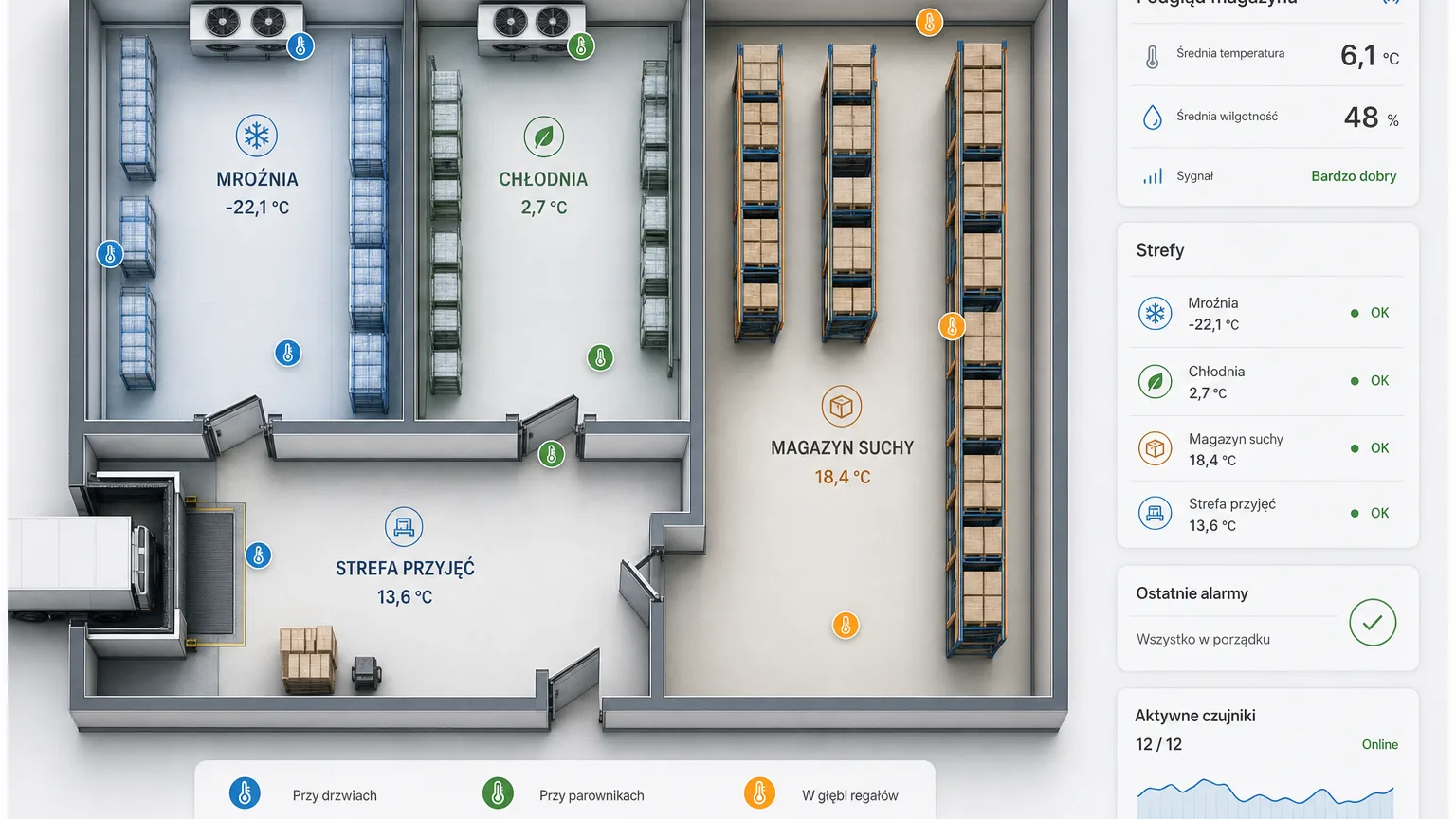
A typical cold chain warehouse is not one temperature but several regimes side by side:
- the freezer room — deep sub-zero for frozen goods, where hours above range mean writing off whole pallets,
- the cold room at 0–4 °C or 2–8 °C — fresh meat, dairy, sensitive products; here the margin for error is measured in tenths of a degree,
- the receiving area and the docks — the most unstable point in the entire chain: open gates, pallets waiting to be booked in, draughts,
- the 15–25 °C warehouse — dry stock, packaging, products requiring controlled humidity.
Each zone needs its own measurement points and its own thresholds. The ranges for individual food groups are collected in a separate piece on food storage temperatures, and how temperature monitoring fits together with the rest of the facility — humidity, leaks, open gates — is shown on our solutions page for warehouses.
Step 2. The map of measurement points — cold zone monitoring starts here
One thermometer by the door does not represent the chamber. The air by the evaporators is coldest; around the door and on the upper rack levels it is warmest — and the goods sit everywhere. The rule is simple: sensors go to the extreme points (warmest and coldest), and in large chambers additionally deep into the storage zones. The receiving area gets a point of its own, because that is where the goods spend their riskiest minutes — formally "in the cold", in practice next to an open gate.
Step 3. Match the sensors to the zone's conditions
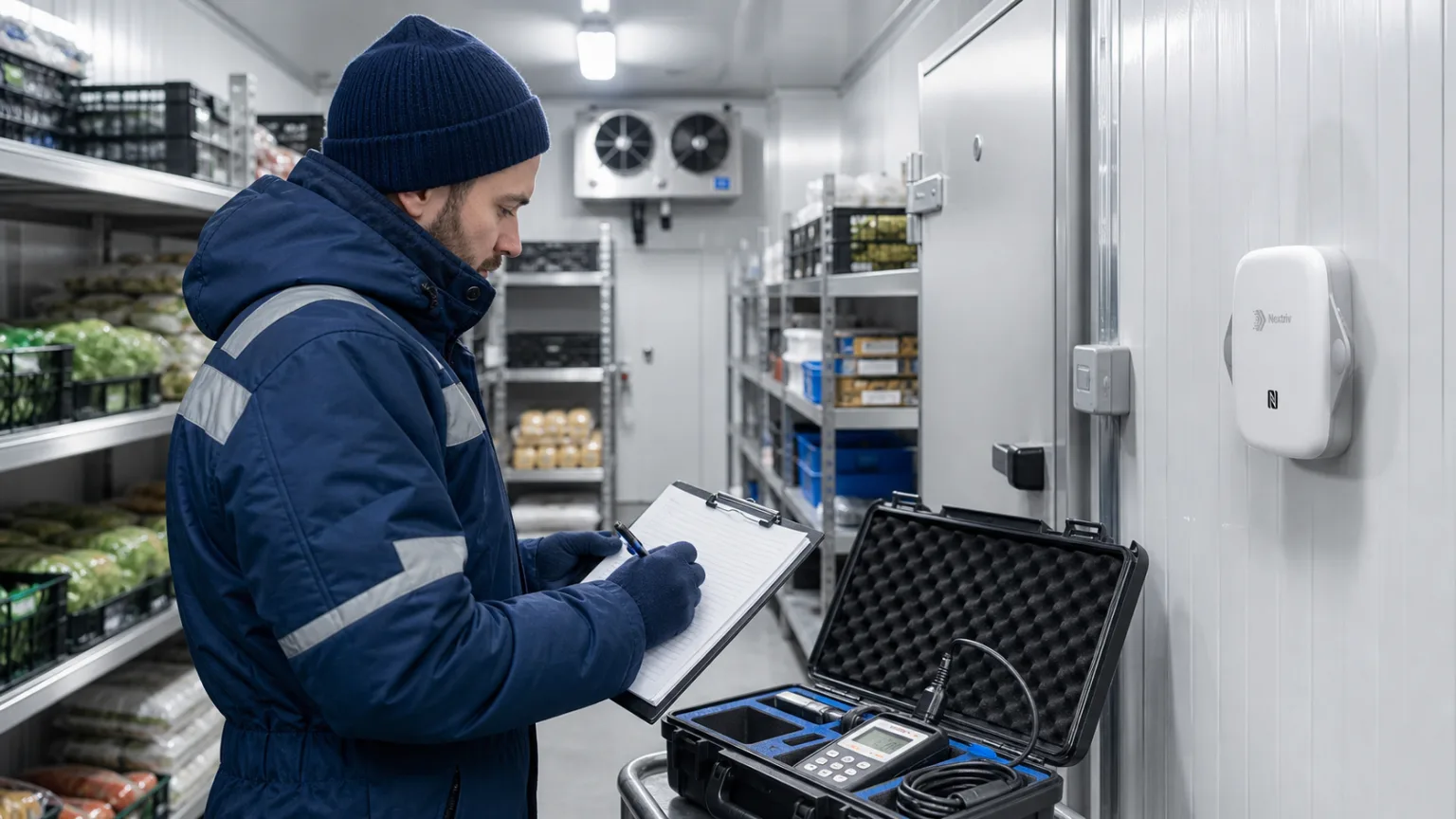
Chambers and refrigerated display cases need hardware that can take sub-zero temperatures, washing and condensation — and whose record has evidential value.
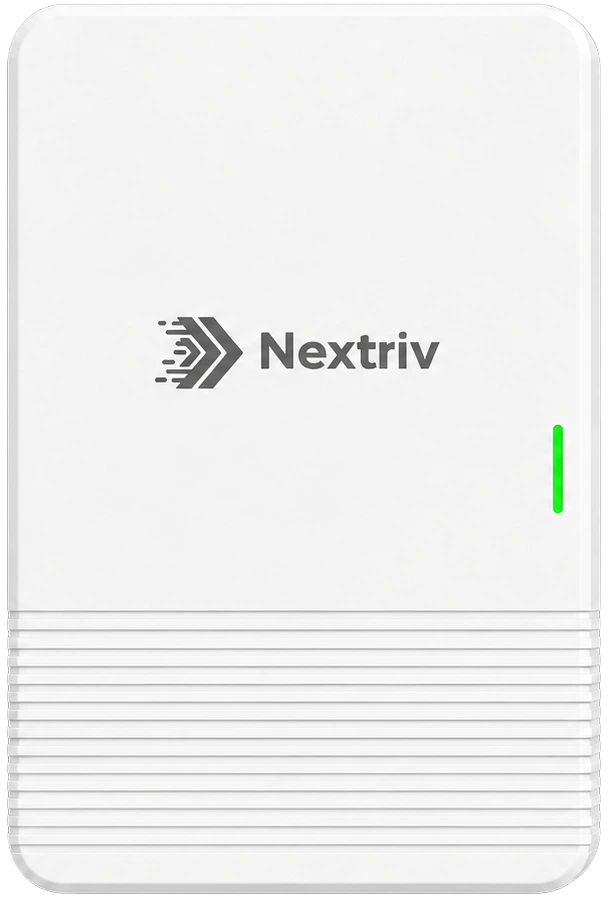
Nextriv Sense Industrial operates from -30 to 60 °C with ±0.2 °C accuracy, holds the EN 12830 certificate for temperature recording in refrigeration and has a food-grade enclosure (FDA-accepted material), so it can hang right next to the products. The magnetic variant grips the chamber's metal wall without drilling, and the 18 mm profile fits between a shelf and the wall. A local log of 3,000 time-stamped measurements backfills the data after every connectivity outage — a network failure leaves no hole in the history.
Where humidity matters alongside temperature — the 15–25 °C warehouse, maturing rooms, packaging zones — a single measurement point covers both parameters.
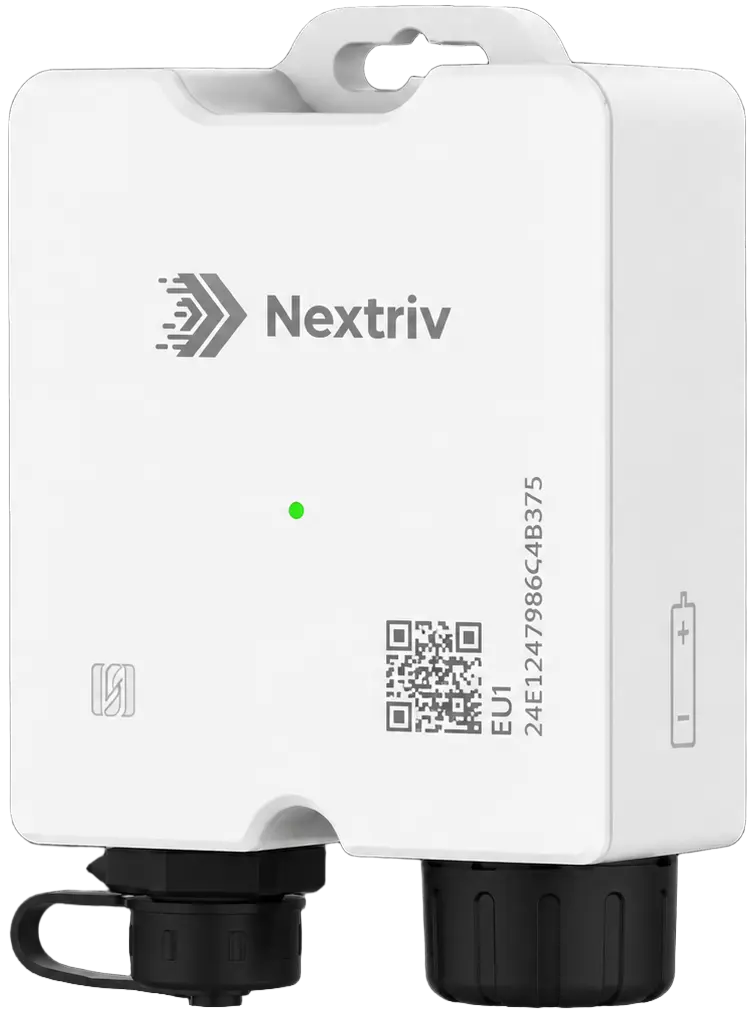
Nextriv Probe Duo measures temperature (±0.2 °C) and humidity (±2% RH) with a single detachable stainless steel probe, likewise EN 12830-certified. The probe is calibrated independently of the logger, with no break in oversight, and a buffer of 4,000 entries with retransmission keeps the record complete.
Step 4. One gateway instead of cables in the chambers
Cabling low-temperature zones is usually the biggest cost of an installation — and the reason "we'll do monitoring someday" drags on for years. Nextriv sensors communicate over long-range radio: up to about 2 km in built-up areas and about 15 km in open terrain, so the signal punches through the chamber walls to a single gateway in the office or the server room. Commissioning needs no integrator: the platform detects new devices automatically within 30–180 seconds of power-on.
Step 5. Thresholds with a margin for reaction
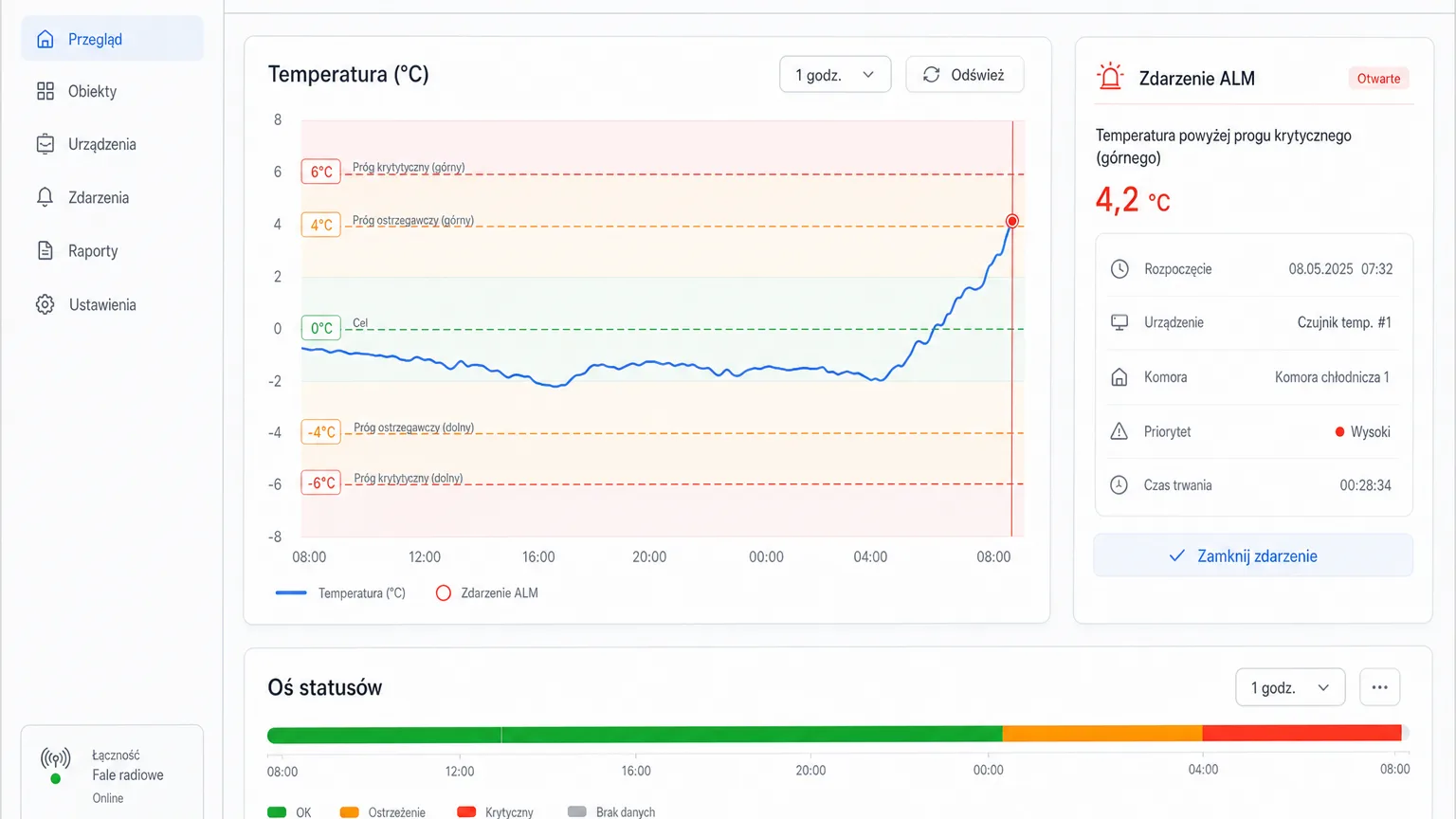
An alarm at the moment the limit is crossed comes too late — which is why every metric in Nextriv has up to four thresholds: warning and critical, lower and upper. In a 2–8 °C cold room, a warning threshold at 7 °C buys time to react before things turn critical at 8 °C; the lower thresholds in turn catch fresh goods being frozen. Every exceedance opens an event with an ALM code, and deduplication makes sure one failure does not bury the team under a hundred repeated alarms — one event is active per sensor and metric, with statuses from detection through acknowledgement to resolution.
Step 6. Notifications, escalation policies — and silence, which is an alarm too
The notification must arrive where someone is actually looking: email, SMS, web push, Microsoft Teams, Discord or an audible in-app alarm — and the webhooks integration passes the event to the warehouse management system. A night-time compressor failure is closed out by escalation policies — if the first person does not acknowledge the event, the system notifies the next ones until someone reacts.
Silence is just as important: a sensor that falls quiet for twice its reporting interval gets an offline status, and the gateway — after just 15 minutes without connectivity. A drained battery or a damaged antenna will not leave a zone unsupervised "on the quiet".
Step 7. Documentation that never needs assembling
A HACCP audit, a sanitary inspection or a customer complaint all come down to the same request: show the record. PDF reports are generated from the measurement history — with charts and a summary, and if needed with statistics, percentiles and a threshold compliance section; a schedule will send them automatically every week. XLSX/CSV exports feed your own analyses, raw measurement history runs from one year up to 1,825 days (5 years), and the calibration register tracks each sensor's calibration deadlines and reminds you before a certificate expires. Exactly what an auditor checks is described in our guide to temperature monitoring under HACCP.
Start with one chamber
There is no need to instrument the whole facility at once. The best pilot is the riskiest chamber plus the receiving area: a few sensors, one gateway, thresholds and a week of observation. The FREE plan includes 10 sensors, a gateway and a full year of measurement history — enough for a pilot with no licence costs. For networks of cold stores and freezer warehouses we have a dedicated solutions page for cold storage.
Plan details are on the pricing page, and if you would rather see the thresholds, escalations and reports on live data — book a short demo.