
Temperature and Humidity in a Dry Warehouse — A Monitoring Guide
Monitor dry-warehouse temperature and humidity without invented universal limits: product requirements, mapping, sensor placement and alarms.
Zespół Nextriv4 min read
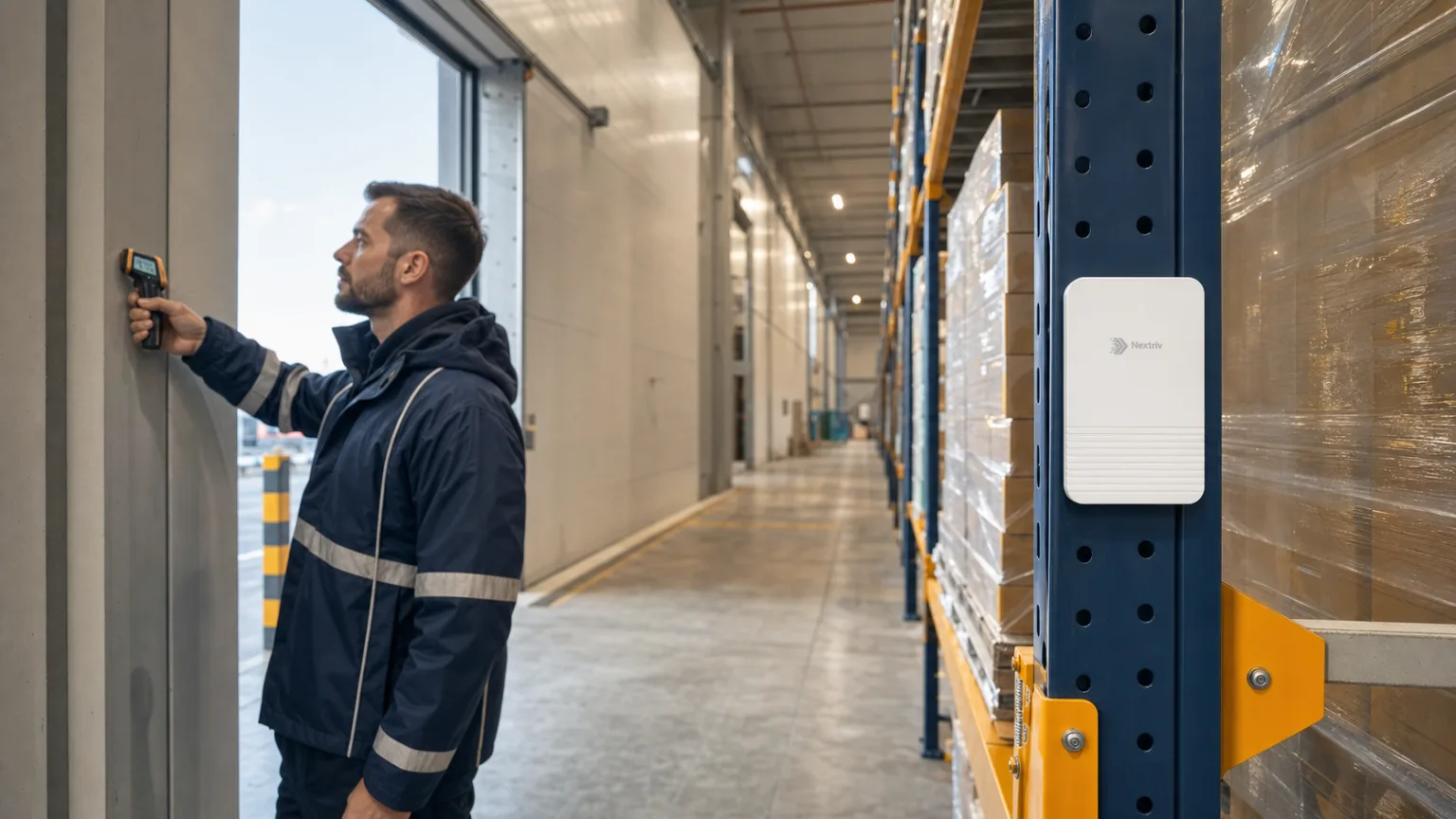
A “dry warehouse” sounds like the opposite of cold storage: if there is no 2–8 °C or −18 °C requirement, surely one thermometer by the manager's office will do. That is misleading. The roof heats the top rack levels, a cold wall creates locally high relative humidity, and an open loading door in November changes conditions faster than a display at the other end of the hall can show. For tablets, powders, spices, cartons, or electronic components, the result need not be a dramatic failure. More often it is reduced shelf life, a caked ingredient, deformed packaging, or corrosion discovered only by the customer.
Good dry-warehouse monitoring does not begin by copying a range from the internet. It begins with three questions: what is stored, what conditions does its manufacturer specify, and where do extremes occur in this particular building?
There is no single limit for every dry warehouse
Terms such as “room temperature,” “ambient conditions,” and “dry place” are used casually, but a quality system needs numerical meaning. In its good storage practices for medical products, WHO gives recommended interpretations for descriptive conditions: 15–25 °C for controlled room temperature, no more than 60% RH for a dry place, and 15–30 °C with no more than 60% RH for ambient conditions. These are useful reference descriptions for medical products, not a universal rule for food, paper, metal parts, and electronics.
The label, product specification, stability assessment, customer agreement, or HACCP plan takes priority. Two goods on the same rack may have different vulnerabilities: a hygroscopic powder reacts to moisture, a photosensitive coating to light, and a steel component to prolonged condensation. If a supplier says only “store in a dry place,” the organisation should translate that statement into accepted limits and document the basis for the decision, rather than leaving an operator to judge conditions by feel.
For a pharmaceutical warehouse, EU GDP requires conditions to follow the manufacturer's recommendations, calls for environmental monitoring, and requires initial temperature mapping before a storage area is brought into use. GDP must not, however, be presented as the law governing every warehouse. The sector and product determine the formal regime; risk management is the common principle.
Temperature and humidity tell one story
Relative humidity describes how close air is to saturation at its current temperature. When temperature falls, the same amount of water vapour produces a higher RH. A morning humidity increase by a cold wall therefore need not mean that more moisture suddenly entered the building; cooling alone may explain it. If a surface falls below the dew point, condensation occurs.
This matters when alarms are interpreted. A humidity threshold alone will not identify a leaking roof, a thermal bridge, or a damp incoming load. The temperature and RH trends can narrow down the cause, but building and product inspection remain necessary. Our guide to optimal indoor humidity explains the general mechanism in more detail.
Map first, select permanent points second
One sensor represents only the place where it is installed. A high-bay warehouse has a vertical gradient, racks obstruct air movement, loading doors form inflow zones, and the HVAC system may not reach exactly as its design suggests. Before selecting permanent points, carry out warehouse temperature mapping and, where moisture affects quality, map both parameters.
The study should cover representative operation: normal loading, daily cycles, door openings, and a season that presents material risk. Temporary loggers should include locations such as:
- lower, middle, and upper rack levels,
- external walls and the zone below the roof,
- deep areas with weak air movement,
- loading doors, docks, and air curtains,
- the vicinity of an air supply, as well as areas outside its direct stream,
- receiving and quarantine zones where goods spend meaningful time.
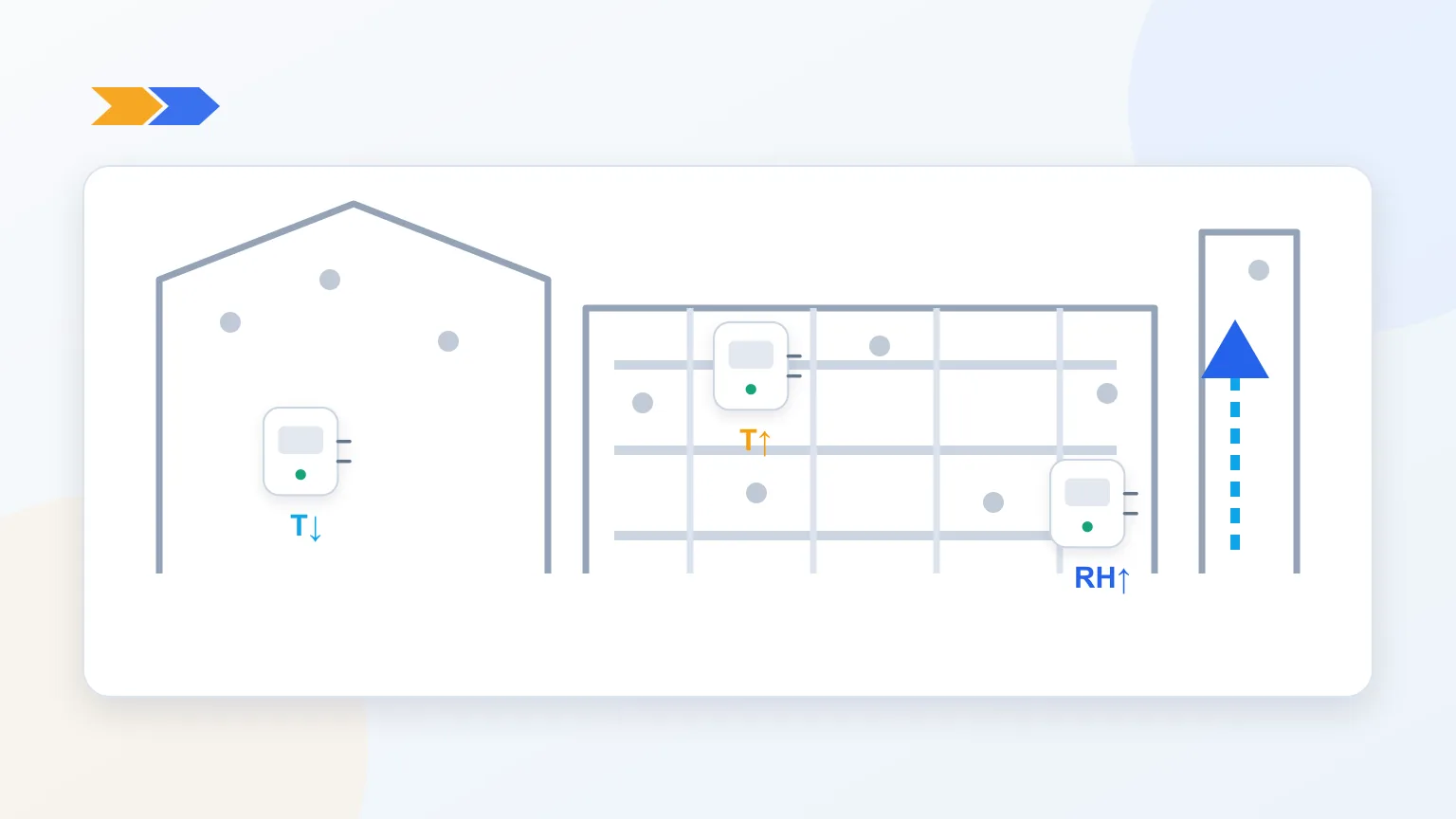
Permanent monitoring does not have to reproduce the full mapping grid. Its locations should guard the representative and extreme points revealed by the study. A reference point in a stable zone is useful as well, helping distinguish a local problem from a hall-wide change. After rack reconstruction, an HVAC change, roof repairs, or a material change to storage practice, reassess the placement.
Set thresholds without alarm noise
Critical limits follow from the product. Warning thresholds should provide time to respond while remaining far enough from natural measurement noise that staff do not learn to ignore alarms. Four thresholds per parameter separate low/high warnings from critical alarms. Distinguishing a local issue from a zone-wide event requires comparing several measurement points.
Do not choose a margin simply because “we always use two degrees.” Consider measurement uncertainty, hall dynamics, response time, and the consequences of an excursion. A short door opening may be normal operation, while a temperature increase below the roof lasting hours may not be. Where time and product impact must be assessed, the procedure should distinguish a technical alarm from a formal quality deviation.
One point, two synchronised parameters
Nextriv Probe Duo measures temperature and humidity with one detachable probe, so both values describe the same point on a shared timeline. According to the product specification, typical accuracy is ±0.2 °C from 0 to 60 °C and ±2% RH at 25 °C, while the local buffer stores 4,000 entries and retransmits them after a connectivity interruption. The buffer backfills history when communication returns; it must not be confused with a guarantee of real-time notification when the entire communication path is unavailable.
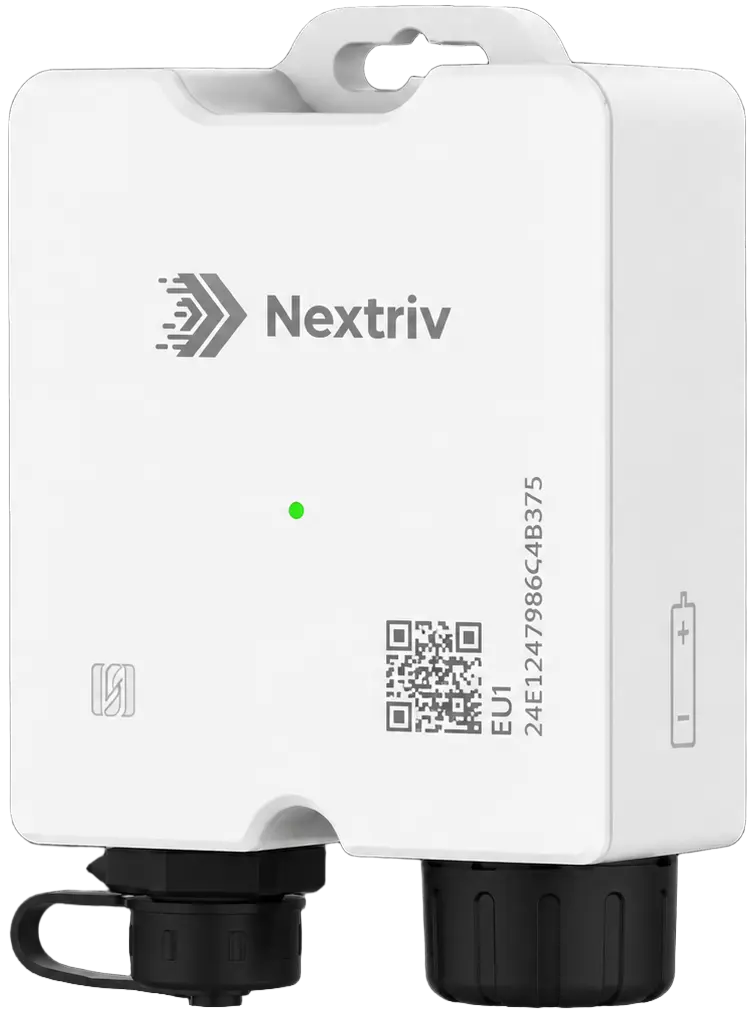
In practice, mount the unit so the probe samples air representative of the goods, not a heated enclosure near the ceiling or the direct stream from a diffuser. Pallets must not cover it, and staff should not move it without recording the change — location is part of the measurement system. Plan sensor calibration and the way monitoring will continue while a probe is being calibrated or serviced.
From alarm to a batch decision
The procedure should assign responsibility, not just a notification channel. After an alarm, the operator checks HVAC, doors, the roof, and a neighbouring point; protects goods when the risk is credible; records actions; and escalates the event to the person authorised to make a product decision. Batch assessment uses the duration and magnitude of the excursion, manufacturer conditions, and available stability data — not the alarm colour alone. Our guide to a temperature excursion covers this workflow in more depth.
Across a warehouse network, it is sensible to use common zone names and a shared report template while assigning thresholds to the actual products and local conditions. Headquarters then receives comparable data without pretending that every building is identical. Built this way, warehouse and logistics monitoring stops being a collection of thermometers and becomes evidence that specific goods remained within conditions deliberately established by the organisation.


