
Optimal indoor humidity — health, comfort and the building
Optimal indoor humidity is 40–60% RH. See what dry and damp air does to health, comfort and the building itself — and how to monitor humidity properly.
Zespół Nextriv4 min read

In this article
Optimal indoor humidity is one of those parameters everyone has heard of and almost nobody measures. Temperature is visible on every thermostat; humidity stays invisible — until it starts stinging your eyes, charging jumpers with static or blooming as mould in the bedroom corner. Yet it is relative humidity that decides whether the winter air in the office dries out mucous membranes, whether the bathroom grows fungus, and whether a wooden floor survives the heating season without gaps. Below we sort out which humidity band is considered optimal, what happens outside it — and how to swap guessing for measurement.
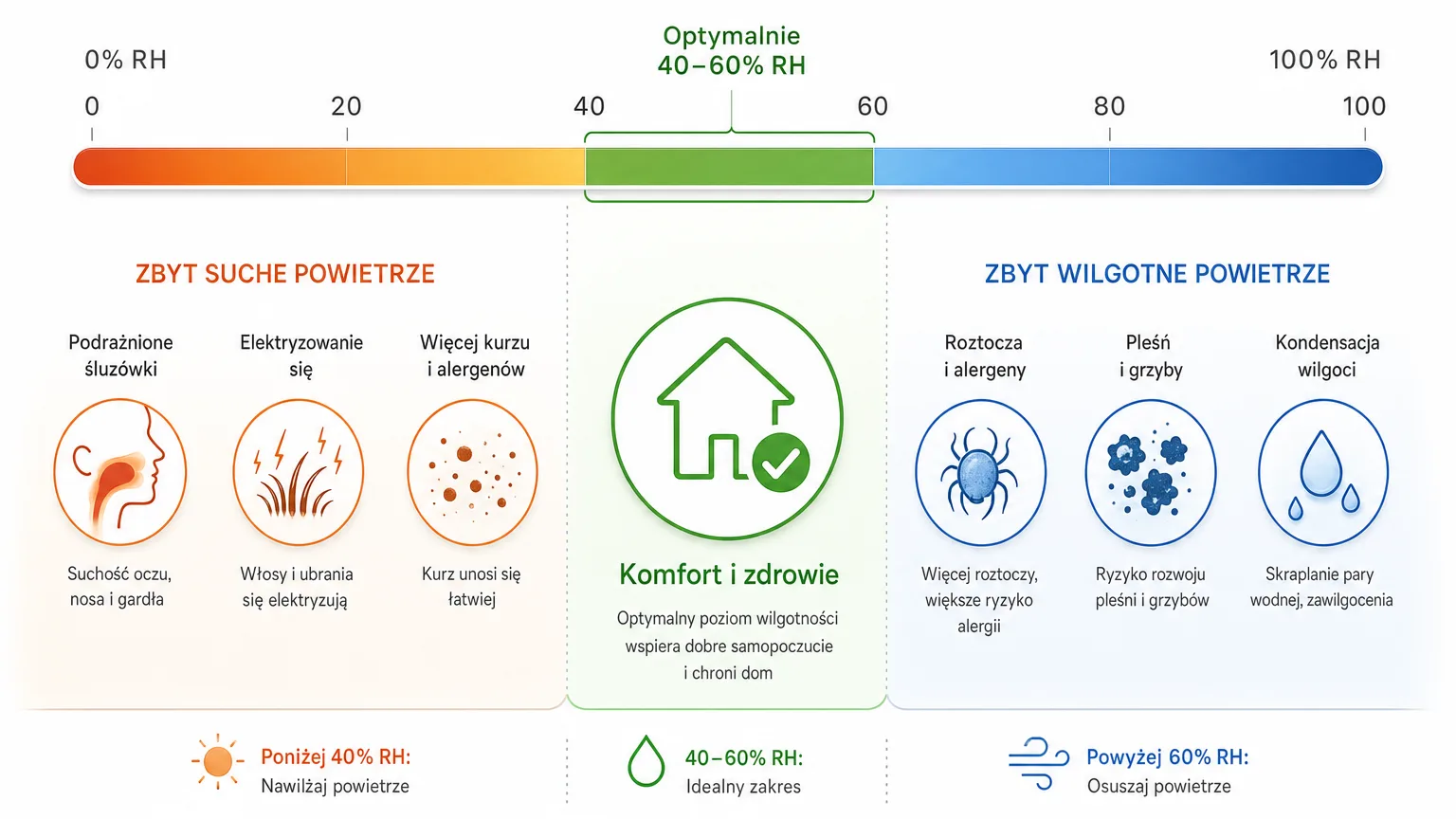
Optimal indoor humidity: the 40–60% RH band
Relative humidity (RH) tells you how saturated the air is with water vapour at a given temperature. For occupied spaces, hygiene and building practice has pointed to the same band for decades: 40–60% RH. It is the range in which, all at the same time:
- the mucous membranes of the airways keep their natural moisture and protective barrier,
- the risk of mould and dust mite growth stays low,
- hygroscopic materials — wood, paper, textiles — do not work excessively,
- the air feels comfortable at typical office and home temperatures.
The key nuance: relative humidity depends on temperature. The same air that had 80% RH out in the frost drops below 25% RH once heated to 21 °C — which is why the heating season almost automatically means dried-out interiors, even though "it's damp outside".
Too dry: what you cannot see but can feel
Below 40% RH — and in winter, in heated buildings without humidification, readings of 20–30% are the norm — problems begin that are rarely linked to the air:
- Dried-out mucous membranes of the nose and throat — a weakened first line of defence against infections; a scratchy throat "from the morning" in the heating season is the classic symptom.
- Dry eyes — particularly painful when working at a screen or wearing contact lenses.
- Static in clothes, hair and carpets, plus more dust hanging in the air.
- Working wood — floors, furniture and instruments give up moisture, shrink and crack.
Importantly, dry air cannot be reliably judged by the senses — unlike stuffiness, which everyone feels after an hour of a meeting. Without measurement, the winter desiccation of an office stays invisible until the wave of complaints about "puffy eyes".
Too damp: the silent cost to the building
Above 60–65% RH the problem stops being merely a health issue and becomes a building issue:
- House dust mites multiply rapidly — bad news for allergy sufferers.
- Mould finds conditions to grow wherever damp air meets a cool surface: lintels, window reveals, corners of external walls, bathrooms without working ventilation.
- Condensation on thermal bridges gradually degrades the building envelope — long before a visible bloom appears, the plaster and wallpaper spend months working in damp.
Here, again, the temperature relationship is key: mould on a wall is almost always a duo of high air humidity and a cold surface. That is why sensible monitoring measures both parameters at once and lets you put them on a single chart.
Museums and archives: where humidity is a critical parameter
In facilities holding collections — museums, archives, libraries — humidity is promoted from a comfort parameter to an asset protection parameter. Paper, parchment, wood and textiles are hygroscopic: every RH swing means the material working, and cyclical swings act like the slow bending of a wire. That is why in conservation practice the stability of humidity can matter more than the average value itself — and why ISO 11799 puts the emphasis on monitoring the conditions, which we break down in detail in our article on ISO 11799 requirements for archives and libraries.
Climate supervision scenarios for collections — from a study store to display cases — are described on our solution page for museums and archives, and the office angle in the solution for buildings and offices.
How to measure so the numbers can be trusted
A cheap supermarket hygrometer can be off by 10 percentage points — with a band only 20 points wide, that is a disqualifying error. In practice three things matter: measurement class, mounting location and continuity of the record.
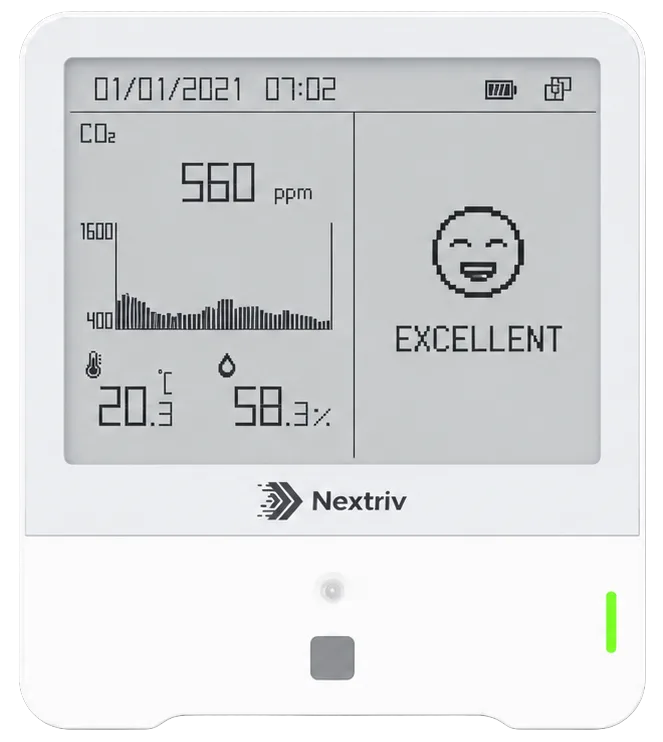
For typical interiors a multi-parameter station works well: Nextriv Sense IAQ measures humidity to ±2% RH and temperature to ±0.2 °C, and alongside them CO₂, volatile organic compounds, pressure, light and presence — seven parameters from a single mounting point, with an e-ink display readable by anyone walking past.
Where conditions are tougher — warehouses, basements with archival materials, unheated zones, a reference measurement outside the building — Nextriv Sense Essential does the job: a sealed IP67 enclosure for indoors and out, RH measurement to ±3%, a tamper-proof local log of around 3,000 readings with retransmission after connectivity outages and at least 10 years on batteries. A detail that matters for collections and audits: the reading history cannot be manually "corrected".

Both devices communicate over a long-range radio link — no cabling and no access to the corporate network, which makes a real difference in the thick walls of warehouses and historic buildings.
Thresholds and alerts: a band instead of a single number
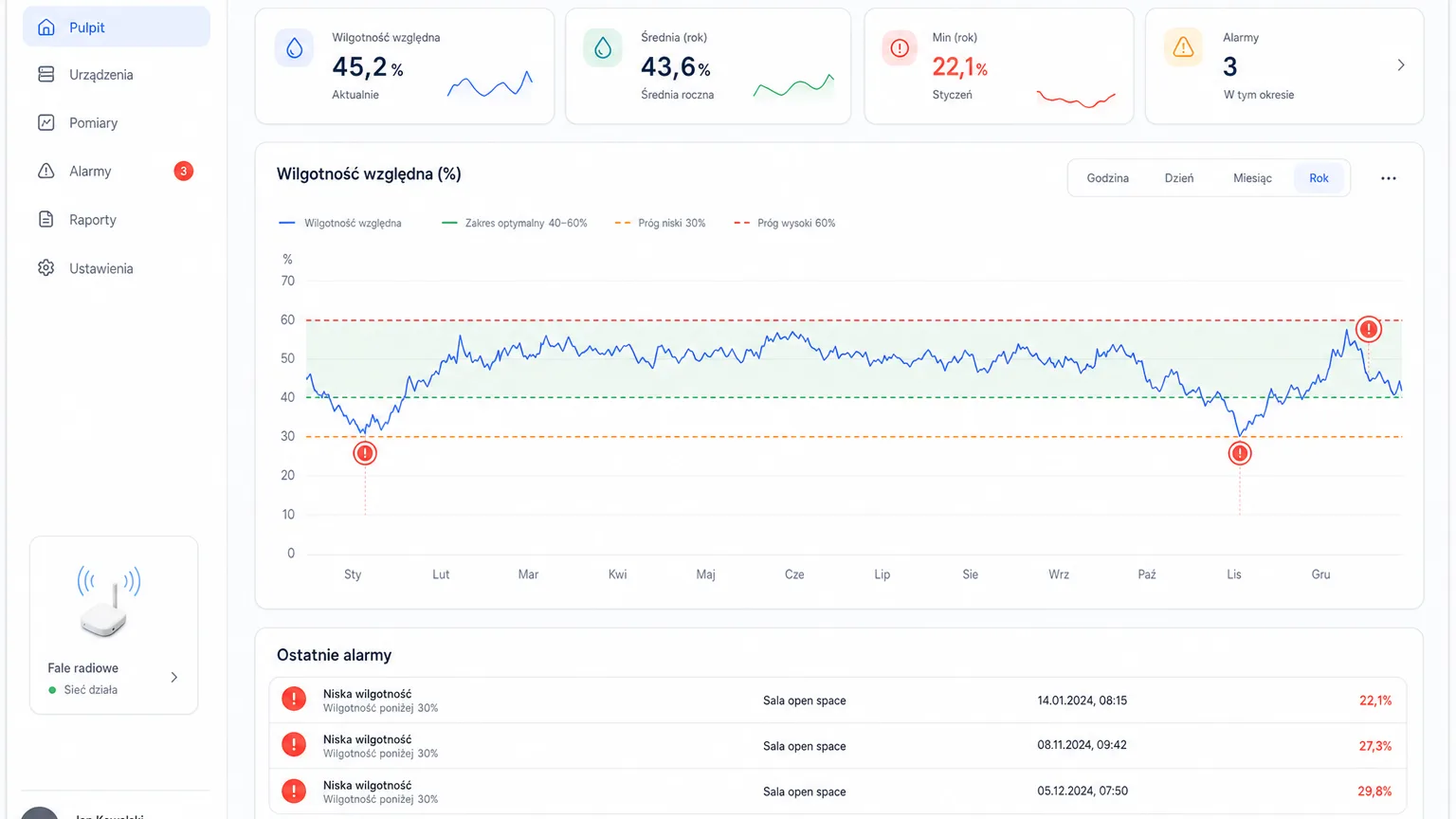
Humidity — unlike most metrics — goes wrong in both directions, so it needs thresholds on both sides of the band. In the Nextriv platform every metric has up to four thresholds: for a typical office a sensible start is warnings at 35% and 65% RH and critical thresholds at 30% and 70%. A breach generates an event with a readable code and a notification on one of six channels — from email and SMS to MS Teams — and once the value returns to the band, the system itself sends an all-clear. Virtual sensors average the readings of several points into a whole-zone metric, and PDF reports and XLSX/CSV exports document the conditions for a facility manager, a conservator or an insurer.
If you are still mapping out the air quality parameters, a good starting point is our guide to what good office air quality is and how to measure it — humidity is one of its main characters.
Where to start
Hang sensors in two or three representative places: the work zone, the problem room (a corner office, a bathroom, a storeroom) and a reference point. After a month the chart itself will show whether the problem is winter desiccation, summer damp or daily swings — and whether a ventilation tweak is enough or humidification is needed. The FREE plan includes 10 sensors and a full year of measurement history, so you spend nothing beyond the hardware to begin.
Check the pricing or book a short demo — we will show what humidity monitoring looks like on live data, complete with thresholds, alerts and a report you can show the facility manager.


