
Wireless sensor battery life — what really drains it
Sensor battery life depends more on configuration than on the cell. What really drains energy — interval, radio, temperature — and how to gain years.
Zespół Nextriv5 min read

In this article
- Measuring costs pennies, transmitting costs a fortune
- Sensor battery life versus the reporting interval
- Radio: the worse the range, the more each packet costs
- Temperature, cell chemistry and whatever lights up
- What the platform does so you do not walk around with a ladder
- Five questions to ask the datasheet
- From a catalogue "up to 5 years" to a real 5 years
Wireless sensor battery life always looks impressive in catalogues: "up to 5 years", "up to 8 years", "even 10 years". The phrase "up to" is doing all the work here. The same sensor can run for eight years or eight months — depending on a few configuration decisions the datasheet mentions in fine print, if at all. Below we take the sensor's energy budget apart: what really drains the energy, which factors you can genuinely influence, and how to read manufacturers' claims so you are not surprised later.
Measuring costs pennies, transmitting costs a fortune
Intuition says a sensor spends its energy on measuring. It is exactly the other way round: for the vast majority of the day the device sleeps, drawing current measured in microamps, and the temperature or humidity reading itself is a sliver of the budget. The most expensive moments are when the radio wakes up — transmitting a packet to the gateway draws orders of magnitude more current than sleep does. Battery life therefore boils down to one question: how many times, and in what conditions, will the sensor transmit.
For the same reason, sensors with long-range radio connectivity run for years where WiFi designs last days: a telemetry packet is a few dozen bytes sent in a fraction of a second in the energy-efficient sub-GHz band, after which the transmitter goes straight back to sleep. We compared the two technologies in detail in the article long-range radio sensor or WiFi.
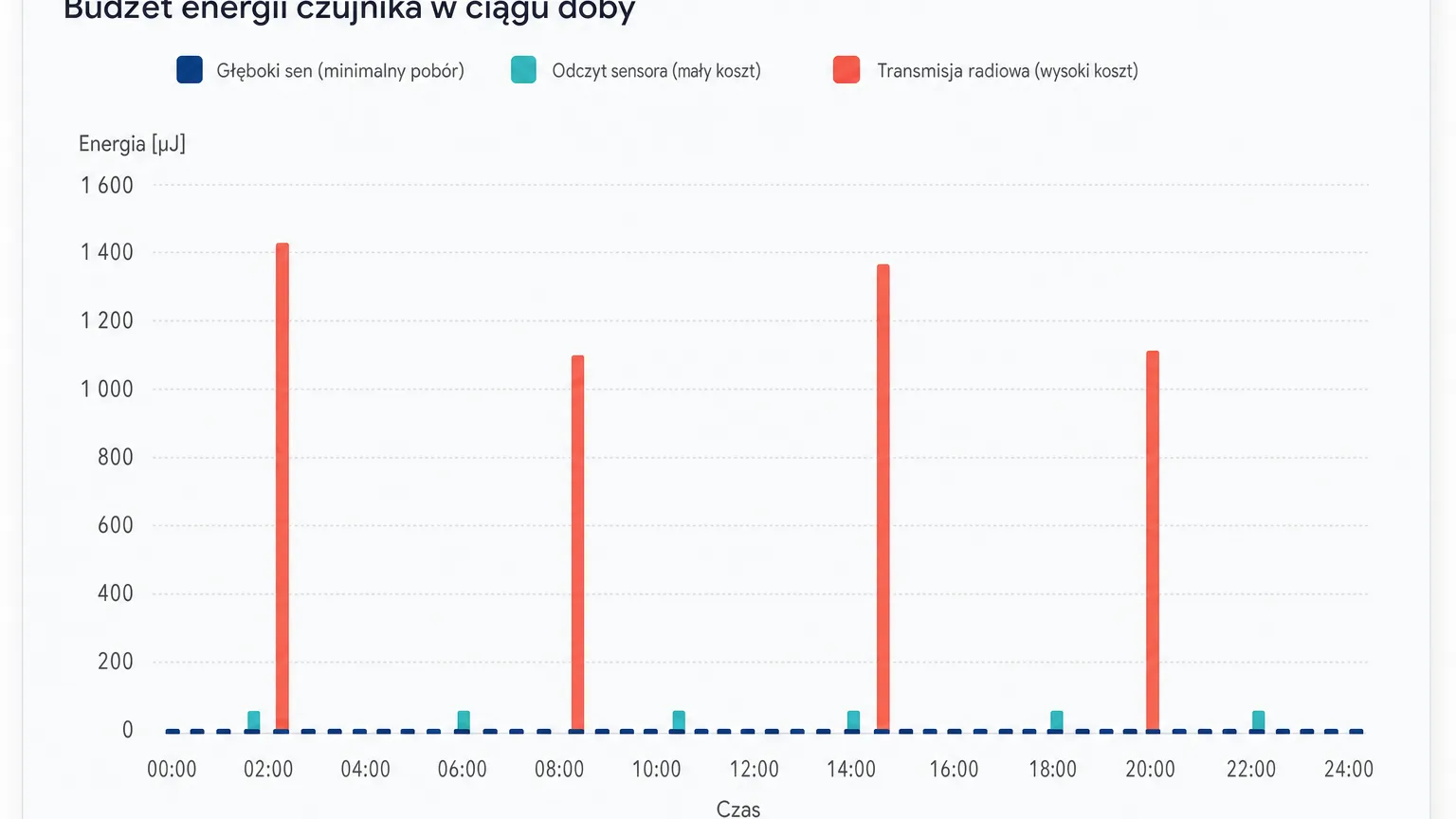
Since transmissions rule the budget, the list of suspects writes itself: how often the sensor transmits, in what radio conditions, at what temperature — and what else is lit up or measuring alongside.
Sensor battery life versus the reporting interval
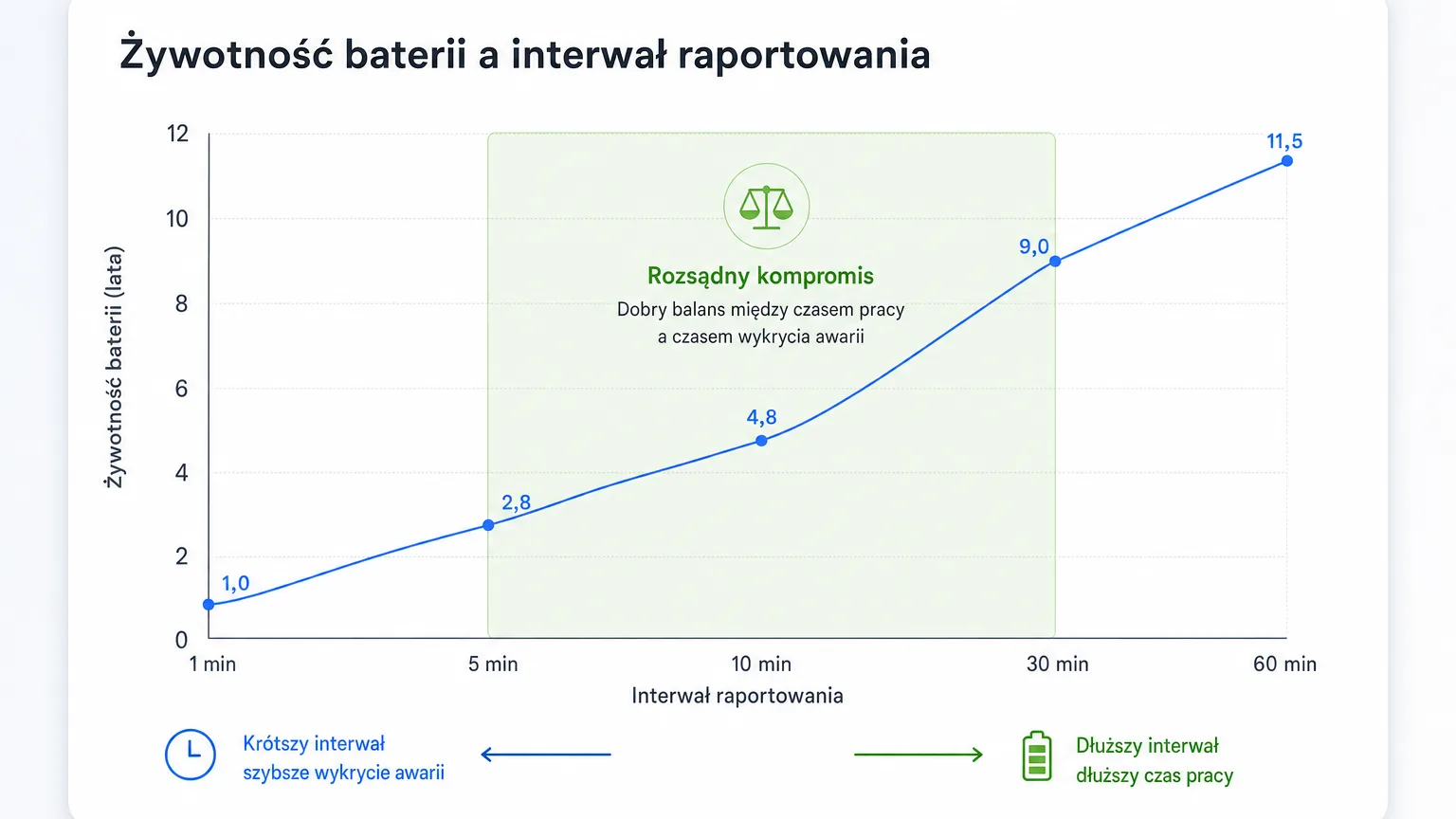
The first and most important factor: how often the device reports. The relationship is almost linear — a sensor transmitting every 5 minutes performs twice as many transmissions as one transmitting every 10 minutes, and drains the cell correspondingly faster.
Specifics from the Nextriv catalogue: Nextriv Sense CO₂ runs around 3–5 years on two replaceable lithium batteries at a 10-minute measurement interval. Nextriv Probe Solo — a temperature logger for fridges and freezers — around 8 years reporting every 10 minutes. Set a one-minute interval "just in case" and divide those numbers by several.
That is why the interval is matched to the dynamics of the process, not to peace of mind. The temperature in an insulated cold room changes on a scale of tens of minutes — a report every 10 minutes will catch every real deviation. The climate of an office or a conference room: every 10–15 minutes. A dry warehouse or an archive with stable conditions: every 30 minutes is more than enough.
There is a flip side that is easy to forget: the Nextriv platform considers a sensor offline after twice its reporting interval. Reporting every 10 minutes, you learn about a damaged sensor after about 20 minutes; reporting every hour — after two hours. The interval is thus always a trade-off between battery life and the time to detect a problem — one more reason to set it deliberately rather than leave the factory default.
Radio: the worse the range, the more each packet costs
The second factor is the radio conditions. A sensor close to the gateway, with a strong signal, transmits briefly and frugally; a sensor at the edge of range transmits longer and slower so the packet gets through at all — and each such transmission costs many times more energy. Manufacturers discreetly admit this: the declared ~8 years of Probe Solo operation applies to "fast radio settings", and the Sense Essential datasheet says outright "depending on interval and radio configuration".
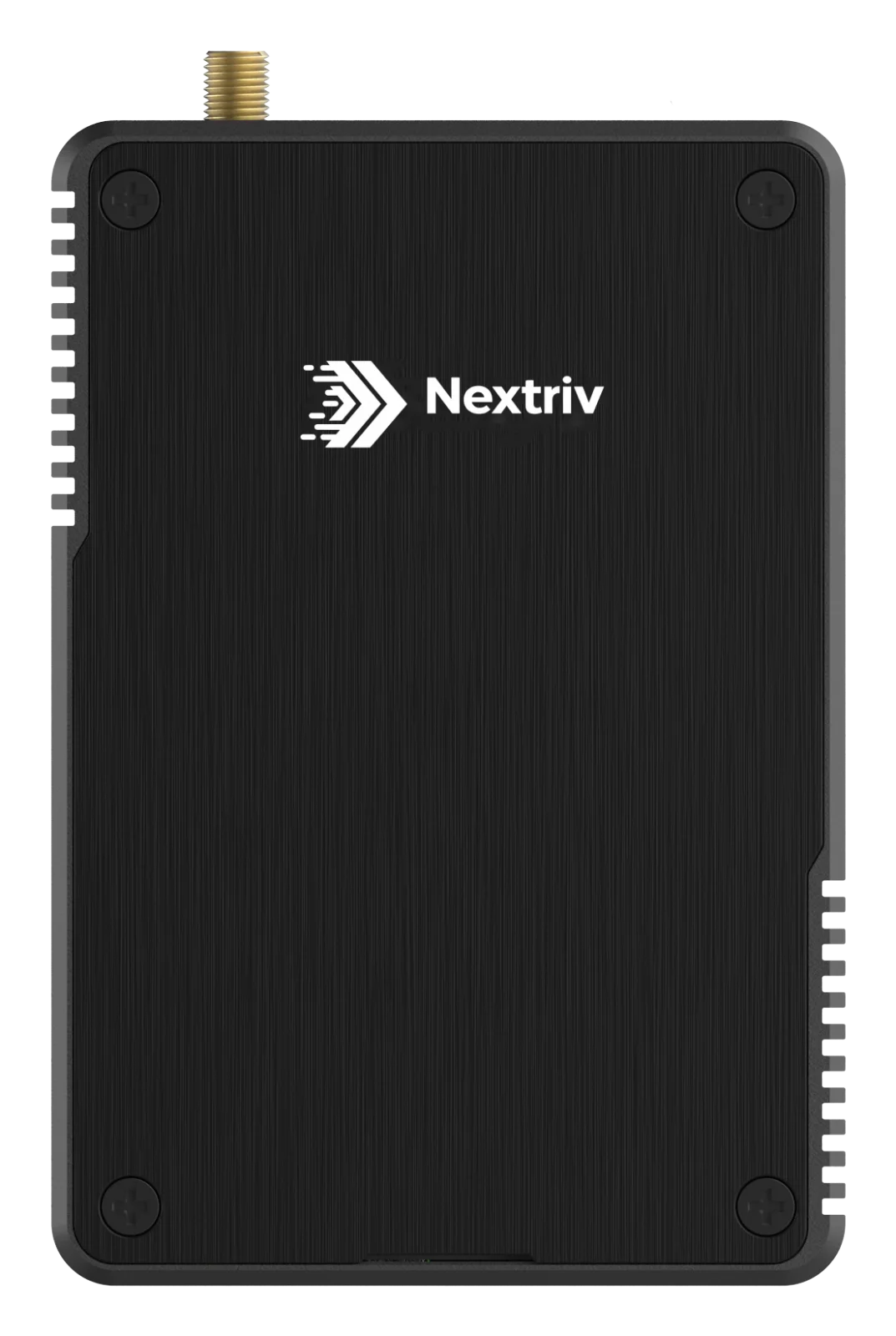
In practice this means gateway placement is an energy decision, not just a range decision. A gateway placed centrally — in a comms cabinet in the middle of the building, say, rather than in a basement corner — shortens the distance to the farthest sensors and lets the whole fleet transmit in economical modes. A single gateway of the Nextriv Hub Compact class, with -140 dBm radio sensitivity and a range of about 2 km in built-up areas, serves around 2,000 devices — so in a typical building the problem is not the number of gateways but their placement.
Retransmissions belong to the same category. When cloud connectivity briefly drops, Nextriv sensors buffer the measurements locally — Sense Essential holds around 3,000 records — and send them on once the network returns. The history is left without holes, but catching up on the backlog means extra transmissions. A stable gateway uplink, for instance with backup 4G and automatic failover, thus indirectly saves the sensors' batteries too.
Temperature, cell chemistry and whatever lights up
The third factor works quietly. At low temperatures every cell delivers less energy than it has on paper — which is why industrial sensors are powered by lithium thionyl chloride (Li-SOCl₂) batteries, which tolerate a wide temperature range and barely self-discharge over the years, rather than ordinary alkaline AAs. Good designs go one step further: in Probe Solo only the steel probe on its lead goes inside the freezer, while the transmitter with the battery stays outside, at a temperature comfortable for the electronics and the cell.
The rest of the budget is eaten by extras. A backlit LCD can cost more than the radio — which is why Sense CO₂ uses an e-ink screen that draws energy only when the image changes and "holds" the displayed reading for free. Indicator LEDs, additional metrics and frequent remote reconfigurations each add their share: little individually, noticeable in total.
What the platform does so you do not walk around with a ladder
Even the best-configured sensor will eventually drain its battery — the difference is whether you learn about it in advance or from a hole in the data. The Nextriv platform reads the battery level from every device's metadata, so replacements are planned ahead instead of touring the sites "just in case". If a sensor goes silent anyway, after twice its reporting interval it lands on the offline list and generates a notification.
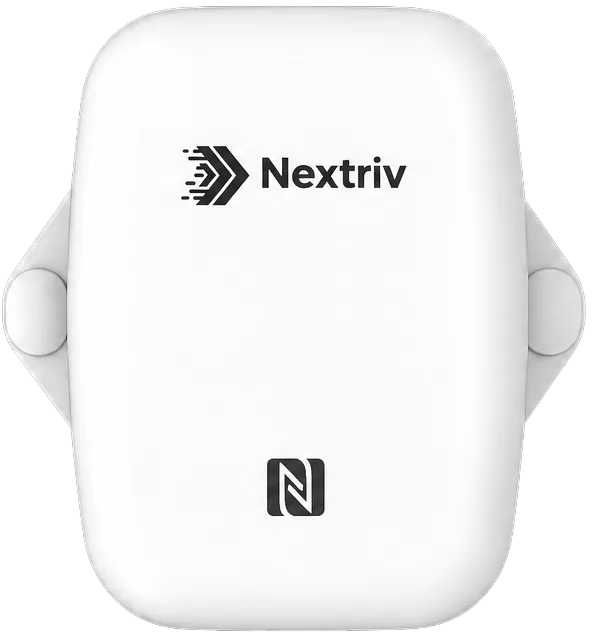
Configuration is changed remotely or contactlessly via NFC — without opening the enclosure, which matters for sealed devices: an intact gasket means an intact IP67 rating. The whole journey from measurement to alert is described on the how it works page.
Five questions to ask the datasheet
Before you believe "up to 10 years", ask:
- At what interval was the battery life quoted? "5 years" at hourly reporting and at 5-minute reporting are two completely different devices.
- At what radio configuration? Claims almost always assume good signal conditions — the margin for difficult locations is yours to add.
- Is the battery replaceable? A replaceable cell is a service job costing a few dozen PLN; a built-in battery means scrapping the whole device after a few years.
- Does the device report its battery level? Without that, planning replacements turns into guesswork.
- Is there a local buffer with retransmission? A battery that lasts years is worth little if every connectivity gap punches a hole in the history.
A good model of an honest specification is Nextriv Sense Essential: at least 10 years of operation with an explicit caveat about the interval and radio configuration, and two replaceable Li-SOCl₂ 2700 mAh batteries.
From a catalogue "up to 5 years" to a real 5 years
Sensor battery life is, at heart, arithmetic: an interval matched to the dynamics of the process, a gateway in a well-thought-out spot and a cell of the right chemistry turn the catalogue "up to 5 years" into real years of service on site. The easiest way to run the numbers is on your own data — the FREE plan described in the pricing includes 10 sensors and a gateway, so you can launch a pilot with no platform fees, and at a demo we will show, on a live system, what the battery levels and intervals of a whole fleet look like.


