
Sense environmental sensors
Nextriv Sense IAQ Pro9-in-1 air quality station
SKU: NX-SN-AQ9P
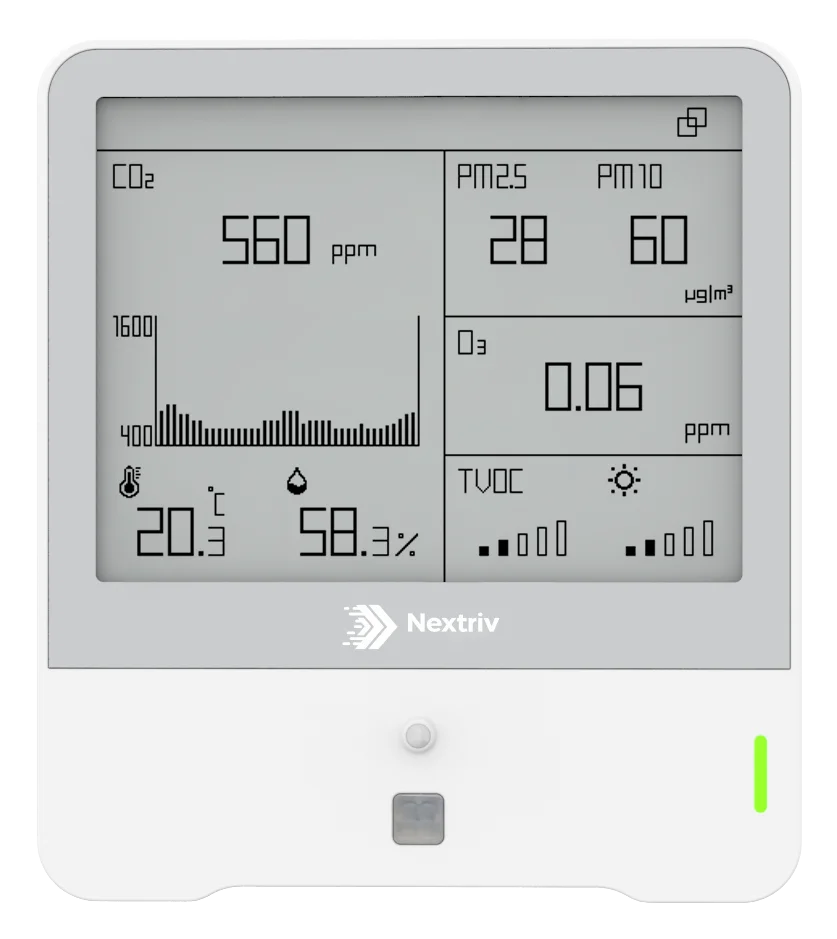
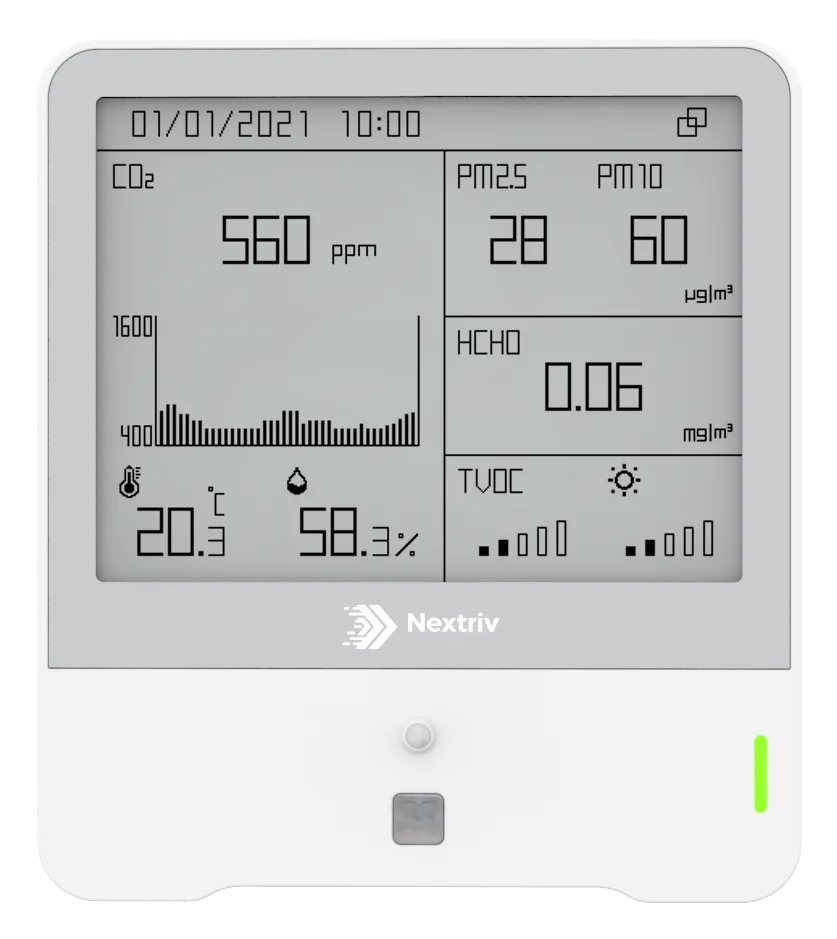
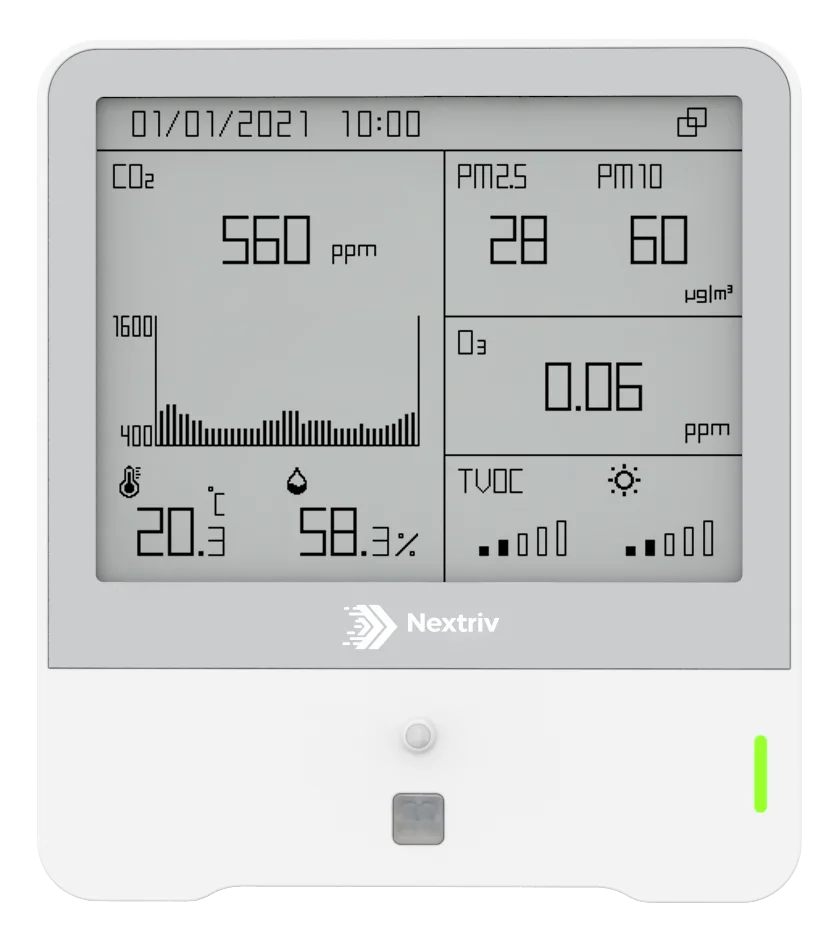
The richest 9-in-1 air quality station — choose formaldehyde (HCHO) or ozone (O₃) measurement. Always-listening radio with instant response to commands, WELL programme compliance.
€600net
VAT is added to the price.
Description
- 9 parameters, including formaldehyde or ozone
- WELL programme compliance
- PM2.5/PM10 particulates as standard
- Always listening — instant response to commands
- Data ready for building certifications
What it is for
This is the flagship of the Sense family — nine parameters in one device and the only sensor in the series with a swappable "ninth sense": your choice of formaldehyde (HCHO) or ozone (O₃). Formaldehyde is the silent lodger of freshly fitted-out interiors — it keeps off-gassing from furniture, adhesives and lacquers for months after a renovation. Ozone, in turn, can be a by-product of disinfection and electrical equipment. Nextriv Sense IAQ Pro was built for facilities that treat air quality as a commitment: offices aiming for healthy-building certifications, medical facilities, premium schools and investors accountable for ESG.
Its formal status sets it apart, too: the device carries a compliance mark of the WELL healthy-building certification programme — independent confirmation that it supports the standard's requirements in the areas of air quality, comfort and well-being. For a building manager that is a ready-made argument in WELL, LEED or BREEAM certification processes: the sensor's data is credible evidence. Property operators base certifications of entire building portfolios on data from sensors of this class.
Structurally it is a device that is "always on duty": permanently powered via USB-C, it operates in continuous radio-listening mode — it executes remote commands instantly, without waiting for a transmission window. That makes it suitable not only for measurement, but also for real-time control scenarios.
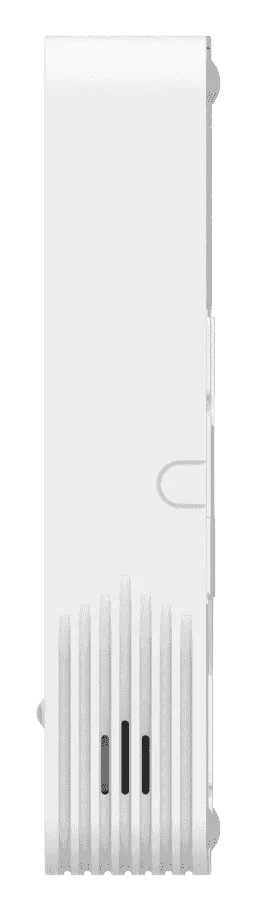
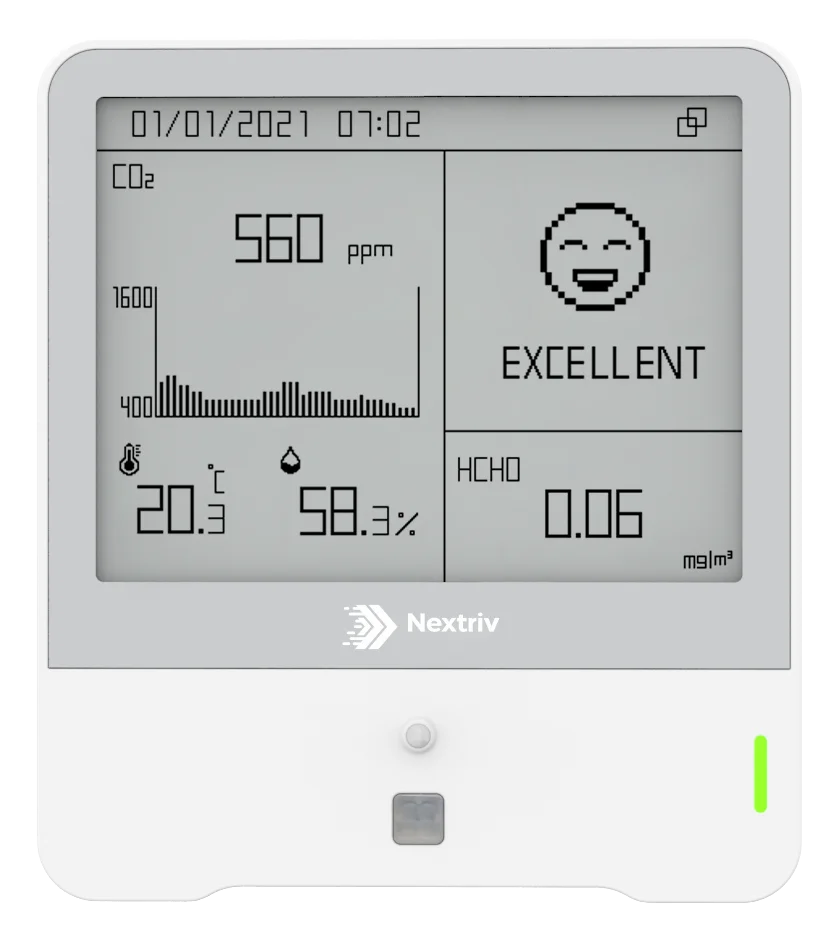
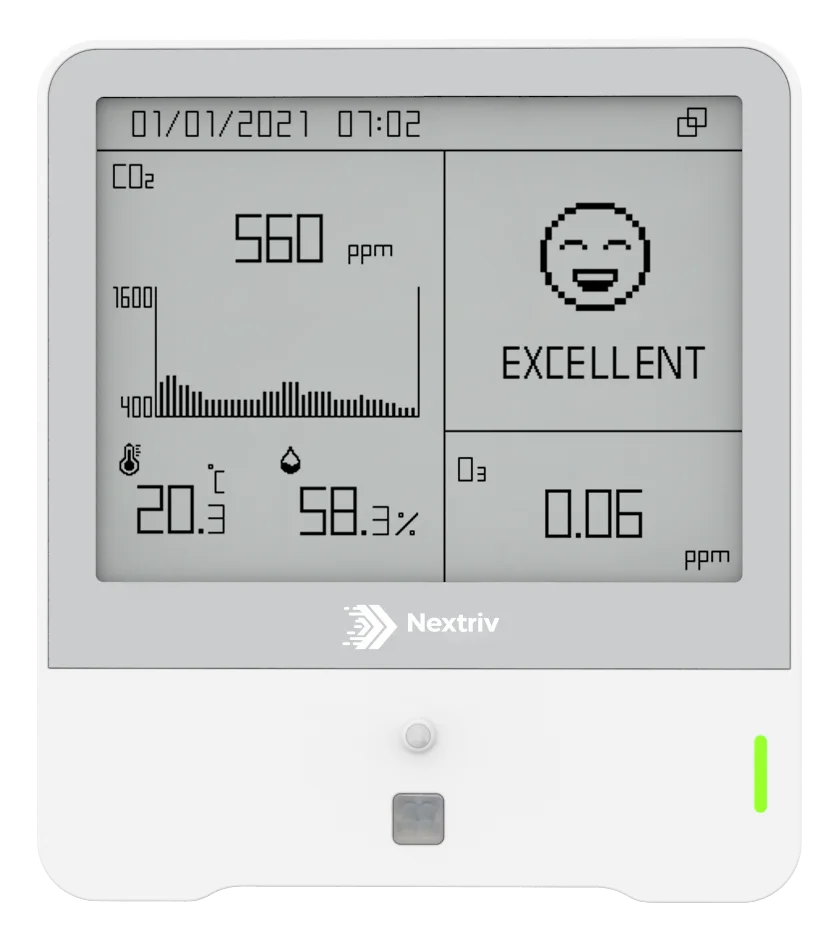
Sensitivity makes the difference here: the formaldehyde path covers 0–1.25 mg/m³ with 0.01 mg/m³ resolution — enough to pick up emissions from new furniture long before the odour detection threshold. The ozone variant measures 0–10 ppm with 0.01 ppm resolution. USB-C-only power is a deliberate design decision: the particulate and gas sensors plus continuous listening demand constant energy — in return, the device never skimps on measurement quality. The enclosure stays the same as across the whole series — a fleet of different variants looks identical on the walls.
Usage scenarios
- Premium residences: sensors of this class wired into a smart-building platform cut energy use and shorten HVAC troubleshooting time — with better humidity control even in a demanding climate.
- Self-storage facilities: sensor data as evidence in LEED certification of entire facility networks.
- Freshly fitted-out office: formaldehyde monitoring documents that post-renovation concentrations dropped to a safe level before the team moves in — in black and white, in data, not in the contractor's assurances.
- Clinic using ozone disinfection: the O₃ variant confirms that after an ozonation cycle the concentration has returned to normal before patients enter the consulting rooms.
- Shopping centre: sensors of this class integrated with building automation steer air quality for customers and staff while optimising energy.
- Campuses and public buildings: monitoring of energy performance and air quality — sensor data as input for municipal policies and smart-city projects.
Key features
- WELL programme compliance mark — independent validation of suitability for healthy-building certification; a strong argument in tenders and ESG reports.
- Swappable ninth sensor: formaldehyde (electrochemical cell, approx. 6-year lifetime) or ozone (approx. 2 years) — one platform, two risk profiles.
- CO₂ measured with photoacoustic technology — a compact, precise alternative to classic optical paths.
- Permanent power + continuous radio listening = instant response to remote commands; the device is fit for control, not just measurement.
- The full PM2.5/PM10 particulate package (laser scattering) as standard.
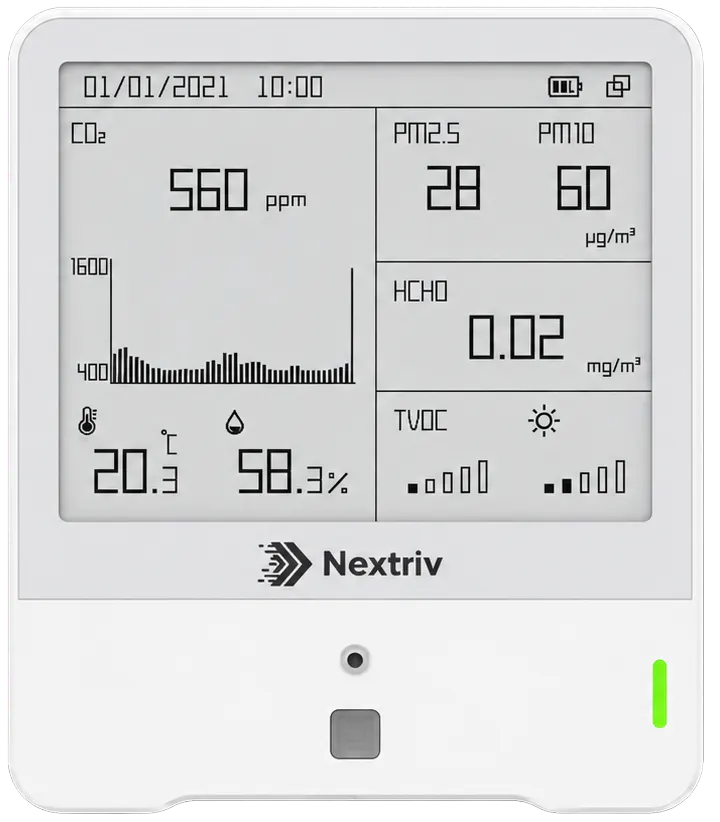
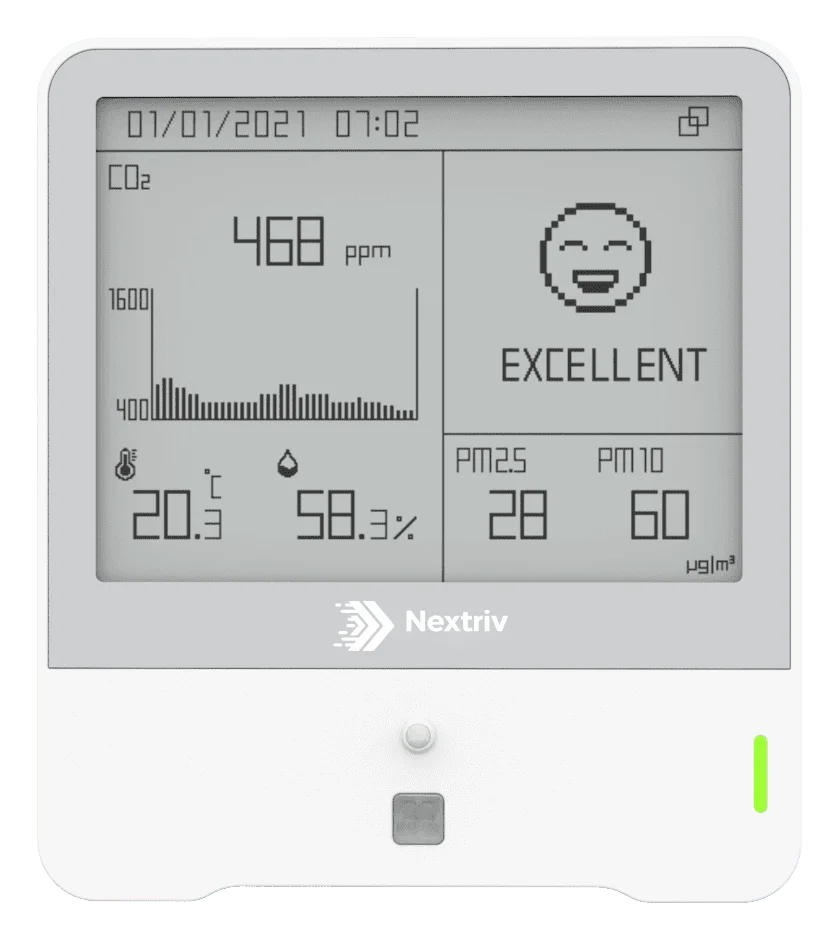
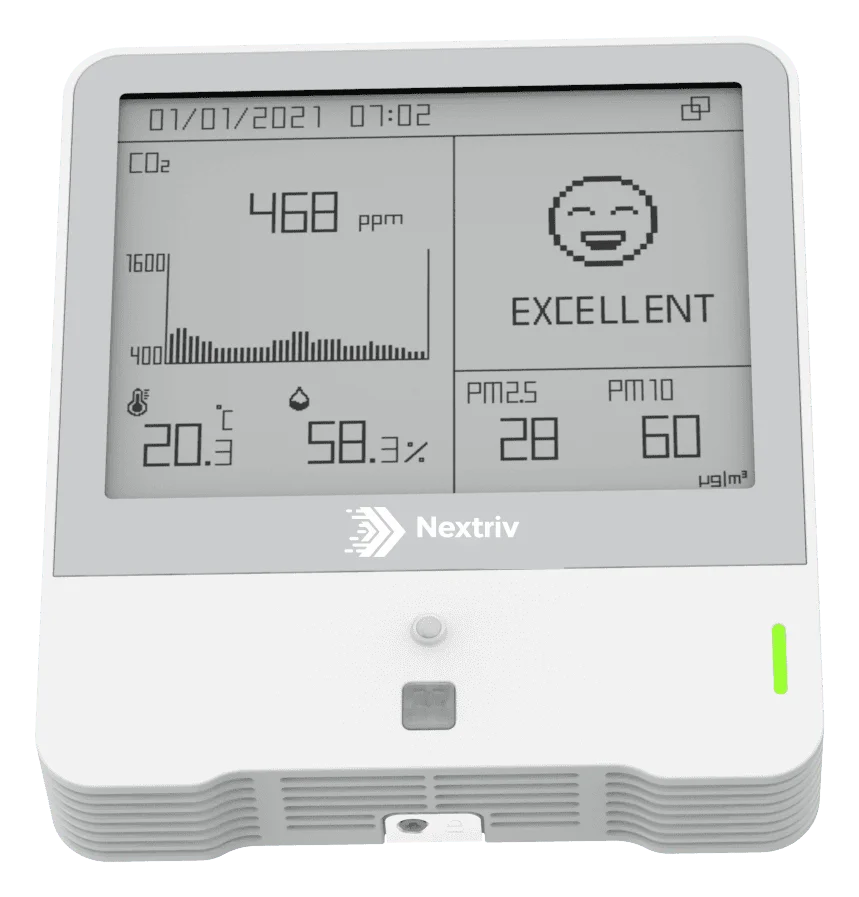
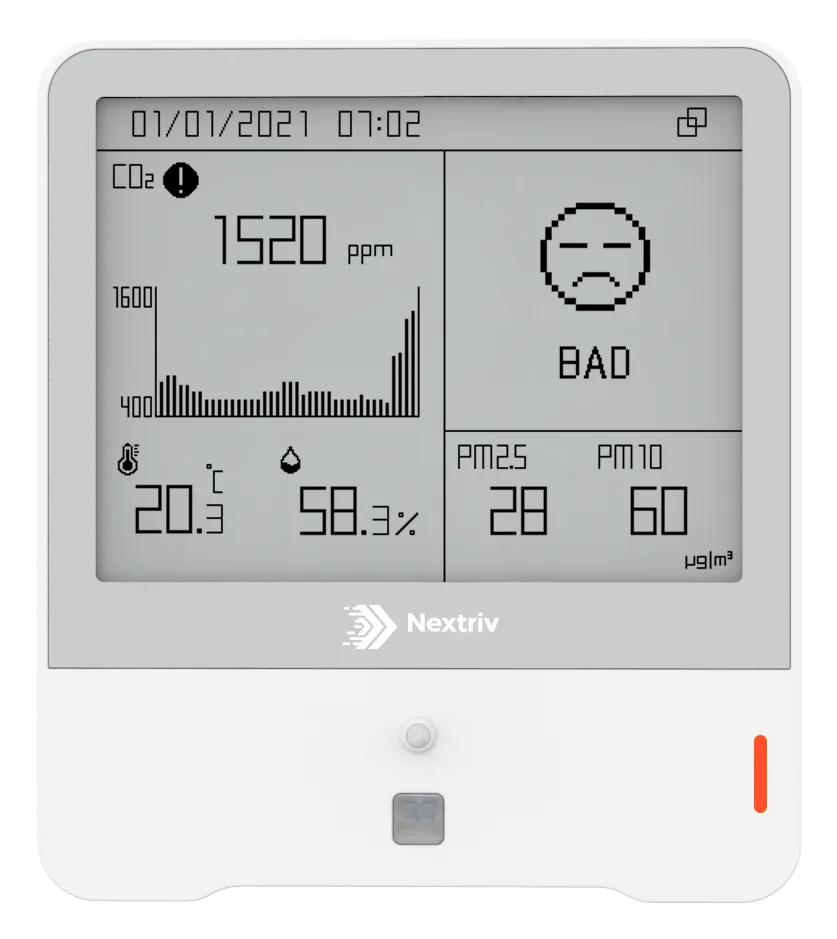
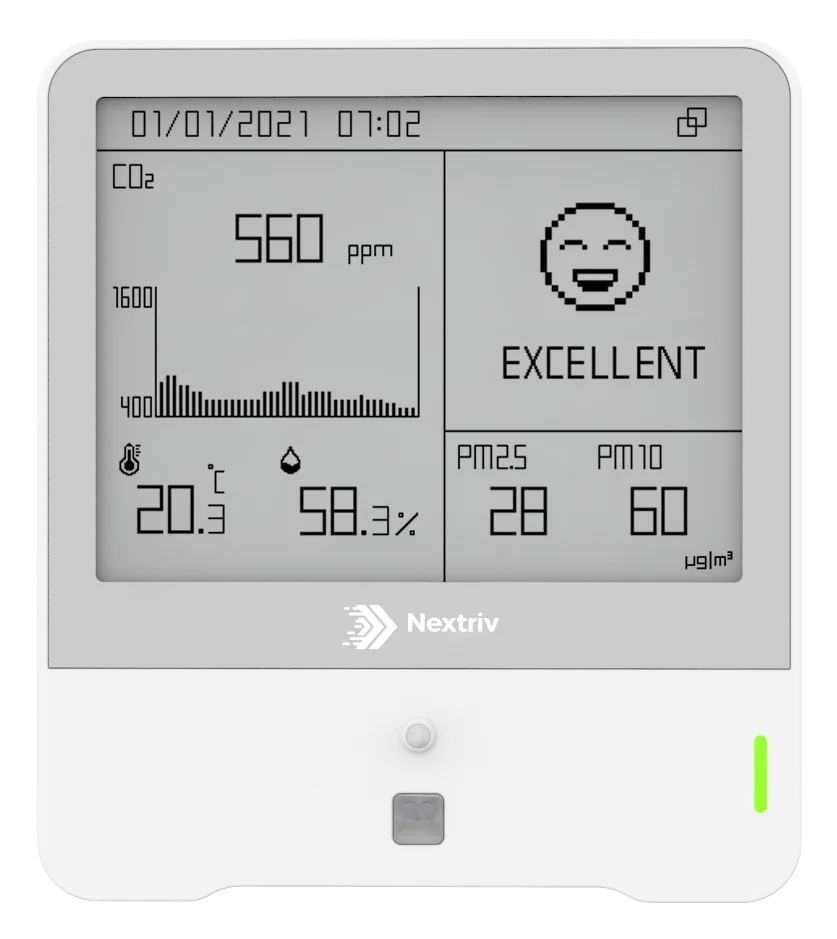
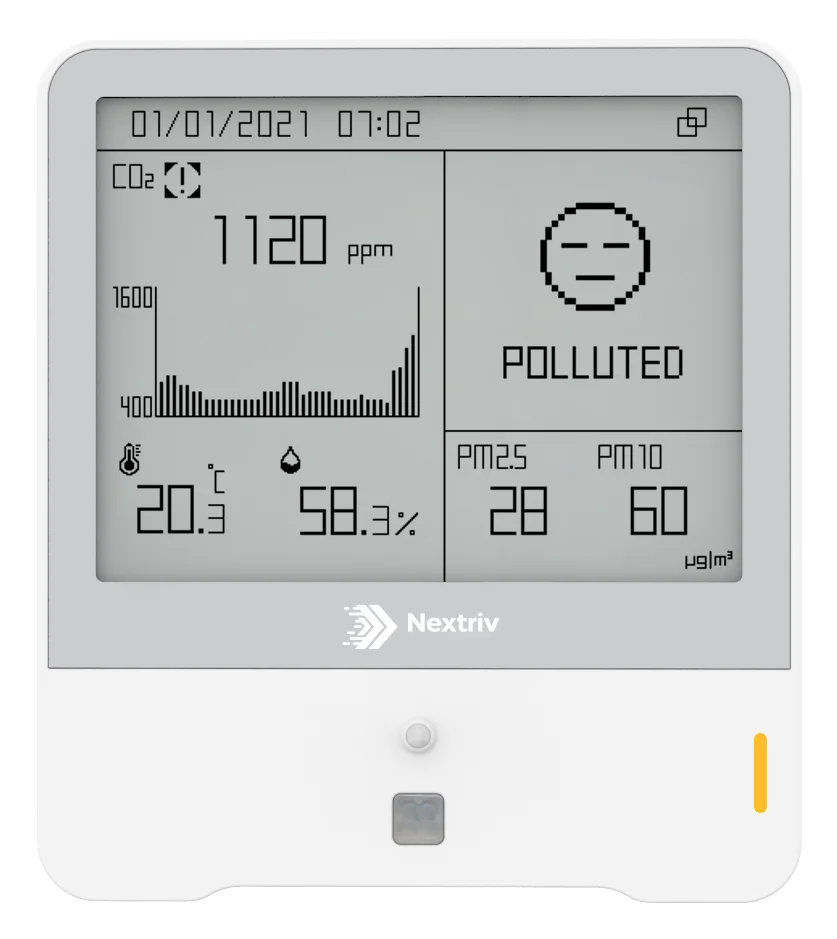
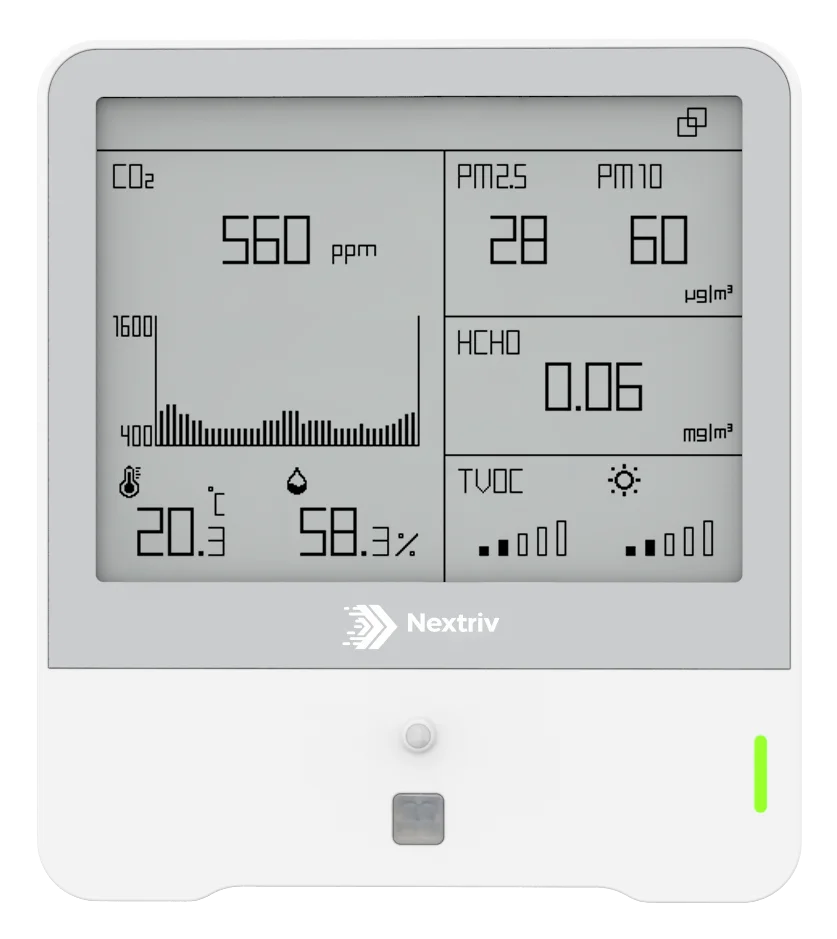
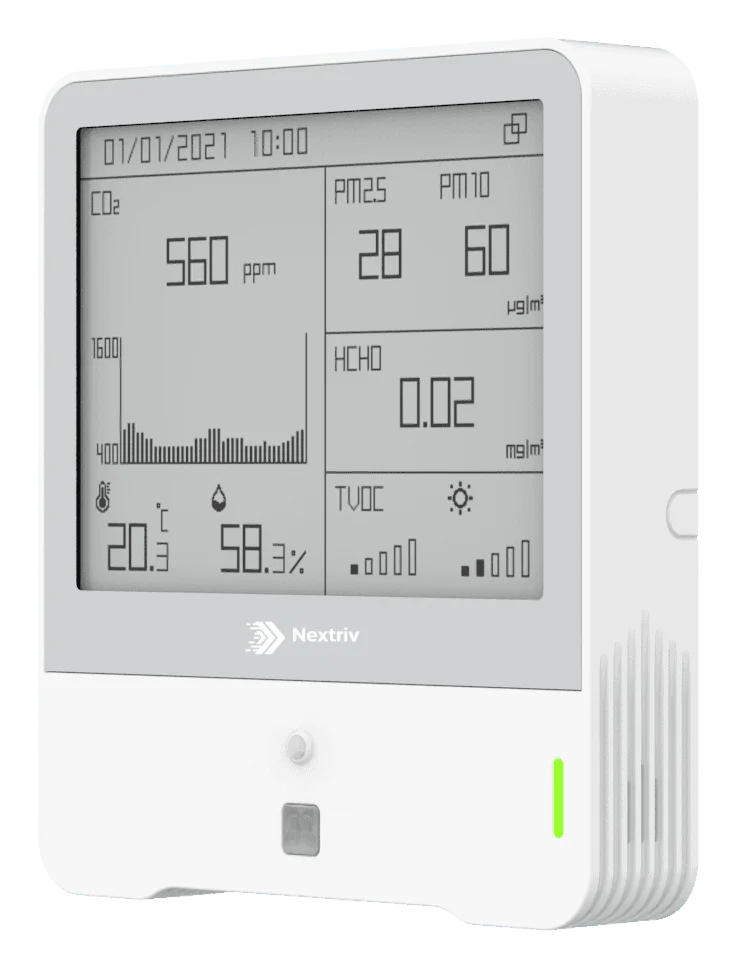
- Large 4.2″ e-ink display with emoticons, "traffic lights" and configurable layouts; built-in acoustic alarm.
- 18,000 records of tamper-proof history + retransmission — certification data with no gaps.
- Setup with a tap of a smartphone (NFC) and remote reconfiguration of entire fleets.
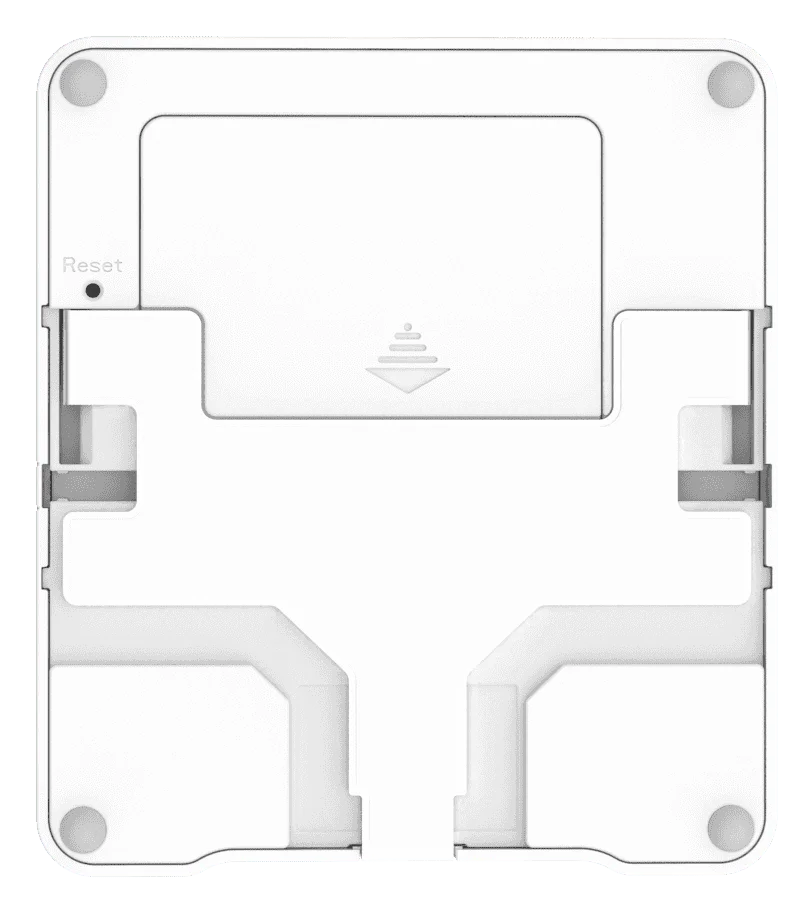
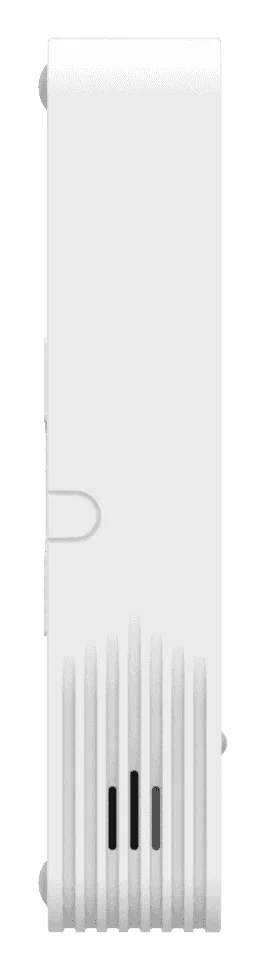
- Anti-theft mounting hardware — important in public spaces.
In the Nextriv system
Nine metrics in the Nextriv platform means nine sets of alarm thresholds — two warning and two critical each — with event codes, statuses and team comments. Notifications travel on the channel that fits the recipient (e-mail, SMS, web push, Discord, MS Teams, in-app sound), and escalation policies make sure a post-renovation formaldehyde alarm doesn't get stuck in someone's inbox. Dashboards line up all nine metrics side by side, floor plans with markers show exactly where the problem arises, and a sensor silent for longer than twice its reporting interval gets an offline status. XLSX/CSV exports feed external ESG reporting systems.
For certified facilities the reports are key: PDFs with statistics and percentiles, threshold-compliance sections and a cryptographic signature (SHA-256 with a QR code and a verification address) — a document whose authenticity an auditor can check on their own. The report schedule delivers them on a recurring basis, and measurement history of up to 5 years covers a full recertification cycle.
Typical deployments
- Commercial buildings: monitoring for WELL/LEED/BREEAM certifications and ESG reporting — continuous data instead of one-off audits.
- Healthcare: ozone checks after disinfection cycles in clinics and consulting rooms, before patients return.
- Schools: the full air quality picture on the display and in reports — including formaldehyde after classroom renovations.
- Laboratories: continuous recording of nine parameters at a single measurement point, with instant response to commands.
Specification
| Temperature | -20…60 °C, ±0.2 °C |
|---|---|
| Humidity | 0…100 % RH, ±2 % RH |
| CO₂ (photoacoustic) | 400…2000 ppm, ±(50 ppm + 5 % of reading), 1 ppm resolution |
| HCHO (option, electrochemical) | 0…1.25 mg/m³, ±10 %, 0.01 mg/m³ resolution; cell lifetime approx. 6 years |
| O₃ (option) | 0…10 ppm, ±5 % full scale, 0.01 ppm resolution; cell lifetime approx. 2 years |
| PM2.5 / PM10 | 0…1000 µg/m³, ±10 µg/m³ (0–100) / ±10 % (100–1000) |
| TVOC (MOX) | index 1.00…5.00 or concentration 0…2000 µg/m³ (±15 % + 20 µg/m³) |
| Pressure / light / motion | 260…1260 hPa ±0.5 hPa; 0…60,000 lx; PIR 80° × 55°, up to 5 m |
| Display | 4.2″ e-ink with emoticons and configurable layouts; alarm buzzer |
| Connectivity | Long-range radio, always-listening mode — instant response to commands |
| Power | USB-C 5 V/1 A (no battery operation) |
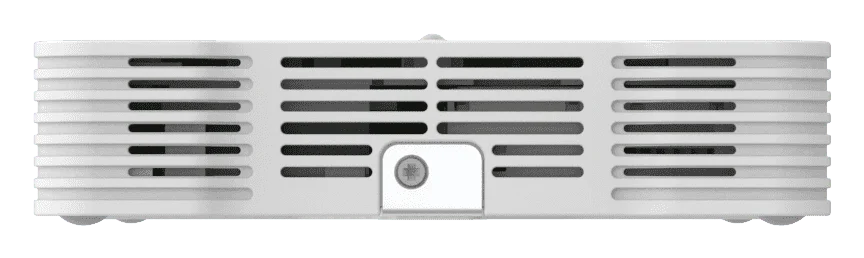
| Ingress protection | IP30 (indoor use), mounting via 3M tape or screws |
Files
- Download
Nextriv Sense IAQ Pro — datasheet
pdfEN0.6 MBversion 1.0
Related products
Other devices from the same family.
Nextriv Sense Display
SKU: NX-SN-DISP
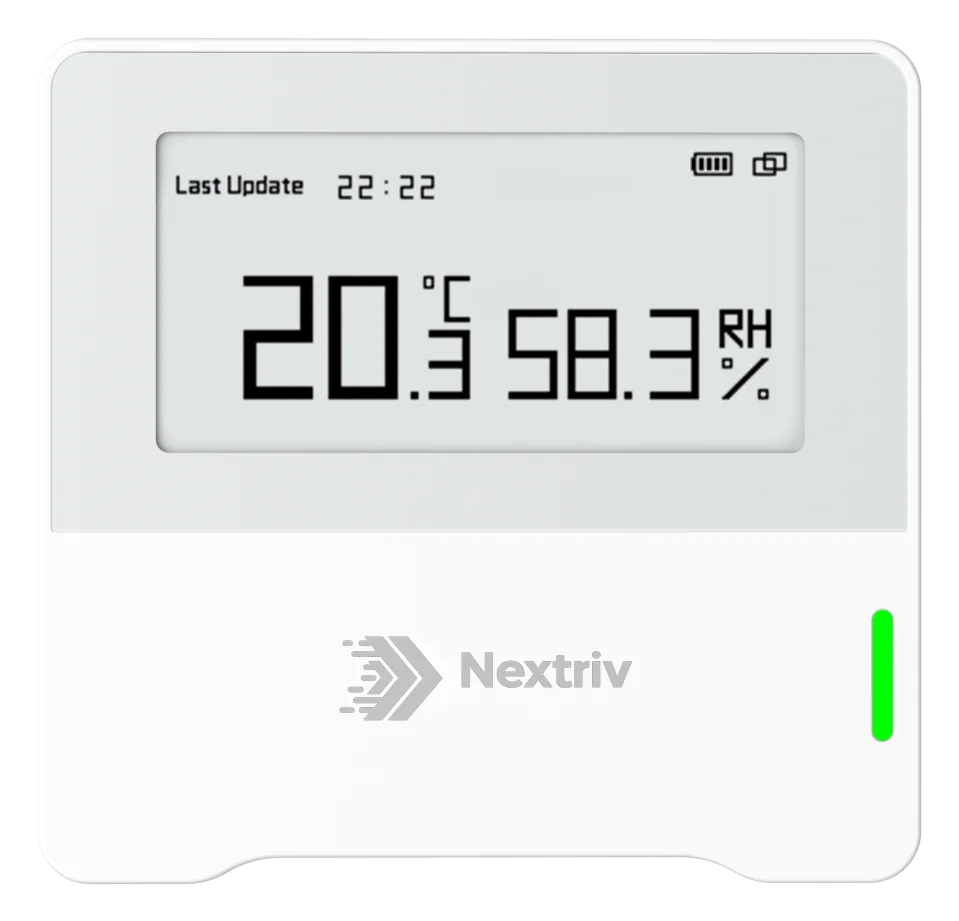
Temperature and humidity sensor with a 2.13″ e-ink display — readings on-site and in the Nextriv platform. Over 7 years on replaceable batteries.
- Temperature
- Humidity
Nextriv Sense CO₂
SKU: NX-SN-CO2
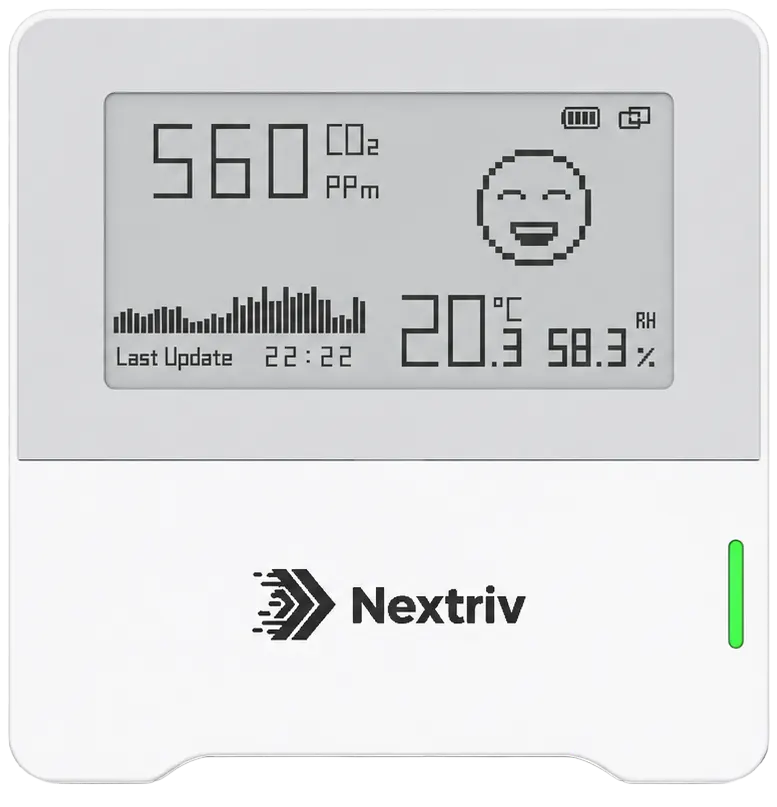
CO₂, temperature and humidity sensor with NDIR measurement and an e-ink display. Shows on the spot when to air the room — and sends the data to the Nextriv platform.
- Temperature
- Humidity
- CO₂
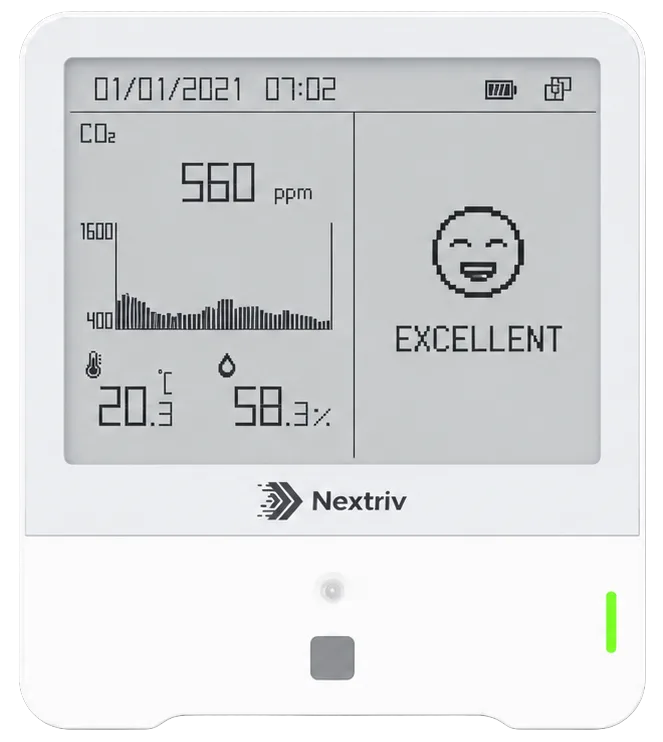
Nextriv Sense IAQ
SKU: NX-SN-AQ7
7-in-1 air quality station: temperature, humidity, CO₂, TVOC, pressure, light and occupancy — with a 4.2″ e-ink display and an 18,000-record buffer.
- Temperature
- Humidity
- CO₂
- TVOC
- +3
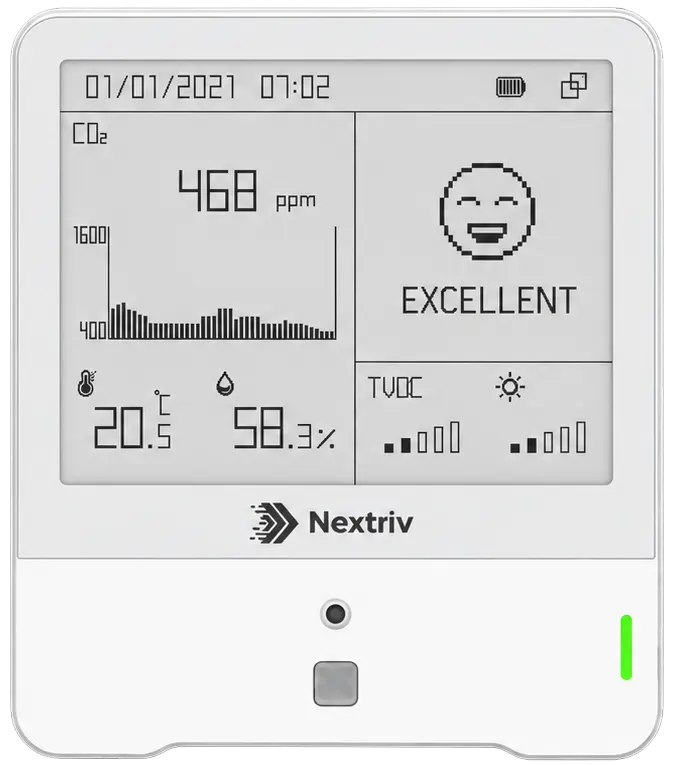
Nextriv Sense IAQ Comfort
SKU: NX-SN-AQ8C
8-in-1 climate monitoring with laser PM2.5/PM10 particulate measurement — the full picture of air health in facilities with elevated dust levels.
- Temperature
- Humidity
- CO₂
- TVOC
- +4
Not sure which set to choose?
Tell us about your facility and we'll match sensors and a gateway to the exact rooms you need to monitor — no unnecessary hardware.