
CO₂-controlled ventilation (DCV) — how sensors cut your heating bills
Demand-controlled ventilation (DCV) matches air exchange to real occupancy. How CO2 sensors cut heating bills without sacrificing comfort indoors.
Zespół Nextriv4 min read

CO2-controlled ventilation (demand-controlled ventilation, DCV) rests on a simple observation: a building does not need fresh air according to a schedule, but according to the people inside it. And yet most air-handling units run on fixed settings — full output from 7:00 to 18:00, regardless of whether fifty people are sitting in the zone or nobody at all. In winter every such "empty" air change is heat thrown away: air we have warmed to 21 °C leaves through the exhaust duct, and freezing air comes in to be heated from scratch. DCV breaks that cycle, because it knows — from measurement, not from the calendar — when ventilation is genuinely needed.
Why ventilating "just in case" drives the bills up
Ventilation is designed for maximum occupancy: a conference room for 12 people, an open space for 40, a gym for 100. Meanwhile the actual use of the space is often a fraction of the design — conference rooms stand empty for most of the day, and a Friday afternoon in the office looks nothing like a Tuesday morning.
A fixed schedule does not see that difference. The result is doubly expensive:
- When there are fewer people than assumed, the unit exchanges (and heats) far more air than anyone needs. That is pure energy loss — the colder it is outside, the more painful.
- When there are more people than assumed — a packed room for an hour-long meeting — the schedule cannot keep up and the carbon dioxide concentration climbs past the comfort limits. You then pay not with a bill, but with the team's concentration.
In other words: without measurement the building airs at the wrong moments in both directions. Only a feedback signal can fix that — and this is where CO₂ comes in.
How CO2-controlled ventilation works
Carbon dioxide is the best available indicator of human presence in a room. Outdoor air contains around 420 ppm of CO₂; every person in an enclosed zone steadily pushes that concentration up by breathing — the smaller the volume and the weaker the air exchange, the faster. A CO₂ chart is, in practice, a chart of how the space is used.
DCV closes a control loop on that measurement:
- A sensor measures the CO₂ concentration in the occupied zone (not in the duct, not at the supply vent).
- The platform compares the reading against thresholds — e.g. a warning one at 800–1000 ppm and a critical one at 1200–1400 ppm.
- The ventilation responds: below the thresholds it runs at minimum speed (or not at all), after a breach it ramps up the output, and once the concentration returns to normal it slows down again.
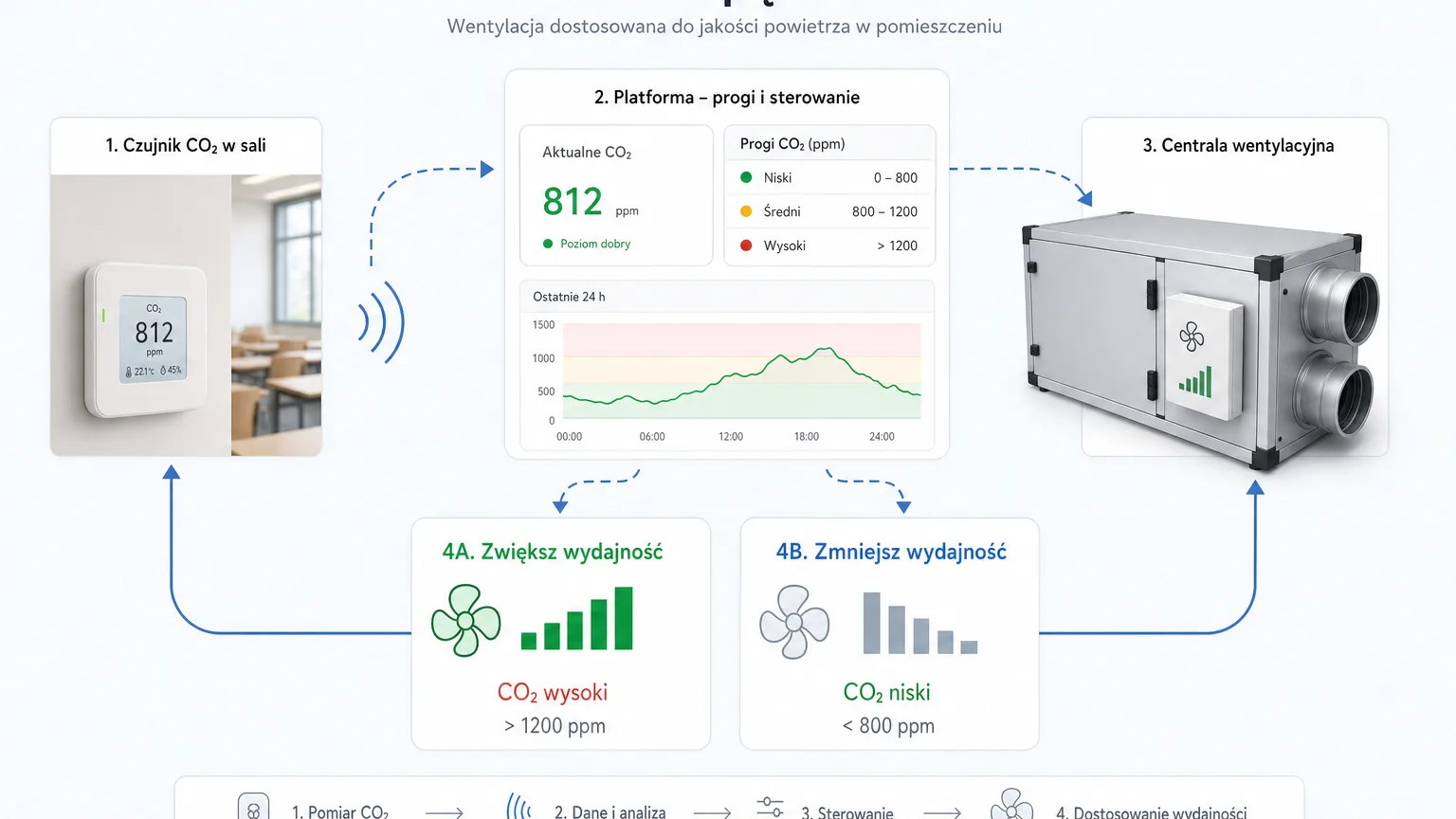
The effect cuts both ways: empty zones stop being ventilated "just in case" (less heating in winter, less cooling in summer), and full rooms get more fresh air exactly when they need it. Which threshold values make sense and where they come from — the Pettenkofer number, the EN 16798-1 categories — is covered in detail in our article on CO₂ standards and thresholds in conference rooms.
The sensor everything depends on
The control loop is only as good as the measurement that feeds it. In practice three things matter:
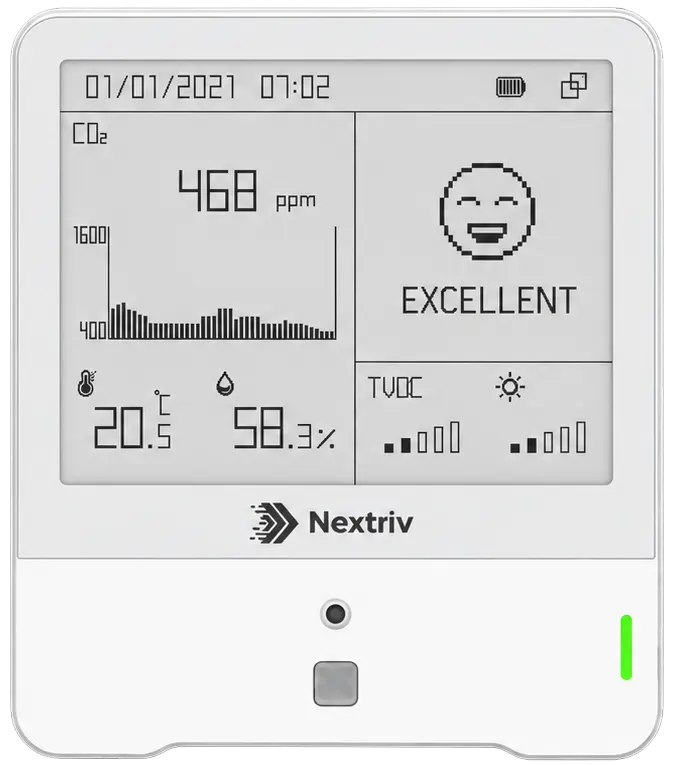
NDIR technology. Optical CO₂ measurement (non-dispersive infrared) is stable over time and can be calibrated — unlike cheap sensors that estimate the concentration indirectly. Nextriv Sense CO₂ measures by NDIR across 400–5000 ppm with ±(30 ppm + 3% of reading) accuracy and supplies temperature (±0.2 °C) and humidity along the way — a complete comfort dataset from a single point.
Installation without cabling. DCV requires a sensor in every controlled zone — and pulling wires to a few dozen rooms can kill a project's budget. A battery-powered sensor with long-range radio connectivity (approx. 2 km in built-up areas, up to 15 km in open terrain) mounts with tape or screws and is configured by holding a smartphone to it over NFC; the replaceable batteries last around 3–5 years at a 10-minute measurement interval.
Feedback for the people. The e-ink display variant shows the reading and an emoticon on the spot — where the automation is not (yet) in place, "to air or not to air" gets settled without logging in to anything.
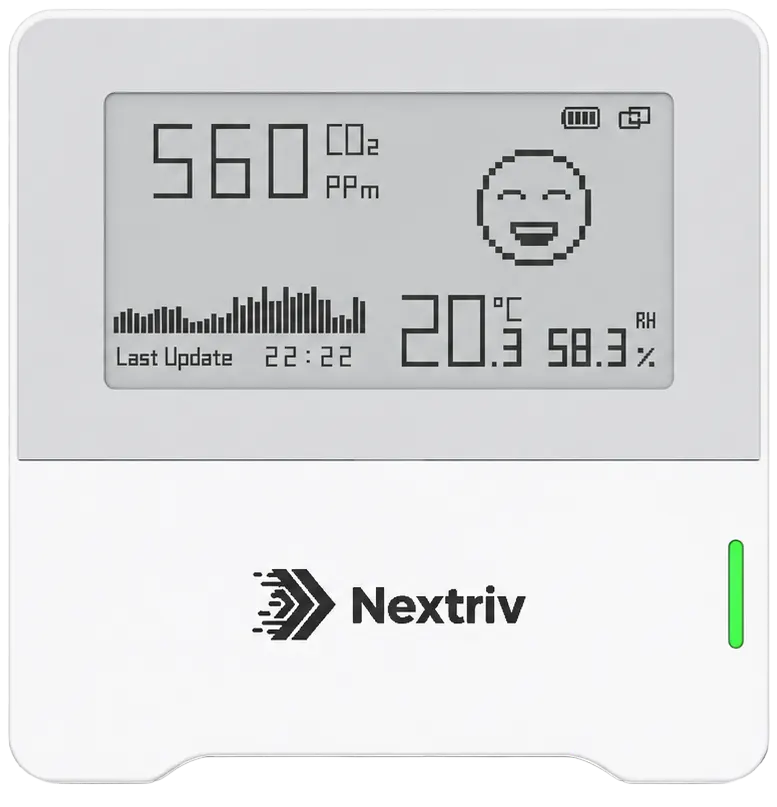
In high-traffic zones — lobbies, corridors along a busy street — it is worth considering a station that also measures particulate matter: Nextriv Sense IAQ Comfort combines NDIR CO₂ measurement with laser PM2.5/PM10 measurement and six other parameters, so the same data loop will also judge how well the units' filtration performs.
From measurement to automation — and to the bills
The Nextriv platform ties the measurements into a working system. The CO₂ metric takes up to four thresholds (warning and critical), and every breach generates an event with a readable code and a notification on a channel the team actually reads — from email and SMS to MS Teams. The data goes outward too: webhook integrations pass events on to the customer's building automation systems, so a threshold breach in a room can directly ramp up the zone's ventilation output.
What does this look like in practice? Two scenarios from deployments of this class of devices:
- A spa resort in Croatia tied CO₂ sensors into the HVAC automation of several buildings at once — guest comfort went up and energy use went down, because the ventilation stopped working for empty zones.
- A social programme in Valencia (and five other European cities) uses CO₂, temperature and humidity sensors in the homes of families affected by energy poverty — the data helps lower heating costs without harming the residents' health: you air as much as needed, not as much as habit suggests.
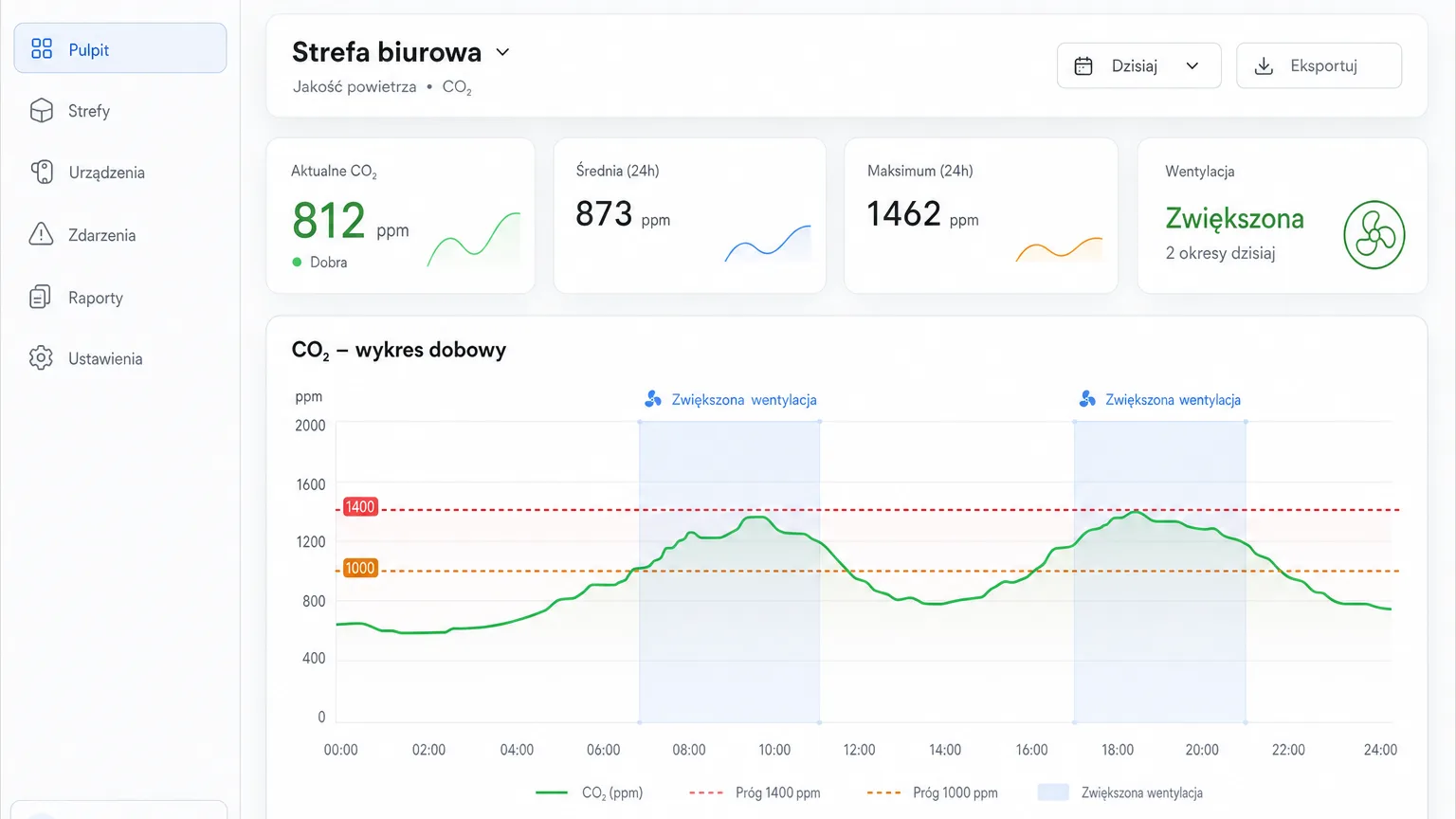
The full scenario for an office building — from sensors on the floors, through thresholds and escalations, to reports for the property manager — is described on the solution page for buildings and offices. And if you are only beginning to sort out the topic of air parameters, a good primer is the piece on what good office air quality is and how to measure it.
Start with data, not a refit
You do not have to modernise the air-handling units to begin. A sensible path looks like this: hang CO₂ sensors in a few representative zones, collect data for two to four weeks and put the charts side by side with the ventilation schedule. Usually that very first chart shows where the unit is working for empty rooms — and how far you can safely lower the settings outside peak hours.
The FREE plan includes 10 sensors, a gateway and a full year of measurement history — a pilot needs no software budget. Have a look at the pricing or book a demo: we will show CO₂ charts from a live building and work out together how much heat escapes today through ventilation running "just in case".


