Leak detection in cold storage — protection against losses
Leak detection in cold storage: condensate, defrost cycles and the plant room under constant watch. Spot and zone sensors alert before water causes losses.
Zespół Nextriv4 min read

Leak detection in cold storage sounds like a secondary topic — surely in a refrigerated facility temperature is what matters most. And yet it is water in the wrong place that accounts for a surprisingly large share of the losses: pallets soaked under a blocked condensate drain, ice on the freezer floor, corroded panels, a chamber out of service at the peak of the season. The paradox is that in a refrigerated facility water is a permanent part of the process — evaporators defrost, floors get washed, the systems pump refrigerant and glycol. The question is not "will water appear", but "will you learn about it while it is a puddle, or once it is damage".
Where the water in a cold store comes from
The risk map is similar in most facilities:
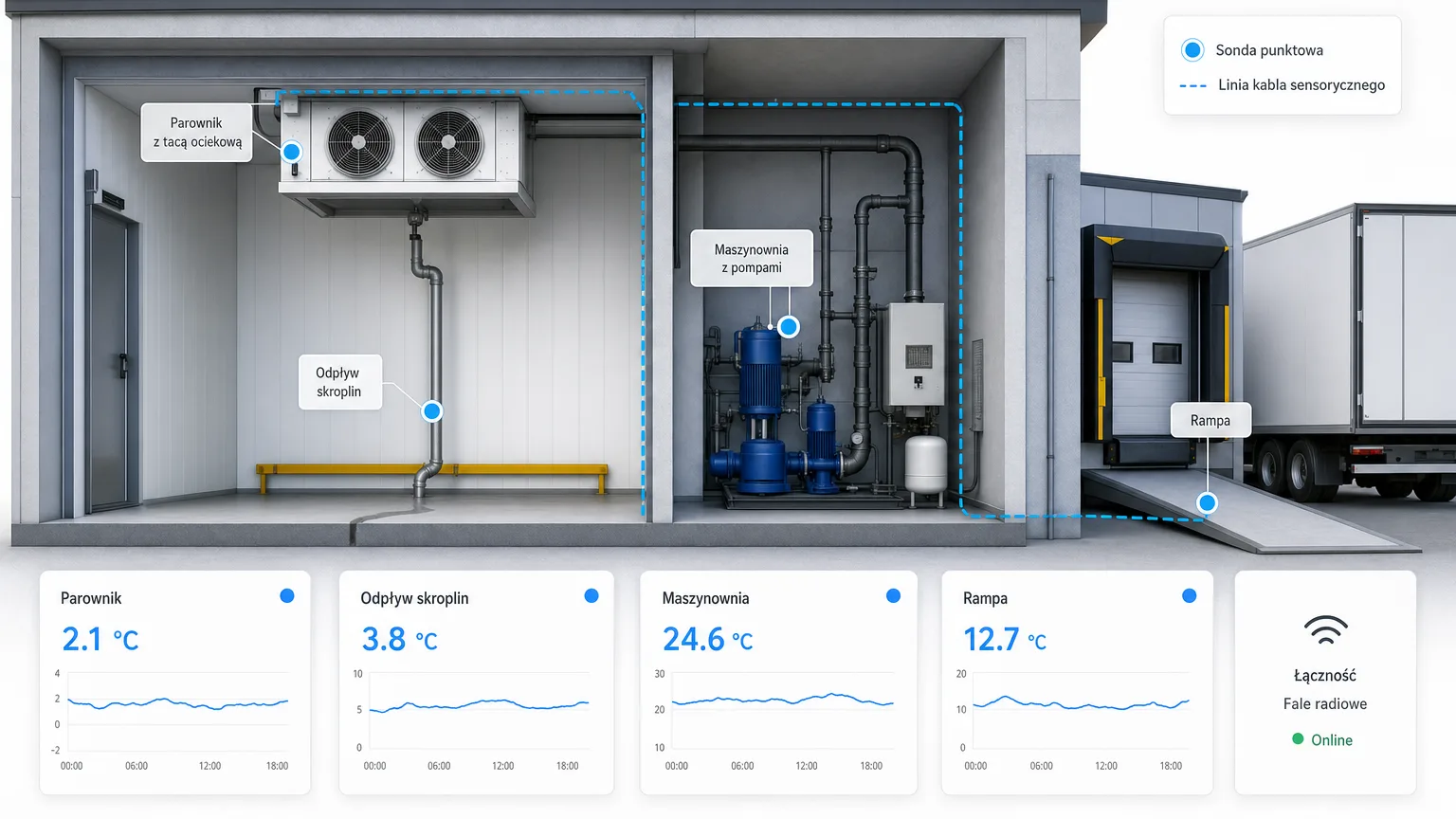
- Evaporators and drip trays. Every defrost cycle produces water that should leave through the condensate drain. A blocked or frozen drain is a classic: the tray overflows, water drips onto the goods or freezes into ice build-up on the ceiling and floor.
- The plant room. Pumps, valves, exchangers and the joints of the glycol installation — a minor leak can seep for weeks behind the unit before anyone takes a look.
- Pipe runs. Chilled water and glycol lines often run above storage zones or along corridors — a leaky joint drips exactly where the goods are standing.
- Docks, airlocks and doors. Warm, humid air forcing its way in through open doors condenses on the cold surfaces; in a freezer it freezes on the airlock floor.
- Washing and chance events. Wash-down water that never drained, a burst hose, a plumbing failure in the room next door.
In a freezer there is an extra plot twist: a leak rarely looks like a puddle, because the water freezes. Ice on the floor is a safety risk for people and forklifts, and ice in the floor structure or the panels becomes, over time, structural damage. All the more reason to catch the water at its source — in the tray, at the drain, in the plant room — before it spreads across the zone.
What an undetected leak costs
The loss almost never ends with the water itself. Soaked secondary packaging can disqualify entire pallets, even if the product inside is untouched. In a facility operating under HACCP, water of unknown origin in a storage zone is a risk that has to be assessed and documented — easier when the system shows exactly when and where it appeared. Then there is the downtime: a chamber shut down for drying and repair earns nothing, and the goods have to be moved somewhere. And finally the insurer, whose first question is usually: "how long had the leak been going on and how was it supervised?". The answer "we don't know" costs the most.
Leak detection in cold storage: spot or zone
Technically the task is solved by two types of sensors — and in most facilities a combination of both works best.
A spot sensor watches a specific, predictable risk point. Nextriv Sense Leak Spot has a probe with a 316 stainless steel head on a 1.5 m lead: the probe lies in the evaporator drip tray, at the condensate drain or under a pump in the plant room, while the transmitter hangs higher up, in a good radio position. About 5 mm of conductive liquid is enough to trigger the alarm. Detection is contact-based — it fires only on physical contact between the electrodes and the liquid, so false alerts are practically nonexistent.
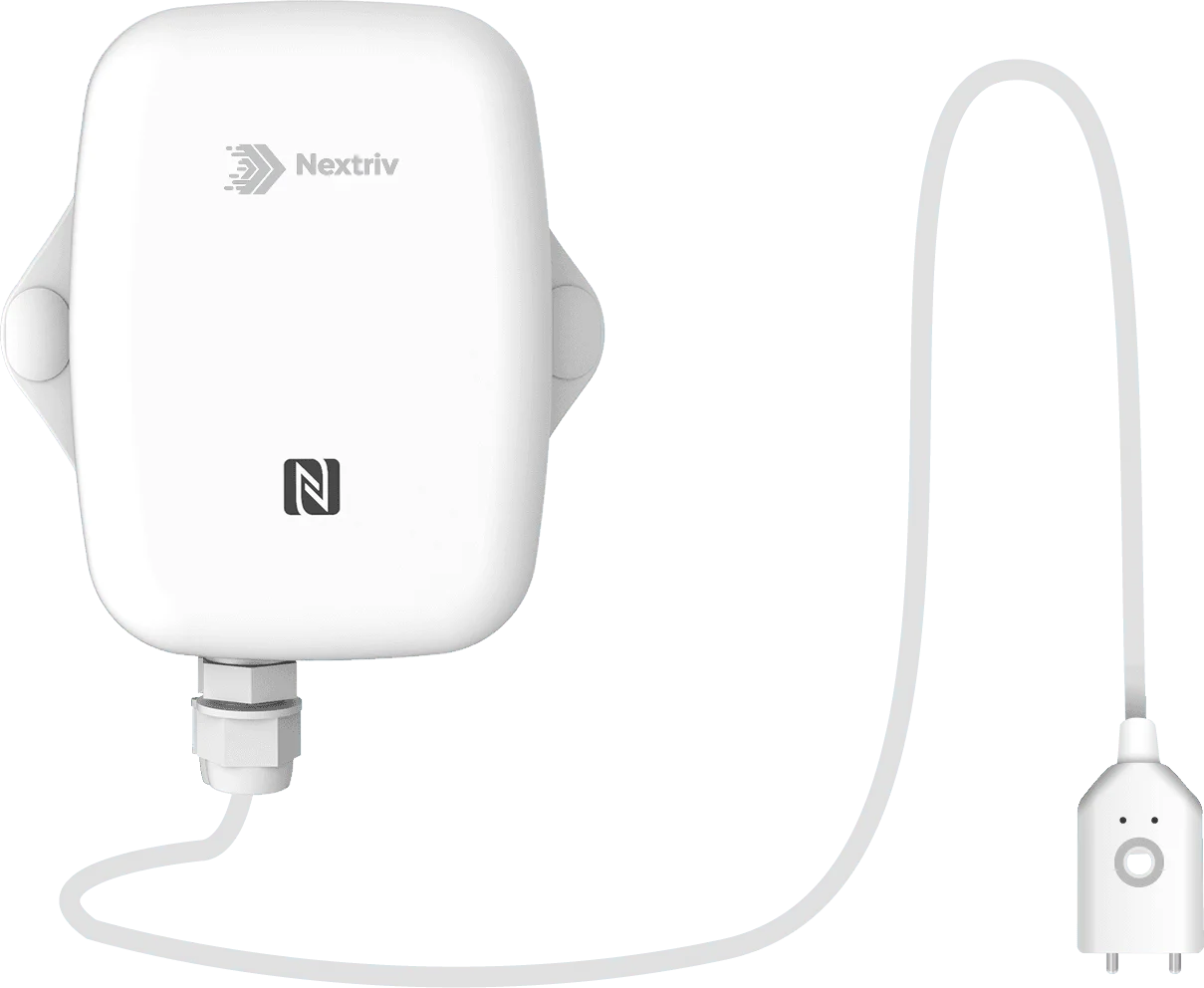
A zone sensor answers the situations where you cannot point a finger at where the water will appear. Nextriv Sense Leak Zone has a sensing cable instead of a probe — 3 m as standard, longer runs to order — which detects liquid at any point along its length. The cable is laid along the glycol pipe run, around the plant room perimeter or along the lowest line of the floor by the chambers; after an incident it only needs drying to return to service. One line replaces a dozen or so points and leaves no dead spots between them.

Three measurements from one installation
Both sensors also report the ambient temperature and humidity — and in cold storage that is not an extra but a second line of defence. Humidity creeping upward week after week in the plant room betrays a micro-leak before water ever touches the probe. The temperature reading from the same transmitter will guard an unheated plant room against frost, and each metric can take up to four alarm thresholds. An operating range of −30 to 70 °C covers chambers, freezers and technical rooms, and long-range radio connectivity — up to about 2 km in built-up surroundings — carries the data through walls and cold-room panelling to a single gateway per site.
The sensors alarm on events and run for years on a battery — what really drains the battery of wireless devices, and how to keep it in check, is covered in a separate article on sensor battery life. A tamper-proof local log of about 2,800 records with automatic backfill after a connectivity gap also provides the evidence for the insurer: when it was detected, how long it lasted, what the conditions were.
An alarm that gets through at night
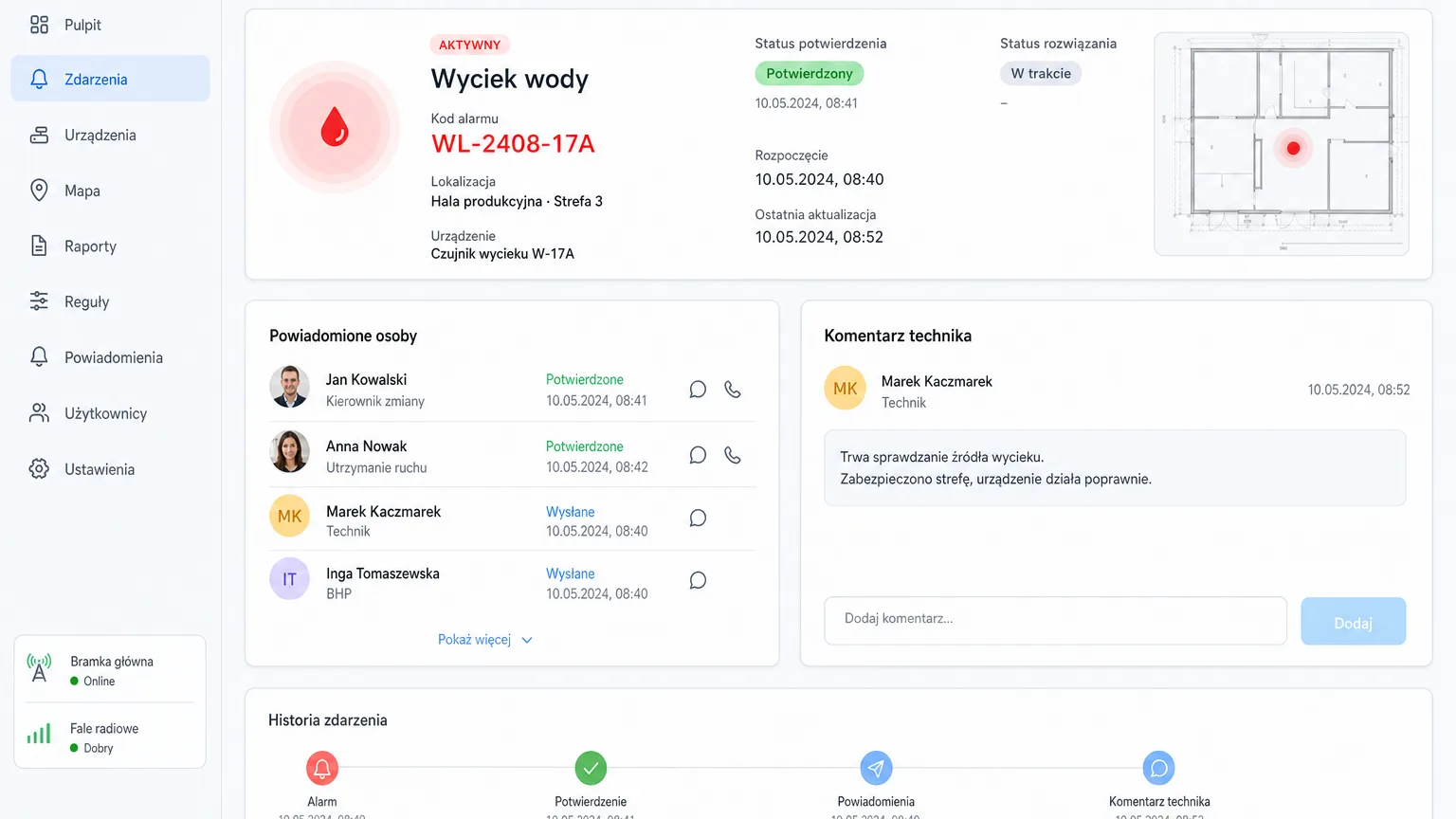
A leak at 3:00 only matters if it wakes someone up. The platform sends notifications over multiple channels — SMS, email, push, MS Teams, Discord, an audible alarm in the app — and escalation policies pass an unacknowledged alarm on to the next people: from the on-duty technician to an external service company. Quiet hours do not apply to critical alarms, so a flood will always break through. Every event has a code, a status and comments — after an incident a full response timeline remains, ready for the documentation.
In direct device-to-device communication mode, the leak signal can also trigger an actuator — a shut-off valve, for example — without the server's involvement, turning the sensor from an informer into part of the anti-flood automation.
Add water to the list of supervised risks
Temperature monitoring in a refrigerated facility is standard today — we walked through it step by step in our guide to monitoring cold zones in a warehouse. Leak detection is the natural extension of the same installation: the same gateways, the same platform, the same alarm channels — just a few extra sensors in the places where water can do the most damage. The whole scenario for cold stores and warehouses is described on the solution page for cold storage and logistics.
Count your risk points — evaporator trays, the plant room, the pipe runs — and check the pricing, or book a demo and we will show a flood alarm from the first drop to the insurer-ready report.