
The vaccine cold chain — requirements and monitoring step by step
The vaccine cold chain step by step: 2–8 °C requirements, probe placement in a thermal buffer, four alarm thresholds, escalation and audit-ready records.
Zespół Nextriv4 min read
In this article
- The vaccine cold chain — what it consists of and where it breaks
- Why 2–8 °C, and what an excursion means
- Continuous recording instead of two readings a day
- Four thresholds and escalation — an alarm that gets through
- Humidity and a second probe — when it's worth it
- Chain documentation for an inspection
- A deployment checklist in 6 steps
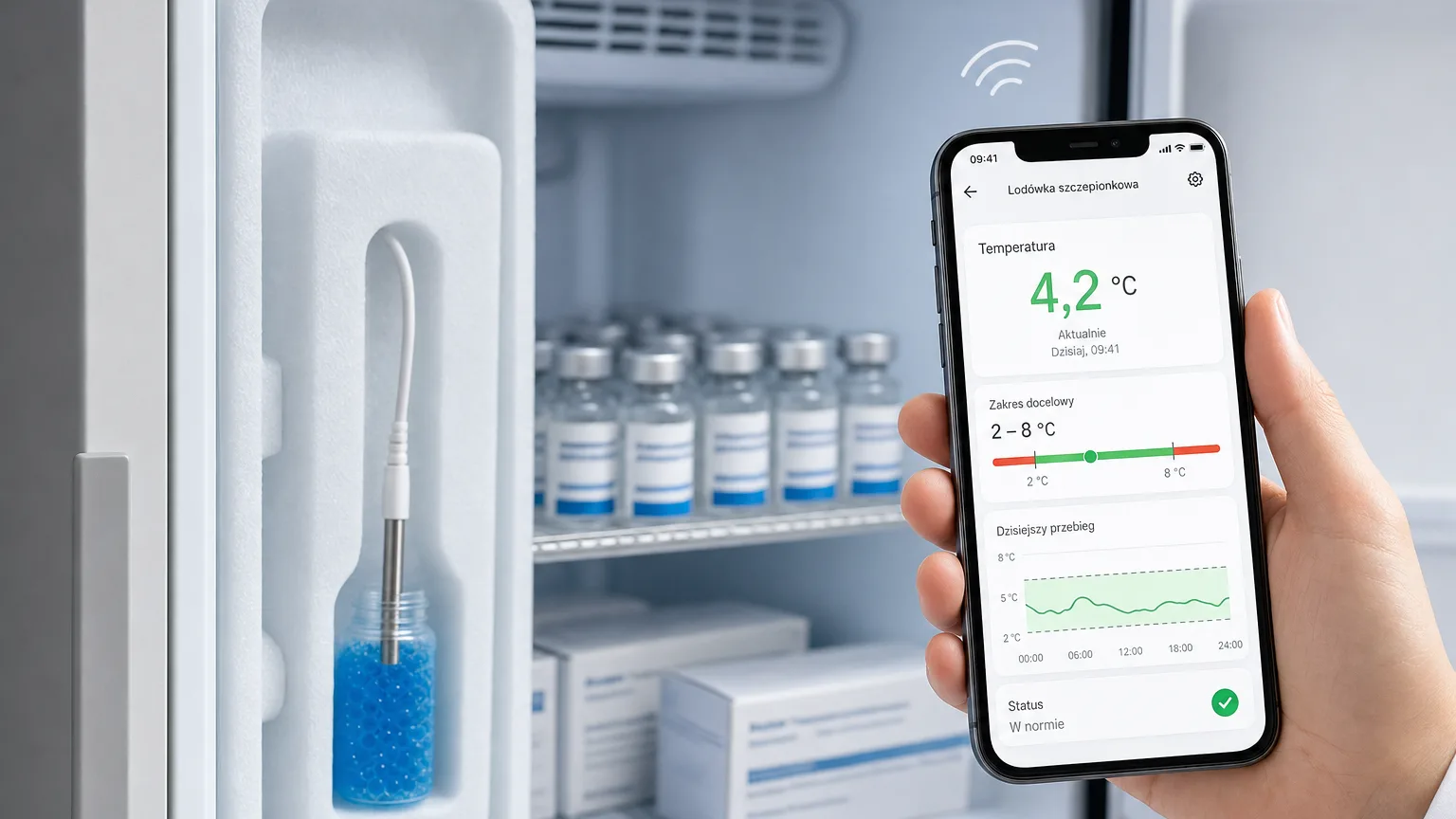
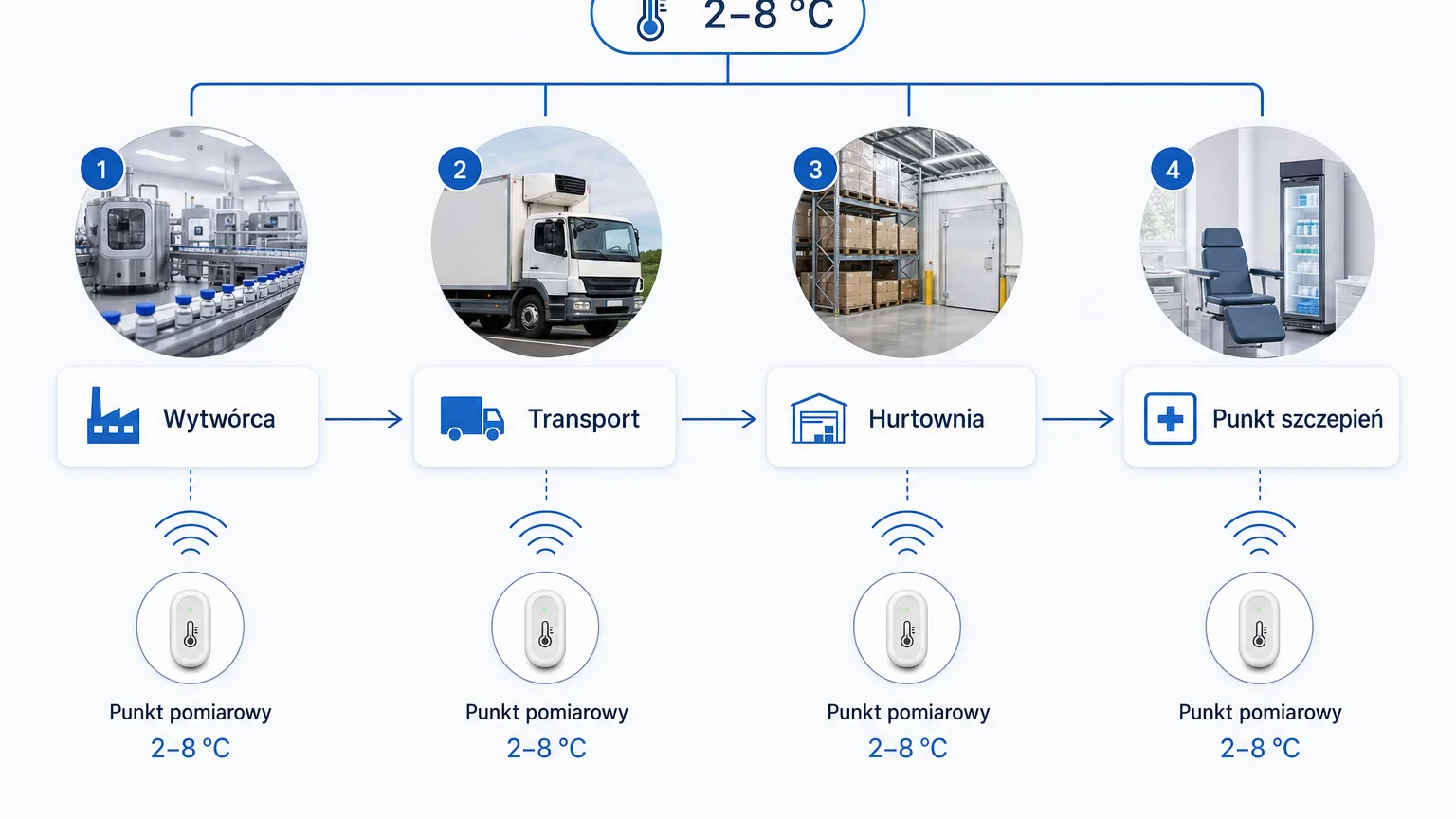
The vaccine cold chain is the road a preparation travels from the manufacturer's production line to the moment it is administered to a patient — and for that entire time it must stay within a narrow temperature window, most often 2–8 °C. One weak link is enough: an overheated fridge in a clinic, a vial frozen next to the evaporator, a few hours without power over a weekend — and the batch loses potency, usually without any visible trace. This guide walks step by step through the requirements and through monitoring that genuinely protects the preparations: from the links of the chain, through probe placement and alarm thresholds, to the documentation an inspection will demand.
The vaccine cold chain — what it consists of and where it breaks
Before a vaccine reaches a patient, it passes through several links, each of which can fail:
- The manufacturer and the distribution warehouse — large cold rooms with power redundancy, usually the best supervised.
- Transport — refrigerated vehicles and passive packaging; a risk of both overheating and freezing with badly chosen ice packs.
- The pharmaceutical wholesaler — 2–8 °C zones and a 15–25 °C warehouse, covered by good distribution practice requirements.
- The vaccination point — the fridge in a practice or pharmacy, the proverbial "last mile".
It's the last mile that breaks most often. The clinic fridge is often a domestic-grade appliance, opened dozens of times a day, checked manually twice a day. Between the reading at 15:00 and 8:00 the next morning, seventeen hours pass in which nobody looks at the thermometer — and failures don't keep office hours.
Why 2–8 °C, and what an excursion means
Most vaccines are validated by their manufacturers for storage at 2–8 °C. Going outside the window works both ways, and both directions can be dangerous:
- Above 8 °C — accelerated loss of active-substance potency; the warmer and the longer, the greater the loss.
- Below 2 °C and freezing — for many preparations, especially those containing adjuvants, the damage is irreversible, even if the temperature quickly returns to normal.
The trouble is that neither scenario is visible to the naked eye. A vial that has been briefly frozen looks identical to a sound one. That's why the only credible protection is continuous recording with automatic alarms — not trust in two readings a day. The threshold logic here is in fact shared with all food refrigeration; we covered it more broadly in the article on cold zone monitoring.
Continuous recording instead of two readings a day
Good measurement starts with physics. In a vaccine fridge, three rules apply:
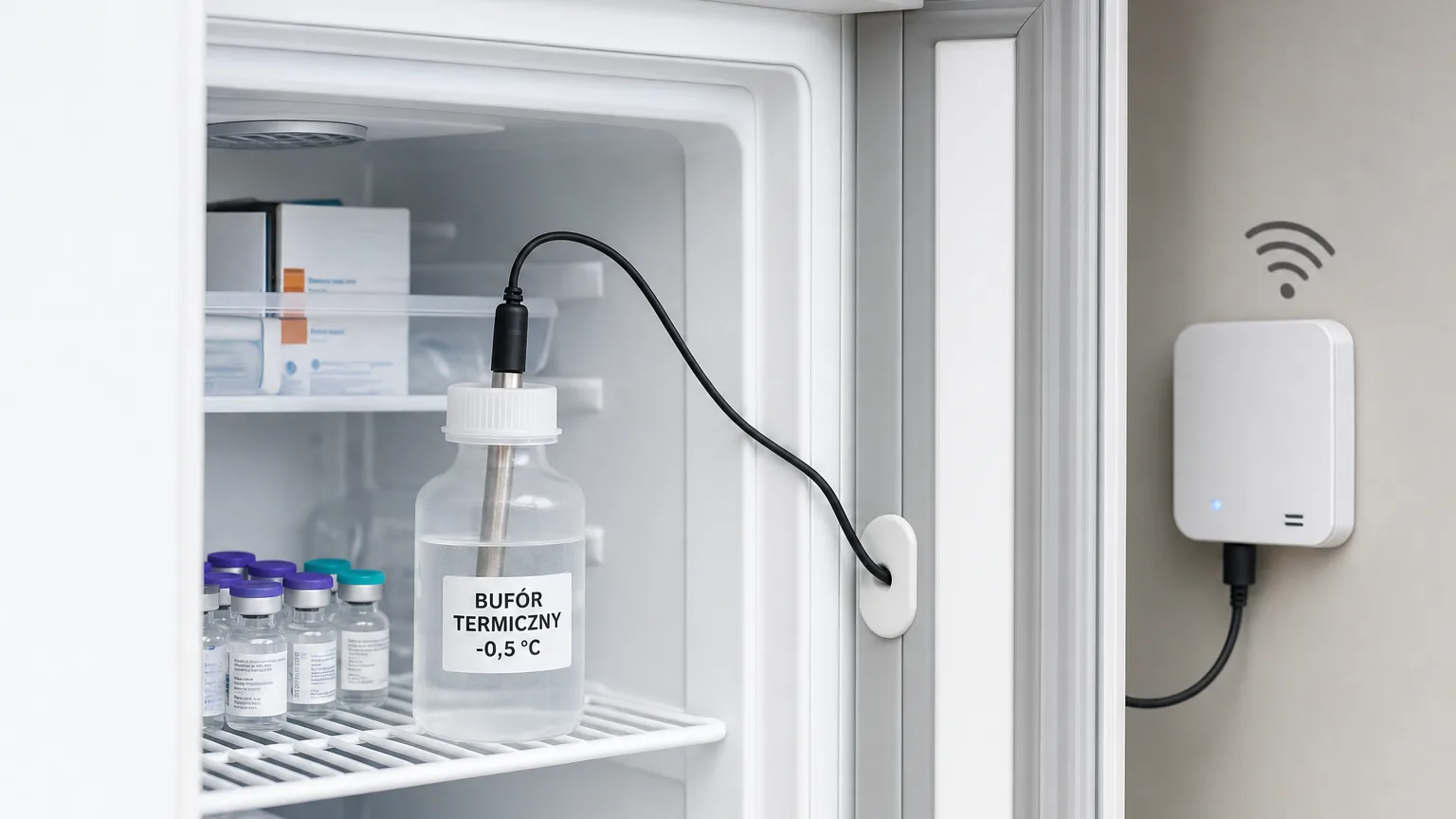
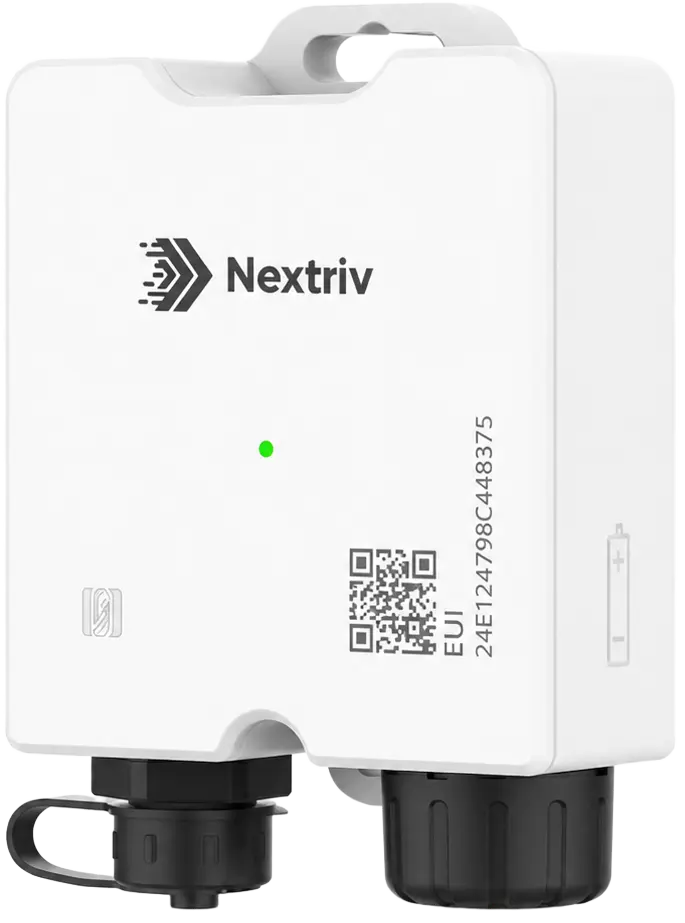
- Transmitter outside, probe inside. The metal enclosure attenuates the signal and chills the electronics. The Nextriv Probe Solo recorder has a probe on a 1.5 m cable with an M12 connector — only the steel probe goes into the chamber; the transmitter stays in the warmth and within network range.
- The probe in a thermal buffer, not in the air. Immersed in a bottle of buffer, it mirrors the thermal inertia of the product rather than of the air, which jumps with every opening of the door. No more false alarms after someone reaches for a vial.
- Records without gaps. The recorder buffers 4,000 measurements locally and sends them on after a connectivity gap — an internet outage leaves no hole in the history. Long-range radio punches through the fridge walls to a gateway in another room.
Four thresholds and escalation — an alarm that gets through
A single "above 8 °C" threshold tells you about the problem when it's already too late. In the Nextriv platform every metric has four thresholds — two warning and two critical. A proven configuration for a vaccine fridge:
| Threshold | Value | What it means |
|---|---|---|
| Critical lower | 2 °C | freezing risk — act immediately |
| Warning lower | 2.5 °C | the temperature is approaching the lower limit |
| Warning upper | 7.5 °C | the fridge is losing its cool — check before it turns critical |
| Critical upper | 8 °C | range exceeded — start the excursion procedure |
The warning at 7.5 °C buys time to react before the preparation is genuinely at risk. The threshold alone isn't enough, though — escalation is the key. When the temperature crosses 8 °C at night, the platform opens a critical event and sends an email and a web push to the person on duty; with no acknowledgement after 10 minutes, an SMS goes to the manager, and after a further 15 minutes the notification reaches a recipient group and the refrigeration service. Six channels are available: email, SMS, web push, Discord, Microsoft Teams and an audible in-app alarm. If the sensor goes silent for twice its reporting interval, it is immediately marked offline — because silence in the cold chain is just as dangerous as a threshold breach.
Humidity and a second probe — when it's worth it
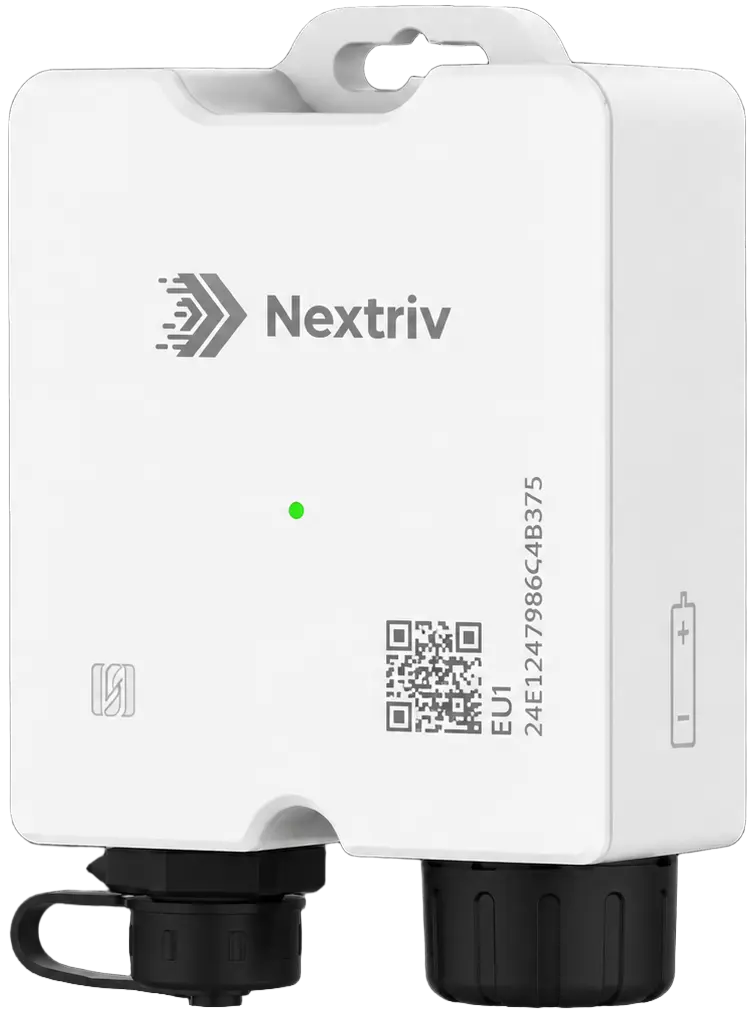
Inside the fridge itself, temperature is what counts. But the buffer zones and the 15–25 °C warehouses where vaccines await distribution need humidity supervision too — cardboard packaging and leaflets absorb moisture. That's where the Nextriv Probe Duo earns its keep: with a single probe it measures temperature to ±0.2 °C and humidity to ±2% RH, with drift below 0.03 °C per year. Each of the two parameters gets its own full set of four thresholds.
Chain documentation for an inspection
An inspection at a vaccination point or a wholesaler expects evidence, not assurances. From continuous monitoring you can pull it out in minutes:
- Measurement history — up to 1825 days (5 years) of raw, unaggregated data; a full year comes with the free plan.
- PDF reports — a summary, charts, statistics and a threshold-compliance section; a report can be signed with a SHA-256 checksum, a QR code and a verification address, so the auditor can confirm for themselves that the document hasn't been altered. A schedule will send it out automatically every week.
- The calibration log — the calibration date, the next due date, the certificate and a reminder before it expires. The probe is detachable (M12), so it travels to the calibration laboratory on its own, without dismounting the transmitter.
- EN 12830 certification — the recorders in this family meet the standard for temperature recording in refrigeration.
The same principles of continuous, auditable records apply across food and pharma alike — we gathered the full picture of the requirements in the guide on HACCP temperature monitoring.
A deployment checklist in 6 steps
- Map the chain's links at your facility: which fridges, which buffer zones, how many measurement points.
- Mount the transmitter outside the chamber, the probe in a thermal buffer inside.
- Set four thresholds: 2 / 2.5 / 7.5 / 8 °C for every vaccine fridge.
- Configure the escalation path: who comes first, who after 10 minutes, who after a further 15.
- Turn on offline detection and back-to-normal notifications — they complete the picture of every event.
- Schedule a weekly PDF report and enter the calibration dates into the log.
Monitoring built this way meets the expectations placed on healthcare facilities — from a practice storing vaccines to a hospital central pharmacy — and on pharmacies and pharmaceutical wholesalers.
Want to see an alarm, an escalation and a signed report on live data? Book a short demo. And if you'd rather simply get started: the free plan includes 10 sensors and a year of history — details in the pricing.


